Results by title
5 books match the query 'Jacksonian America'

Jacksonian America
Society, 0ality, and PoliticsEdward Pessen
University of Illinois Press, 1985
A perennial choice for courses on antebellum America, Jacksonian America continues to be a popular classroom text with scholars of the period, even among those who bridle at Pessen's iconoclastic views of Old Hickory and his "inegalitarian society."
[more]
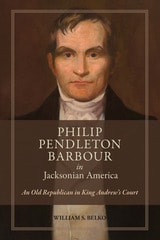
Philip Pendleton Barbour in Jacksonian America
An Old Republican in King Andrew’s CourtWilliam S. Belko
University of Alabama Press, 2016
William S. Belko’s Philip Pendleton Barbour in Jacksonian America provides the first comprehensive biography of a pivotal yet nearly forgotten statesman who made numerous key contributions to a transformative period of early American history.
Barbour, a Virginia lawyer, participated in America’s transition from a mostly republican government to a truer majority democracy, notably while serving as the twelfth Speaker of the United States House of Representatives and later as an associate justice of the United States Supreme Court. After being elected to the US Congress during the War of 1812, Barbour also emerged as one of the foremost champions of states’ rights, consistently and energetically fighting against expansions of federal powers. He, along with other Jeffersonian Old Republicans, opposed federal plans for a national tariff and internal improvements. Later, Barbour became one of the first Jeffersonian politicians to join the Jacksonian Democrats in Jackson’s war against a national bank.
Barbour continued to make crucial strides in support of states’ rights after taking his seat on the United States Supreme Court in 1836 under Chief Justice Roger Taney. He contributed to the Charles River Bridge v. Warren Bridge and Briscoe v. Bank of Kentucky decisions, which bolstered states’ rights. He also delivered the opinion of the court in New York v. Miln, which provided the basis for the State Police Powers Doctrine.
Expertly interweaving biography, history, political science, and jurisprudence, Philip Pendleton Barbour in Jacksonian America remembers the man whose personal life and career were emblematic of the decades in which the United States moved from the Age of Jefferson to the Age of Jackson, contributing to developments that continue to animate American politics today.
[more]
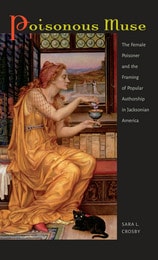
Poisonous Muse
The Female Poisoner and the Framing of Popular Authorship in Jacksonian AmericaSara L. Crosby
University of Iowa Press, 2016
The nineteenth century was, we have been told, the “century of the poisoner,” when Britain and the United States trembled under an onslaught of unruly women who poisoned husbands with gleeful abandon. That story, however, is only half true. While British authorities did indeed round up and execute a number of impoverished women with minimal evidence and fomented media hysteria, American juries refused to convict suspected women and newspapers laughed at men who feared them.
This difference in outcome doesn’t mean that poisonous women didn’t preoccupy Americans. In the decades following Andrew Jackson’s first presidential bid, Americans buzzed over women who used poison to kill men. They produced and devoured reams of ephemeral newsprint, cheap trial transcripts, and sensational “true” pamphlets, as well as novels, plays, and poems. Female poisoners served as crucial elements in the literary manifestos of writers from Nathaniel Hawthorne and Edgar Allan Poe to George Lippard and the cheap pamphleteer E. E. Barclay, but these characters were given a strangely positive spin, appearing as innocent victims, avenging heroes, or engaging humbugs.
The reason for this poison predilection lies in the political logic of metaphor. Nineteenth-century Britain strove to rein in democratic and populist movements by labeling popular print “poison” and its providers “poisoners,” drawing on centuries of established metaphor that negatively associated poison, women, and popular speech or writing. Jacksonian America, by contrast, was ideologically committed to the popular—although what and who counted as such was up for serious debate. The literary gadfly John Neal called on his fellow Jacksonian writers to defy British critical standards, saying, “Let us have poison.” Poisonous Muse investigates how they answered, how they deployed the figure of the female poisoner to theorize popular authorship, to validate or undermine it, and to fight over its limits, particularly its political, gendered, and racial boundaries.
Poisonous Muse tracks the progress of this debate from approximately 1820 to 1845. Uncovering forgotten writers and restoring forgotten context to well-remembered authors, it seeks to understand Jacksonian print culture from the inside out, through its own poisonous language.
[more]
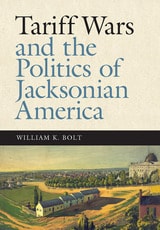
Tariff Wars and the Politics of Jacksonian America
William K. Bolt
Vanderbilt University Press, 2016
Before the Civil War, the American people did not have to worry about a federal tax collector coming to their door. The reason why was the tariff, taxing foreign goods and imports on arrival in the United States. Tariff Wars and the Politics of Jacksonian America attempts to show why the tariff was an important part of the national narrative in the antebellum period. The debates in Congress over the tariff were acrimonious, with pitched arguments between politicians, interest groups, newspapers, and a broader electorate.
The spreading of democracy caused by the tariff evoked bitter sectional controversy among Americans. Northerners claimed they needed a tariff to protect their industries and also their wages. Southerners alleged the tariff forced them to buy goods at increased prices. Having lost the argument against the tariff on its merits, in the 1820s, southerners began to argue the Constitution did not allow Congress to enact a protective tariff. In this fight, we see increased tensions between northerners and southerners in the decades before the Civil War began.
As Tariff Wars reveals, this struggle spawned a controversy that placed the nation on a path that would lead to the early morning hours of Charleston Harbor in April of 1861.
[more]