Results by title

3 books match the query 'Jaikumar, Priya'
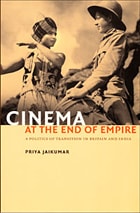
cover of Cinema at the End of Empire: A Politics of Transition in Britain and India

Cinema at the End of Empire

A Politics of Transition in Britain and India

Priya Jaikumar

Duke University Press, 2006

How did the imperial logic underlying British and Indian film policy change with the British Empire’s loss of moral authority and political cohesion? Were British and Indian films of the 1930s and 1940s responsive to and responsible for such shifts? Cinema at the End of Empire illuminates this intertwined history of British and Indian cinema in the late colonial period. Challenging the rubric of national cinemas that dominates film studies, Priya Jaikumar contends that film aesthetics and film regulations were linked expressions of radical political transformations in a declining British empire and a nascent Indian nation. As she demonstrates, efforts to entice colonial film markets shaped Britain’s national film policies, and Indian responses to these initiatives altered the limits of colonial power in India. Imperially themed British films and Indian films envisioning a new civil society emerged during political negotiations that redefined the role of the state in relation to both film industries.

In addition to close readings of British and Indian films of the late colonial era, Jaikumar draws on a wealth of historical and archival material, including parliamentary proceedings, state-sponsored investigations into colonial filmmaking, trade journals, and intra- and intergovernmental memos regarding cinema. Her wide-ranging interpretations of British film policies, British initiatives in colonial film markets, and genres such as the Indian mythological film and the British empire melodrama reveal how popular film styles and controversial film regulations in these politically linked territories reconfigured imperial relations. With its innovative examination of the colonial film archive, this richly illustrated book presents a new way to track historical change through cinema.
[more]
cover of Uncanny Histories in Film and Media

Uncanny Histories in Film and Media

Patrice Petro

Rutgers University Press, 2022
Uncanny Histories in Film and Media brings together a stellar lineup of established and emergent scholars who explore the uncanny twists and turns that are often occluded in larger accounts of film and media. Prompted by fresh archival research and new conceptual approaches, the works included here probe the uncanny as a mode of historical analysis that reveals surprising connections and unsettling continuities.  The uncanny stands for what often eludes us, for what remains unfamiliar or mysterious or strange.  Whether writing about film movements, individual works, or the legacies of major or forgotten critics and theorists, the contributors remind us that at the heart of the uncanny, and indeed the writing of history, is a troubling of definitions, a challenge to our inherited narratives, and a disturbance of what was once familiar in the uncanny histories of our field.
 
[more]
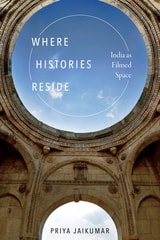
cover of Where Histories Reside: India as Filmed Space

Where Histories Reside

India as Filmed Space

Priya Jaikumar

Duke University Press, 2019

In Where Histories Reside Priya Jaikumar examines eight decades of films shot on location in India to show how attending to filmed space reveals alternative timelines and histories of cinema. In this bold “spatial” film historiography, Jaikumar outlines factors that shape India's filmed space, from state bureaucracies and commercial infrastructures to aesthetic styles and neoliberal policies. Whether discussing how educational shorts from Britain and India transform natural landscapes into instructional lessons or how Jean Renoir’s The River (1951) presents a universal human condition through the particularities of place, Jaikumar demonstrates that the history of filming a location has always been a history of competing assumptions, experiences, practices, and representational regimes. In so doing, she reveals that addressing the persistent question of “what is cinema?” must account for an aesthetics and politics of space.
[more]