Results by title

3 books match the query 'James, Robin'

cover of Good Vibes Only: Phenomenology and the Biopolitics of Algorithmic Legitimation

Good Vibes Only

Phenomenology and the Biopolitics of Algorithmic Legitimation

Robin James

Duke University Press, 2026

In Good Vibes Only, Robin James argues that "the vibes"—the mathematical vectors driving modern technologies—have shifted. Considering the forms of governance performed by the algorithms fueling AI, recommender systems, facial recognition, and other contemporary technologies, James vividly illustrates our new biopolitical regime—one in which discourses of legitimacy function in place of norms to draw patriarchal, racial, and capitalist lines around personhood. James innovatively combines continental philosophy, popular music studies, and media studies to show how the math driving modern technologies translates into both political forms of governance and colloquial cultural practices ranging from social media posts to playlist categories to hip hop aesthetics. Qualitative atmospheres and abstractions are undergirded by quantitative orientations, utilized by users and platforms alike. Good Vibes Only breaks down the phenomenology of how these algorithmic “vibes” have shifted the way biopower governs, not with disciplinary or regulatory norms, but with orientations or lineages that it assesses for their capacity to carry patriarchal racial capitalist property relations into speculative realities.
[more]
cover of Resilience & Melancholy: Pop Music, Feminism, Neoliberalism

Resilience & Melancholy

Pop Music, Feminism, Neoliberalism

Robin James

University of Michigan Press, 2027

Following the first edition’s breakthrough study of popular feminism in 2010s popular music, this new edition of Resilience & Melancholy expands its original analysis into the 2020s. Robin James reads pop music from artists like Taylor Swift, Charli XCX, Rihanna, Beyonce, and Lady Gaga against the work of philosophers, feminists, and media theorists like Michel Foucault, Patricia Hill Collins, and Steven Shaviro. The result is an accessible dive into the last two decades of pop music and its politics.

Throughout the book, James shows how pop music and the politics of gender and race intersect in their discourse of resilience. While the book argues that resilience is a postfeminist strategy that invites female artists to lean into patriarchal, racial, capitalist privilege, it also finds that artists such as Beyonce, Rihanna, and Atari Teenage Riot offer a melancholic alternative to resilience in their work. As music has continued to evolve, this melancholic opposition has evolved and responded to the co-optation of melancholy into chill, the asset-ification of music, the de-monetization of musical labor, and the rise of a reactionary masculine resilience.
[more]
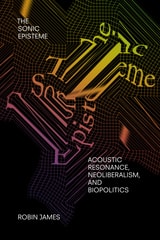
cover of The Sonic Episteme: Acoustic Resonance, Neoliberalism, and Biopolitics

The Sonic Episteme

Acoustic Resonance, Neoliberalism, and Biopolitics

Robin James

Duke University Press, 2019

In The Sonic Episteme Robin James examines how twenty-first-century conceptions of sound as acoustic resonance shape notions of the social world, personhood, and materiality in ways that support white supremacist capitalist patriarchy. Drawing on fields ranging from philosophy and sound studies to black feminist studies and musicology, James shows how what she calls the sonic episteme—a set of sound-based rules that qualitatively structure social practices in much the same way that neoliberalism uses statistics—employs a politics of exception to maintain hegemonic neoliberal and biopolitical projects. Where James sees the normcore averageness of Taylor Swift and Spandau Ballet as contributing to the sonic episteme's marginalization of nonnormative conceptions of gender, race, and personhood, the black feminist political ontologies she identifies in Beyoncé's and Rihanna's music challenge such marginalization. In using sound to theorize political ontology, subjectivity, and power, James argues for the further articulation of sonic practices that avoid contributing to the systemic relations of domination that biopolitical neoliberalism creates and polices.
[more]