Results by title
14 books match the query 'Jane Addams'
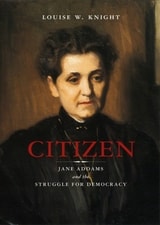
Citizen
Jane Addams and the Struggle for DemocracyLouise W. Knight
University of Chicago Press, 2005
Citizen covers the first half of Addams's life, from 1860 to 1899. Knight recounts how Addams, a child of a wealthy family in rural northern Illinois, longed for a life of larger purpose. She broadened her horizons through education, reading, and travel, and, after receiving an inheritance upon her father's death, moved to Chicago in 1889 to co-found Hull House, the city's first settlement house. Citizen shows vividly what the settlement house actually was—a neighborhood center for education and social gatherings—and describes how Addams learned of the abject working conditions in American factories, the unchecked power wielded by employers, the impact of corrupt local politics on city services, and the intolerable limits placed on women by their lack of voting rights. These experiences, Knight makes clear, transformed Addams. Always a believer in democracy as an abstraction, Addams came to understand that this national ideal was also a life philosophy and a mandate for civic activism by all.
As her story unfolds, Knight astutely captures the enigmatic Addams's compassionate personality as well as her flawed human side. Written in a strong narrative voice, Citizen is an insightful portrait of the formative years of a great American leader.
“Knight’s decision to focus on Addams’s early years is a stroke of genius. We know a great deal about Jane Addams the public figure. We know relatively little about how she made the transition from the 19th century to the 20th. In Knight’s book, Jane Addams comes to life. . . . Citizen is written neither to make money nor to gain academic tenure; it is a gift, meant to enlighten and improve. Jane Addams would have understood.”—Alan Wolfe, New York Times Book Review
“My only complaint about the book is that there wasn’t more of it. . . . Knight honors Addams as an American original.”—Kathleen Dalton, Chicago Tribune
Embodied Care
Jane Addams, Maurice Merleau-Ponty, and Feminist EthicsMaurice Hamington
University of Illinois Press, 2004
Hamington's argues that human bodies are "built to care"; as a result, embodiment must be recognized as a central factor in moral consideration. He takes the reader on an exciting journey from modern care ethics to Merleau-Ponty's philosophy of the body and then to Jane Addams's social activism and philosophy. The ideas in Embodied Care do not lead to yet another competing theory of morality; rather, they progress through theory and case studies to suggest that no theory of morality can be complete without a full consideration of the body.

In the Shadow of Jane Addams
Hull-House and Planning in a Working-Class NeighborhoodAnn Durkin Keating and Rima Lunin Schultz
University of Illinois Press, 2027
The authors focus on five plans proposed between 1889 and 1961 by Hull-House, the US government, the Chicago Plan Commission, residents, and finally the 1961 University of Illinois plan that destroyed the existing neighborhood. Proposals often expected residents to leave while eliminating the diversity of people, industries, and businesses in favor of the homogeneity favored by the middle and upper classes. At the same time, other plans tried but failed to improve the Near West Side’s inadequate housing, environmental conditions, and poor access to social services. Keating and Schultz also show how the definition of urban planning changed over time and how it impacted ideas for the neighborhood.
Detailed and perceptive, In the Shadow of Jane Addams explores how power, policy, and local voices shaped urban neighborhoods in Chicago and across the United States.
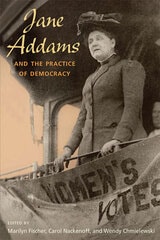
Jane Addams and the Practice of Democracy
Edited by Marilyn Fischer, Carol Nackenoff, and Wendy Chmielewski
University of Illinois Press, 2008
Using a rich array of newly available sources and contemporary methodologies from many disciplines, the ten original essays in this volume give a fresh appraisal of Addams as a theorist and practitioner of democracy. In an increasingly interdependent world, Addams's life work offers resources for activists, scholars, policy makers, and theorists alike. This volume demonstrates how scholars continue to interpret Addams as a model for transcending disciplinary boundaries, generating theory out of concrete experience, and keeping theory and practice in close and fruitful dialogue.
Contributors are Harriet Hyman Alonso, Victoria Bissell Brown, Wendy Chmielewski, Marilyn Fischer, Shannon Jackson, Louise W. Knight, Carol Nackenoff, Karen Pastorello, Wendy Sarvasay, Charlene Haddock Seigfried, and Camilla Stivers.
Jane Addams in the Classroom
Edited by David Schaafsma
University of Illinois Press, 2014
Balancing theoretical and practical considerations, the collection examines Addams's emphasis on listening to and learning from those around her and encourages contemporary educators to connect with students through innovative projects and teaching methods. In the first essays, Addams scholars lay out how her narratives drew on experience, history, and story to explicate theories she intended as guides to practice. Six teacher-scholars then establish Addams's ongoing relevance by connecting her principles to exciting events in their own classrooms. An examination of the Jane Addams Children's Book Award and a fictional essay on Addams's work and ideas round out the volume.
Accessible and wide-ranging, Jane Addams in the Classroom offers inspiration for educators while adding to the ongoing reconsideration of Addams's contributions to American thought.
Contributors include Todd DeStigter, Lanette Grate, Susan Griffith, Lisa Junkin, Jennifer Krikava, Lisa Lee, Petra Munro, Bridget O'Rourke, David Schaafsma, Beth Steffen, Darren Tuggle, Erin Vail, and Ruth Vinz.

Jane Addams, a Writer's Life
Katherine Joslin
University of Illinois Press, 2003
Jane Addams, a Writer's Life is an expansive, revealing, and refreshing reexamination of the renowned reformer as an imaginative writer. Jane Addams is best known for her groundbreaking social work at Hull-House, the force of her efforts toward Progressive political and social reform, and the bravery of her commitment to pacifism, for which she received the Nobel Peace Prize. Katherine Joslin moves beyond this history to present Addams as a literary figure, one whose writing employed a synthesis of fictional and analytical prose that appealed to a wide audience.
Joslin traces Addams's style from her early works, Philanthropy and Social Progress and her contributions to Hull House Maps and Papers, influenced by Florence Kelley, to her modernist and experimental last books, The Second Twenty Years at Hull-House and My Friend, Julia Lathrop, placing Addams in the context of other Chicago writers including Theodore Dreiser, Upton Sinclair, Harriet Monroe, Frank Norris and James T. Farrell. Joslin's close readings showcase Addams's distinguishing literary devices, such as using stories about people rather than sociological argument to make moral points. As Joslin pursues the argument that Addams's power as a public figure stemmed from the success of her books and essays, Addams herself emerges as a literary woman.
Jane Addams
A BIOGRAPHYJames Weber LinnIntroduction by Anne Firor Scott
University of Illinois Press, 1935
James Weber Linn's life of this forceful public figure offers a rare glimpse of the private Addams, from her childhood and schooling through her first efforts in public service and her rise to a position of national influence. Linn's biography is based on Addams's personal papers, which she turned over to him before she died: files of her manuscripts, published and unpublished, along with all of her letters and papers, from her first valentine to her last speech. Out of this treasure trove, in combination with Addams's substantial published works, he has written a unique life of his aunt, beautifully illuminating her private reflections and inner strength as well as her formidable public persona.

Jane Addams
The Most Dangerous Woman in AmericaMarlene Targ Brill
Ohio University Press, 2024
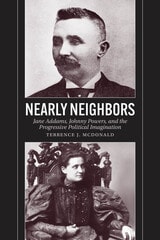
Nearly Neighbors
Jane Addams, Johnny Powers, and the Progressive Political ImaginationTerrence J. McDonald
University of Chicago Press, 2026
Jane Addams was full of courage and goodwill when she opened Hull House in Chicago’s Nineteenth Ward in 1889. However, she failed to understand that her immigrant neighbors had been well-organized around mostly Catholic churches and schools for decades before her arrival. Her ultimate political rival, Johnny Powers, grew up in this culture but was no ethnic hero or deep political thinker. Nearly Neighbors is the first book to provide a contextualized history of their encounter, embedding it in the social and political culture and structures of Chicago and the Nineteenth Ward in the 1890s.
Terrence J. McDonald provides a crucial analysis of two pivotal figures in Chicago’s political history, in part by providing the first detailed assessment of Powers’s life and practices, but also by demonstrating Addams’s misconception of him and her neighbors—and why it matters for understanding her Progressive work overall. In both her political work and writings, Addams saw her ethnic neighbors as bundles of economic need, rather than bearers of ethnic culture. At the same time, she was recruited by elite allies into causes that appeared to be opposed by her neighbors. These views and practices permitted Powers to win in their climactic political battle in 1898 simply by claiming to be the neighborhood defender against Addams and her “downtown” allies. Nearly Neighbors offers a new way of understanding Addams and the complicated legacy of her famous political work and writings.
The Selected Papers of Jane Addams, Volume 4
Moving Beyond Hull-House, 1901-1907Jane Addams; Edited by Stacy Lynn with Cathy Moran Hajo and Victoria Sciancalepore
University of Illinois Press, 2026
The fourth volume in the series follows Addams’s increasingly busy life. Her activities included greater participation in the women’s suffrage movement and speaking tours of twenty-five states and the District of Columbia to discuss child labor, settlement work, and women’s issues. At the same time, she maintained relationships with an intimate circle of female friends, her extended family, the Hull-House community, and most importantly her companion Mary Rozet Smith. The editors provide an extensive collection of documents on this side of Addams’s life while rooting her in the unique time and place of an era of fast and far-reaching change.
The Selected Papers of Jane Addams
Vol. 2: Venturing into UsefulnessEdited by Mary Lynn McCree Bryan, Barbara Bair, and Maree de Angury; with the assistance of Elizabeth Stevens, Stewart Burns, and Ellen Skerrett
University of Illinois Press, 2009
Artfully annotated, The Selected Papers of Jane Addams offers an evocative choice of correspondence, photographs, and other primary documents, presenting a multi-layered narrative of Addams's personal and emerging professional life. Themes inaugurated in the previous volume are expanded here, including dilemmas of family relations and gender roles; the history of education; the dynamics of female friendship; religious belief and ethical development; changes in opportunities for women; and the evolution of philanthropy, social welfare, and reform ideas.
The Selected Papers of Jane Addams
Vol. 3: Creating Hull-House and an International Presence, 1889-1900Jane Addams Edited by Mary Lynn McCree Bryan, Maree de Angury, and Ellen Skerrett: with the assistance of Richard R. Seidel,
University of Illinois Press, 2019
The third volume in this acclaimed series documents Addams’s creation of Hull-House and her rise to worldwide fame as the acknowledged female leader of progressive reform. It also provides evidence of her growing commitment to pacifism. Here we see Addams, a force of thought, action, and commitment, forming lasting relationships with her Hull-House neighbors and the Chicago community of civic, political, and social leaders, even as she matured as an organizer, leader, and fund-raiser, and as a sought-after speaker, and writer. The papers reveal her positions on reform challenges while illuminating her strategies, successes, and responses to failures. At the same time, the collection brings to light Addams’s private life. Letters and other documents trace how many of her Hull-House and reform alliances evolved into deep, lasting friendships and also explore the challenges she faced as her role in her own family life became more complex.
Fully annotated and packed with illustrations, The Selected Papers of Jane Addams, Volume 3 is a portrait of a woman as she changed—and as she changed history.
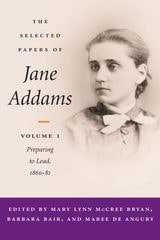
The Selected Papers of Jane Addams
vol. 1: Preparing to Lead, 1860-81Edited by Mary Lynn McCree Bryan, Barbara Bair, and Maree de Angury
University of Illinois Press, 2002
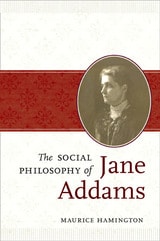
The Social Philosophy of Jane Addams
Maurice Hamington
University of Illinois Press, 2009
Although there has been a resurgence of scholarly interest in Jane Addams, much of the recent literature has dwelt more on her extraordinary and pioneering life than on the philosophical contribution of her twelve books and hundreds of published articles. This study is the first book-length work to focus entirely on Addams as a philosopher, a moral and political theorist who was steeped in the classic American Pragmatist tradition but who transcended that tradition to emphasize the significance of gender, race, and class.
Exploring Addams's contribution to epistemology, ethics, and feminist theory, Maurice Hamington sets the intellectual framework for Addams's social philosophy by discussing her influences, her particular brand of feminism, and finally her unique analytical perspective, which she described as "sympathetic knowledge." The book also investigates how Addams applied her social philosophy to issues of politics, women's rights, prostitution, business ethics, education, and religion.
Addams's philosophical work remains relevant to current feminist ethical discourse, and The Social Philosophy of Jane Addams leads to an understanding of a cosmopolitan theorist who eschewed ideological stances in favor of intermediary steps toward social progress.