Results by title
3 books match the query 'Japanese Occupation'
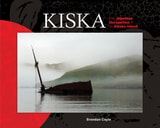
Kiska
The Japanese Occupation of an Alaska IslandBrendan Coyle
University of Alaska Press, 2014
Alaska’s windswept Aleutian Island chain arcs for over a thousand miles toward Asia from the Alaska Peninsula. In this remote and hostile archipelago is Kiska Island, an uninhabited sub-arctic speck in the tempestuous Bering Sea. Few have the opportunity even to visit this island, but in June of 1942 Japanese troops seized Kiska and neighboring Attu in the only occupation of North American territory since the War of 1812.
The bastion of Japan’s possessions in Alaska, Kiska was soon fortified with 7,500 enemy troops, their equipment, and a labyrinth of tunnels. For thirteen months Japanese troops withstood constant bombardment from American forces while retaining a tenuous hold on the island. Finally forced to abandon their position, the Japanese occupiers evacuated without their equipment and personal effects, leaving behind a trail of artifacts.
Brendan Coyle spent fifty-one days on the island searching out the tunnels, the equipment, and the objects, all frozen in time. Kiska brings together the images Coyle amassed during his exploration and his archival research. Accompanying explanations put the images in historical perspective, opening a window on a little-known battlefield and shining a rare light on a shadowy occupation.
[more]
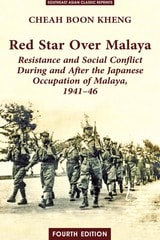
Red Star Over Malaya
Resistance and Social Conflict During and After the Japanese Occupation, 1941-1946Cheah Boon Kheng
National University of Singapore Press, 2012
Red Star Over Malaya is an account of the inter-racial relations between Malays and Chinese during the final stages of the Japanese occupation. In 1947, none of the three major race of Malaya - Malays, Chinese, and Indians - regarded themselves as pan-ethnic "Malayans" with common duties and problems. With the occupation forcibly cut them off from China, Chinese residents began to look inwards towards Malaya and stake political claims, leading inevitably to a political contest with the Malays. As the country advanced towards nationhood and self-government, there was tension between traditional loyalties to the Malay rulers and the states, or to ancestral homelands elsewhere, and the need to cultivate an enduring loyalty to Malaya on the part of those who would make their home there in future.
As Japanese forces withdrew from the countryside, the Chinese guerrillas of the communist-led resistance movement, the Malayan People's Anti-Japanese Army (MPAJA), emerged from the jungle and took control of some 70 per cent of the country's smaller towns and villages, seriously alarming the Malay population. When the British Military Administration sought to regain control of these liberated areas, the ensuing conflict set the tone for future political conflicts and marked a crucial stage in the history of Malaya. Based on extensive archival research, Red Star Over Malaya provides a riveting account of the way the Japanese occupation reshaped colonial Malaya, and of the tension-filled months that followed Japan's surrender. This book is fundamental to an understanding of social and political developments in Malaysia during the second half of the 20th century.
As Japanese forces withdrew from the countryside, the Chinese guerrillas of the communist-led resistance movement, the Malayan People's Anti-Japanese Army (MPAJA), emerged from the jungle and took control of some 70 per cent of the country's smaller towns and villages, seriously alarming the Malay population. When the British Military Administration sought to regain control of these liberated areas, the ensuing conflict set the tone for future political conflicts and marked a crucial stage in the history of Malaya. Based on extensive archival research, Red Star Over Malaya provides a riveting account of the way the Japanese occupation reshaped colonial Malaya, and of the tension-filled months that followed Japan's surrender. This book is fundamental to an understanding of social and political developments in Malaysia during the second half of the 20th century.
[more]
The Japanese Occupation of Malaya and Singapore, 1941-45
A Social and Economic HistoryPaul H. Kratoska
National University of Singapore Press, 2018
For three-and-a-half bleak years during World War II, Japan occupied Malaya and Singapore, transforming a once prosperous and vibrant region into a desolate place rife with unemployment, corruption, inflation and shortages of essential supplies. As Japan’s promised Greater East Asia crumbled, malnourished residents increasingly faced a struggle to survive, with little prospect of better times ahead.
Originally published in 1998, The Japanese Occupation of Malaya and Singapore is fully updated with material from newly discovered and recently translated documents and as well as new archival evidence. Kratoska’s work offers a clear depiction of wartime life under foreign occupation, and explains how the legacies of war and occupation shaped the post-war recovery in Malaya and Singapore.
Originally published in 1998, The Japanese Occupation of Malaya and Singapore is fully updated with material from newly discovered and recently translated documents and as well as new archival evidence. Kratoska’s work offers a clear depiction of wartime life under foreign occupation, and explains how the legacies of war and occupation shaped the post-war recovery in Malaya and Singapore.
[more]