Results by title
7 books match the query 'Japanese occupation, 1942-1945'
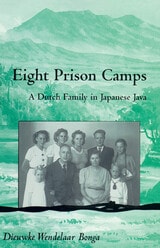
Eight Prison Camps
A Dutch Family in Japanese JavaDieuwke Wendelaar Bonga
Ohio University Press, 1996
Eldest daughter of eight children, the author grew up in Surakarta, Java, in what is now Indonesia. In the months following the bombing of Pearl Harbor, however, Dutch nationals were rounded up by Japanese soldiers and put in internment camps. Her father and brother were sent to separate men’s camps, leaving the author, her mother, and the five younger children in the women’s camp. In this and later seven other prison camps in central Java, their lives gradually deteriorated from early days of fear and crowding to near starvation, forced labor, beatings, and seeing others disappear or die. On the family’s return to Holland after the war, they found a nation recovering from German occupation and largely ignorant of the horror of the Far East experience.
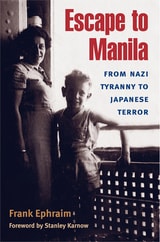
Escape to Manila
From Nazi Tyranny to Japanese TerrorFrank Ephraim. Foreword by Stanley A. Karnow
University of Illinois Press, 2002
A harrowing account of Jewish refugees in the Philippines
With the rise of Nazism in the 1930s more than a thousand European Jews sought refuge in the Philippines, joining the small Jewish population of Manila. When the Japanese invaded the islands in 1941, the peaceful existence of the barely settled Jews filled with the kinds of uncertainties and oppression they thought they had left behind.
In this book Frank Ephraim, who fled to Manila with his parents, gathers the testimonies of thirty-six refugees, who describe the difficult journey to Manila, the lives they built there upon their arrival, and the events surrounding the Japanese invasion. Combining these accounts with historical and archival records, Manila newspapers, and U.S. government documents, Ephraim constructs a detailed account of this little-known chapter of world history.
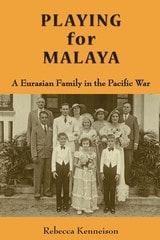
Playing for Malaya
A Eurasian Family in the Pacific WarRebecca Kenneison
National University of Singapore Press, 2011
So begins a stunning personal account of a Eurasian family living in Malaya. One of the many gaps in Reggie's account of his family was that his mother was Eurasian. When Rebecca Kenneison discovered this omission after his death, she set out to learn more about her extended family on the other side of the world. Her voyage of discovery is compelling in itself, but Playing for Malaya has a much larger purpose. Set in the 1930s and 1940s, it recounts the experiences of an extended Eurasian family during the invasion and occupation of Malaya by the Japanese. Colonial society considered Eurasians insufficiently European to be treated as British, but they seemed all too European to the Japanese, who subjected the Eurasian community to discrimination and considerable violence. Because many Eurasians, including members of the Kenneison family, supported the Allied cause, their wartime experiences are an extraordinary account of tragedy, heroism and endurance, presented here with great consequence and clarity.
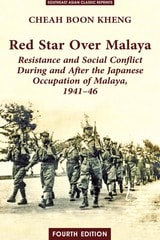
Red Star Over Malaya
Resistance and Social Conflict During and After the Japanese Occupation, 1941-1946Cheah Boon Kheng
National University of Singapore Press, 2012
As Japanese forces withdrew from the countryside, the Chinese guerrillas of the communist-led resistance movement, the Malayan People's Anti-Japanese Army (MPAJA), emerged from the jungle and took control of some 70 per cent of the country's smaller towns and villages, seriously alarming the Malay population. When the British Military Administration sought to regain control of these liberated areas, the ensuing conflict set the tone for future political conflicts and marked a crucial stage in the history of Malaya. Based on extensive archival research, Red Star Over Malaya provides a riveting account of the way the Japanese occupation reshaped colonial Malaya, and of the tension-filled months that followed Japan's surrender. This book is fundamental to an understanding of social and political developments in Malaysia during the second half of the 20th century.

The Japanese Experience in Indonesia
Selected Memoirs of 1942-1945Anthony Reid
Ohio University Press, 1986
Although the wartime Japanese military administration of Indonesia was critical to the making of modern Indonesia, it remains shrouded in mystery, in part because of the systematic destruction of records following the Japanese surrender. These excerpts from personal memoirs of individual Japanese soldiers and administrators provide unique glimpses of the occupation—from the Japanese landing on Java and the Dutch surrender, to the independence proclamation in Jakarta, to the violence in Surabaya following the Japanese surrender. Through the eyes of Japanese at all levels of responsibility, we see the internal Indonesian turmoil, the struggle toward an independence movement, and the efforts of some Japanese to promote independence, despite the policies of imperial headquarters.
Not only does this collection illuminate modern Indonesian history, it provides students of Japanese history with a feeling for the variety of Japanese responses to the war effort. The Japanese Experience in Indonesia will therefore be of interest to Southeast and East Asian historians and political scientists, as well as to those with a more general interest in World War II.
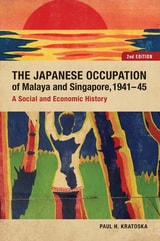
The Japanese Occupation of Malaya and Singapore, 1941-45
A Social and Economic HistoryPaul H. Kratoska
National University of Singapore Press, 2018
Originally published in 1998, The Japanese Occupation of Malaya and Singapore is fully updated with material from newly discovered and recently translated documents and as well as new archival evidence. Kratoska’s work offers a clear depiction of wartime life under foreign occupation, and explains how the legacies of war and occupation shaped the post-war recovery in Malaya and Singapore.
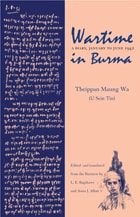
Wartime in Burma
A Diary, January to June 1942Theippan Maung Wa
Ohio University Press, 2009
This diary, begun after the Japanese attack on Pearl Harbor and covering the invasion of Burma up to June 1942, is a moving account of the dilemmas faced by the well-loved and prolific Burmese author Theippan Maung Wa (a pseudonym of U Sein Tin) and his family. At the time of the Japanese invasion, U Sein Tin was deputy secretary in the Ministry of Home and Defense Affairs. An Oxford-trained member of the Indian Civil Service, working for the British administration on the eve of the invasion, he lived with his wife and three small children in Rangoon.
Wartime in Burma is a stirring memoir that presents a personal account of U Sein Tin’s feelings about the war, his anxiety for the safety of his family, the bombing of Rangoon, and what happened to them during the next six chaotic months of the British retreat. The author and his family leave Rangoon to live in a remote forest in Upper Burma with several other Burmese civil servants, their staff, and valuable possessions—rich pickings for robbers. His diary ends abruptly on June 5, his forty-second birthday; U Sein Tin was murdered on June 6 by a gang of Burmese bandits. The diary pages, scattered on the floor of the house, were rescued by his wife and eventually published in Burma in 1966. What survives is a unique account that shines new light on the military retreat from Burma.