Results by title
4 books match the query 'Japanese poetry'
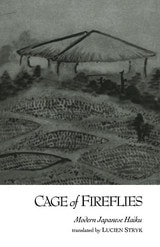
Cage Of Fireflies
Modern Japanese HaikuLucien Stryk
Ohio University Press, 1993
In all arts — music, painting, dance, theatre — change has come with that startling moment of dissatisfaction when the artist upends complacency, shocks the old to its foundations, and emerges with clear vision. He has had the courage to rescue his art from dullness. Two of Japan’s “Great Four” of haiku, Basho (1644-94) and Shiki (1862-1902), were such revolutionaries, albeit two hundred years apart. Before Basho, haiku was but a pleasant occupation for the idle. He set about transforming it with such success that experts to this day agree that his were the first true haiku.
Shiki, who lived into the 20th century, was passionate in his attempt to salvage haiku from its past, sending out shock waves by dismissing virtually all earlier work, including most of Basho’s. He saw it as his mission to make a difference — to let nothing, not even the most revered, stand in the way. He proclaimed, “A poem has no meaning. It is feeling alone.” And he practiced what he preached.
Autumn wind:
gods, Buddha—
lies, lies, lies.
These modern Japanese poets, many of whom are translated here into English for the first time, learned as much from Basho as from Shiki, and from Buson (1715-83) and Issa (1763-1827), the “Great Four.” Yet in a sense they are followers of Shiki, in spite of the harshness of his views and the impossibly high standards he demanded. They were forced to reckon with him, became willing participants in a heated dialogue with him. They had to: his spirit dominated the age. Stryk captures that spirit here, in this Cage of Fireflies.
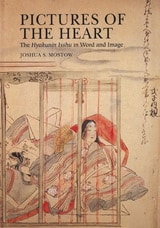
Pictures of the Heart
The <em>Hyakunin Isshu</em> in Word and ImageJoshua S. Mostow
University of Michigan Press, 2015
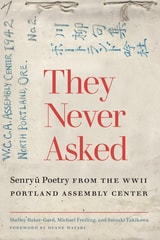
They Never Asked
Senryu Poetry from the WWII Portland Assembly CenterShelley Baker-Gard
Oregon State University Press, 2023
The Japanese American communities in Oregon and southern Washington were relatively small and many of the detainees knew each other; they drew on existing family and community networks to help each other through the long summer, living in inhumane conditions under the constant threat of violence. Several members of Bara Ginsha, a Portland poetry group, decided to continue their work while incarcerated, primarily by writing senryū, a type of Japanese poetry related to haiku.
They Never Asked is a collection of work produced by Bara Ginsha members in the WCCA camp, based on a journal kept by Masaki Kinoshita. The senryū collected here were written by a group of twenty-two poets, who produced hundreds of poems. Individually, the poems reflect the thoughts and feelings the authors experienced while being detained in the Center; collectively, they reflect the resilience and resistance of a community denied freedom. Editors Shelley Baker-Gard, Michael Freiling, and Satsuki Takikawa present translations of the poems alongside the originals, supplemented by historical and literary context and a foreword by Duane Watari, Masaki Kinoshita’s grandson.

Zen, Poetry, the Art of Lucien Stryk
Susan Porterfield
Ohio University Press, 1993
Lucien Stryk has been a presence in American letters for almost fifty years. Those who know his poetry well will find this collection particularly gratifying. Like journeying again to places visited long ago, Stryk’s writing is both familiar and wonderfully fresh.
For those just becoming acquainted with Stryk’s work, Zen, Poetry, the Art of Lucien Stryk makes an excellent introduction. It includes his early essay, “The American Scene Versus the International Scene,” written shortly after his service in the Pacific during World War II, and “Digging In,” his first published poem, as well as some of his best-known pieces on Zen and Zen poetry. Among the latter are “Beginnings, Ends,” “Poetry and Zen,” “I Fear Nothing: A Note on the Zen Poetry of Death,” and his introduction to the great haiku poets, Issa and Basho. Selections of his most recent work include “The Red Rug: An Introduction to Poetry,” and an imagined conversation among all four leading haiku poets called “Meeting at Hagi-no-Tera.”
Porterfield’s informative collection includes essays about Stryk’s work as well as his own prose and poetry. As the volume makes clear, writing poetry is for Lucien Stryk a sacred act. It is both escape and communion, inseparable from life’s daily activities.