Results by title
185 books match the query 'Jazz' and 11 start with a
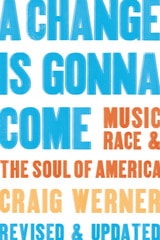
A Change Is Gonna Come
Music, Race & the Soul of AmericaCraig Werner
University of Michigan Press, 2006
—Notes
"No one has written this way about music in a long, long time. Lucid, insightful, with real spiritual, political, intellectual, and emotional grasp of the whole picture. A book about why music matters, and how, and to whom."
—Dave Marsh, author of Louie, Louie and Born to Run: The Bruce Springsteen Story
"This book is urgently needed: a comprehensive look at the various forms of black popular music, both as music and as seen in a larger social context. No one can do this better than Craig Werner."
—Henry Louis Gates, Jr., W.E.B. Du Bois Professor of the Humanities, Harvard University
"[Werner has] mastered the extremely difficult art of writing about music as both an aesthetic and social force that conveys, implies, symbolizes, and represents ideas as well as emotion, but without reducing its complexities and ambiguities to merely didactic categories."
—African American Review
A Change Is Gonna Come is the story of more than four decades of enormously influential black music, from the hopeful, angry refrains of the Freedom movement, to the slick pop of Motown; from the disco inferno to the Million Man March; from Woodstock's "Summer of Love" to the war in Vietnam and the race riots that inspired Marvin Gaye to write "What's Going On."
Originally published in 1998, A Change Is Gonna Come drew the attention of scholars and general readers alike. This new edition, featuring four new and updated chapters, will reintroduce Werner's seminal study of black music to a new generation of readers.
Craig Werner is Professor of Afro-American Studies at the University of Wisconsin, and author of many books, including Playing the Changes: From Afro-Modernism to the Jazz Impulse and Up Around the Bend: An Oral History of Creedence Clearwater Revival. His most recent book is Higher Ground: Stevie Wonder, Aretha Franklin, Curtis Mayfield, and the Rise and Fall of American Soul.
A Listener's Guide to Free Improvisation
John Corbett
University of Chicago Press, 2016
Corbett equips his reader for a journey into a difficult musical landscape, where there is no steady beat, no pre-ordained format, no overarching melodic or harmonic framework, and where tones can ring with the sharpest of burrs. In “Fundamentals,” he explores key areas of interest, such as how the musicians interact, the malleability of time, overcoming impatience, and watching out for changes and transitions; he grounds these observations in concrete listening exercises, a veritable training regime for musical attentiveness. Then he takes readers deeper in “Advanced Techniques,” plumbing the philosophical conundrums at the heart of free improvisation, including topics such as the influence of the audience and the counterintuitive challenge of listening while asleep. Scattered throughout are helpful and accessible lists of essential resources—recordings, books, videos— and a registry of major practicing free improvisors from Noël Akchoté to John Zorn, particularly essential because this music is best experienced live.
The result is a concise, humorous, and inspiring guide, a unique book that will help transform one of the world’s most notoriously unapproachable artforms into a rewarding and enjoyable experience.
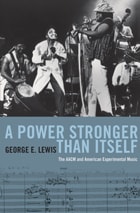
A Power Stronger Than Itself
The AACM and American Experimental MusicGeorge E. Lewis
University of Chicago Press, 2008
Founded in 1965 and still active today, the Association for the Advancement of Creative Musicians (AACM) is an American institution with an international reputation. George E. Lewis, who joined the collective as a teenager in 1971, establishes the full importance and vitality of the AACM with this communal history, written with a symphonic sweep that draws on a cross-generational chorus of voices and a rich collection of rare images.
Moving from Chicago to New York to Paris, and from founding member Steve McCall’s kitchen table to Carnegie Hall, A Power Stronger Than Itself uncovers a vibrant, multicultural universe and brings to light a major piece of the history of avant-garde music and art.
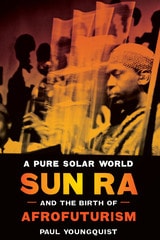
A Pure Solar World
Sun Ra and the Birth of AfrofuturismBy Paul Youngquist
University of Texas Press, 2016
Surveying the range of Sun Ra’s extraordinary creativity, this book explores how the father of Afrofuturism brought “space music” to a planet in need of transformation, supporting the aspirations of black people in an inhospitable white world.
Sun Ra said he came from Saturn. Known on earth for his inventive music and extravagant stage shows, he pioneered free-form improvisation in an ensemble setting with the devoted band he called the “Arkestra.” Sun Ra took jazz from the inner city to outer space, infusing traditional swing with far-out harmonies, rhythms, and sounds. Described as the father of Afrofuturism, Sun Ra created “space music” as a means of building a better future for American blacks here on earth.
A Pure Solar World: Sun Ra and the Birth of Afrofuturism offers a spirited introduction to the life and work of this legendary but underappreciated musician, composer, and poet. Paul Youngquist explores and assesses Sun Ra’s wide-ranging creative output—music, public preaching, graphic design, film and stage performance, and poetry—and connects his diverse undertakings to the culture and politics of his times, including the space race, the rise of technocracy, the civil rights movement, and even space-age bachelor-pad music. By thoroughly examining the astro-black mythology that Sun Ra espoused, Youngquist masterfully demonstrates that he offered both a holistic response to a planet desperately in need of new visions and vibrations and a new kind of political activism that used popular culture to advance social change. In a nation obsessed with space and confused about race, Sun Ra aimed not just at assimilation for the socially disfranchised but even more at a wholesale transformation of American society and a more creative, egalitarian world.
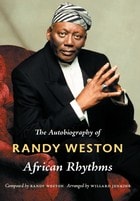
African Rhythms
The Autobiography of Randy WestonRandy Weston
Duke University Press, 2010
Africa is at the core of Weston’s music and spirituality. He has traversed the continent on a continuous quest to learn about its musical traditions, produced its first major jazz festival, and lived for years in Morocco, where he opened a popular jazz club, the African Rhythms Club, in Tangier. Weston’s narrative is replete with tales of the people he has met and befriended, and with whom he has worked. He describes his unique partnerships with Langston Hughes, the musician and arranger Melba Liston, and the jazz scholar Marshall Stearns, as well as his friendships and collaborations with Duke Ellington, Dizzy Gillespie, Coleman Hawkins, Thelonious Monk, Billy Strayhorn, Max Roach, Charlie Parker, Miles Davis, the novelist Paul Bowles, the Cuban percussionist Candido Camero, the Ghanaian jazz artist Kofi Ghanaba, the Gnawa musicians of Morocco, and many others. With African Rhythms, an international jazz virtuoso continues to create cultural history.

After Django
Making Jazz in Postwar FranceTom Perchard
University of Michigan Press, 2015
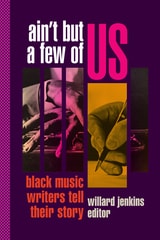
Ain't But a Few of Us
Black Music Writers Tell Their StoryWillard Jenkins, editor
Duke University Press, 2022
Contributors
Eric Arnold, Bridget Arnwine, Angelika Beener, Playthell Benjamin, Herb Boyd, Bill Brower, Jo Ann Cheatham, Karen Chilton, Janine Coveney, Marc Crawford, Stanley Crouch, Anthony Dean-Harris, Jordannah Elizabeth, Lofton Emenari III, Bill Francis, Barbara Gardner, Farah Jasmine Griffin, Jim Harrison, Eugene Holley Jr., Haybert Houston, Robin James, Willard Jenkins, Martin Johnson, LeRoi Jones, Robin D. G. Kelley, Tammy Kernodle, Steve Monroe, Rahsaan Clark Morris, John Murph, Herbie Nichols, Don Palmer, Bill Quinn, Guthrie P. Ramsey Jr., Ron Scott, Gene Seymour, Archie Shepp, Wayne Shorter, A. B. Spellman, Rex Stewart, Greg Tate, Billy Taylor, Greg Thomas, Robin Washington, Ron Welburn, Hollie West, K. Leander Williams, Ron Wynn
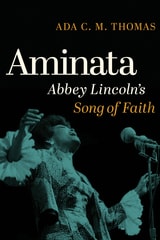
Aminata
Abbey Lincoln’s Song of FaithAda C.M. Thomas
Rutgers University Press, 2026
Abbey Lincoln (1930–2010), one of the greatest jazz vocalists of the twentieth century, was also an acclaimed composer, poet, playwright, actress, and activist and a towering figure within the African American intellectual tradition. Through constant reinvention, she resisted easy stereotyping and helped open a space for Black women artists to invoke their whole selves. Here, with meticulous research and insightful analysis, Ada C. M. Thomas contemplates Lincoln’s music alongside her poetry, plays, and reflections, revealing a multifaceted artist whose philosophical inquiries resonate deeply with the Black experience.
Thomas places Lincoln's albums in the context of both the female jazz and blues singers who influenced her and the male composers she collaborated with, including John Coltrane, Thelonious Monk, and Max Roach. Highlighting Lincoln’s central position within a vibrant global community of Black artists, activists, and writers, it also puts her work into conversation with that of contemporaries and close friends like Maya Angelou, Miriam Makeba, and Toni Morrison. Above all, it traces Lincoln’s extraordinary spiritual and intellectual journey, from her early life in Michigan to her rebirth in the 1970s as Aminata Moseka, meaning “faithful goddess of love,” and her ultimate resurgence in the 1990s as a critically acclaimed jazz artist and composer. With reverence and rigor, Thomas invites readers to rediscover Abbey Lincoln and embrace the transformative power of her words.

Art from Start to Finish
Jazz, Painting, Writing, and Other ImprovisationsEdited by Howard S. Becker, Robert R. Faulkner, and Barbara Kirshenblatt-Gimblett
University of Chicago Press, 2006
Art from Start to Finish gathers a unique group of contributors from the worlds of sociology, musicology, literature, and communications—many of them practicing artists in their own right—to discuss how artists from jazz musicians to painters work: how they coordinate their efforts, how they think, how they start, and, of course, how they finish their productions.
Specialists in the arts have much to say about the works themselves, which are often neglected by scholarsi n other fields. Art from Start to Finish takes a different tack by exploring the creative process itself and its social component. Any reader who makes art or has an interest in it will value this book.

At the Vanguard of Vinyl
A Cultural History of the Long-Playing Record in JazzDarren Mueller
Duke University Press, 2024

Avant-Garde Jazz Musicians
Performing "Out There"David G. Such
University of Iowa Press, 1993
Avant-Garde Jazz Musicians focuses on performers whose out styles, by definition, transcend traditional boundaries of jazz and most Western forms of music; some of these performers are well known, such as John Coltrane, Ornette Coleman, and Cecil Taylor, and others are not, including Daniel Carter, Billy Bang, and Jemeel Moondoc. David Such uses an interdisciplinary approach, ranging from philosophy to ethnomusicology to psychobiology, to examine how both cultural and personal factors have influenced the out musicians and their music and what the music symbolizes to listeners and to the musicians themselves.
Such strikes a balance between out music itself and the cultural domain as he explores the social contexts and economic pressures that affect out musical performance. Using material from extensive personal interviews, Such evaluates the impact of civil rights, postindustrialization, and urbanization on the beliefs and attitudes of out musicians.
By performing with many of the out musicians he interviews, Such is able to examine out music and the worldviews of out musicians in a uniquely comprehensive manner and to resolve some of the more controversial issues surrounding out jazz. In the process, he makes out music more understandable to jazz fans and scholars alike and clarifies its role in the overall development of jazz.