Results by title

5 books match the query 'Jean - Jacques Rousseau'

cover of Jean-Jacques Rousseau: Transparency and Obstruction

Jean-Jacques Rousseau

Transparency and Obstruction

Jean Starobinski

University of Chicago Press, 1988
Jean Starobinski, one of Europe's foremost literary critics, examines the life that led Rousseau, who so passionately sought open, transparent communication with others, to accept and even foster obstacles that permitted him to withdraw into himself. First published in France in 1958, Jean-Jacques Rousseau remains Starobinski's most important achievement and, arguably, the most comprehensive book ever written on Rousseau. The text has been extensively revised for this edition and is published here along with seven essays on Rousseau that appeared between 1962 and 1970.
[more]
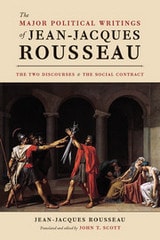
cover of The Major Political Writings of Jean-Jacques Rousseau: The Two "Discourses" and the "Social Contract"

The Major Political Writings of Jean-Jacques Rousseau

The Two "Discourses" and the "Social Contract"

Jean-Jacques Rousseau

University of Chicago Press, 2012

Individualist and communitarian. Anarchist and totalitarian. Classicist and romanticist. Progressive and reactionary. Since the eighteenth century, Jean-Jacques Rousseau has been said to be all of these things. Few philosophers have been the subject of as much or as intense debate, yet almost everyone agrees that Rousseau is among the most important and influential thinkers in the history of political philosophy. This new edition of his major political writings, published in the year of the three-hundredth anniversary of his birth, renews attention to the perennial importance of Rousseau’s work.
 
The book brings together superb new translations by renowned Rousseau scholar John T. Scott of three of Rousseau’s works: the Discourse on the Sciences and Arts, the Discourse on the Origin and Foundations of Inequality Among Men, and On the Social Contract. The two Discourses show Rousseau developing his well-known conception of the natural goodness of man and the problems posed by life in society. With the Social Contract, Rousseau became the first major thinker to argue that democracy is the only legitimate form of political organization. Scott’s extensive introduction enhances our understanding of these foundational writings, providing background information, social and historical context, and guidance for interpreting the works. Throughout, translation and editorial notes clarify ideas and terms that might not be immediately familiar to most readers.
 
The three works collected in The Major Political Writings of Jean-Jacques Rousseau represent an important contribution to eighteenth-century political theory that has exerted an extensive influence on generations of thinkers, beginning with the leaders of the French Revolution and continuing to the present day. The new translations on offer here will be welcomed by a wide readership of both Rousseau scholars and readers with a general interest in political thought.
[more]
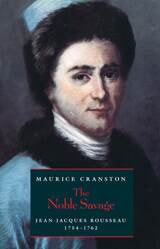
cover of The Noble Savage: Jean-Jacques Rousseau, 1754-1762

The Noble Savage

Jean-Jacques Rousseau, 1754-1762

Maurice Cranston

University of Chicago Press, 1991

In this second volume of the unparalleled exposition of Rousseau's life and works, Cranston completes and corrects the story told in Rousseau's Confessions, and offers a vivid, entirely new history of his most eventful and productive years.

"Luckily for us, Maurice Cranston's The Noble Savage: Jean-Jacques Rousseau, 1754-1762 has managed to craft a highly detailed account of eight key years of Rousseau's life in such a way that we can both understand and even, on occasion, sympathize."—Olivier Bernier, Wall Street Journal

Maurice Cranston (1920-1993), a distinguished scholar and recipient of the James Tait Black Memorial Prize for his biography of John Locke, was professor of political science at the London School of Economics. His numerous books include The Romantic Movement and Philosophers and Pamphleteers, and translations of Rousseau's The Social Contract and Discourse on the Origins of Inequality.
[more]
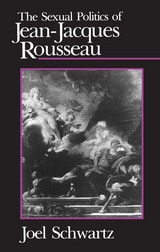
cover of The Sexual Politics of Jean-Jacques Rousseau

The Sexual Politics of Jean-Jacques Rousseau

Joel Schwartz

University of Chicago Press, 1984
Joel Schwartz presents the first systematic treatment of Rousseau's understanding of the political importance of women, sexuality, and the family. Using both Rousseau's lesser-known literary works and such major writings as Emile, Julie, and The Second Discourse, he offers an original and provocative presentation of Rousseau's argument. To read Rousseau, Schwartz believes, is to enter into a profound discourse about the meaning of sexual equality and the opportunities, pitfalls, costs, and benefits that sexual relationships bestow and impose on us all. His own thoughtful reading of Rousseau opens up fresh perspectives on political philosophy and the history of sexual, masculine, and feminine psychology.
[more]
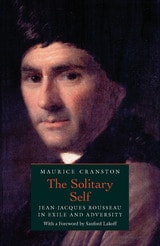
cover of The Solitary Self: Jean-Jacques Rousseau in Exile and Adversity

The Solitary Self

Jean-Jacques Rousseau in Exile and Adversity

Maurice Cranston

University of Chicago Press, 1997

A monumental achievement, Maurice Cranston's trilogy provides the definitive account of Jean-Jacques Rousseau's turbulent life. Now available in paperback, this final volume completes a masterful biography of one of the most important philosophers of all time. The Solitary Self traces the last tempestuous years of Rousseau's life.

"The Solitary Self is a fitting coda to a magisterial work. Cranston . . . is a compelling stylist who narrates Rousseau's tribulations with a mixture of compassion and dry humor."—Thomas Pavel, Wall Street Journal

"Cranston not only recreates for his readers a rounded view of Rousseau himself, he sets it firmly in the social and political context of Europe's ancien regime. . . . An engrossing work of history."—John Gray, New Statesman

"Cranston's painstaking archival research and lucid style yield the most detailed and thoroughly documented biography of Rousseau written in English. His epilogue masterfully sums up Rousseau's importance as political philosopher and initiator of romantic sensibilities."—Choice

"Anyone curious about the paradoxes of a most paradoxical man will not go wrong by starting with this invaluable biography."—James Miller, Washington Post Book World

"As absorbing as a picaresque novel."—Naomi Bliven, New Yorker

"A monument of scholarship. . . . This amazing biography, like Boswell's account of Johnson, recreates the daily life of Rousseau: what he did, who he saw, what he said, what he wrote. . . . We may be quite confident that we hold in our hands the authoritative account of this life. The definitive Rousseau."—Isaac Kramnick, New Republic

Maurice Cranston (1920-1993), a distinguished scholar and recipient of the James Tait Black Memorial Prize for his biography of John Locke, was professor of political science at the London School of Economics. His numerous books include The Romantic Movement and Philosophers and Pamphleteers, and translations of Rousseau's The Social Contract and Discourse on the Origins of Inequality.

[more]