Results by title
56 books match the query 'Jesus Christ' and 5 start with a
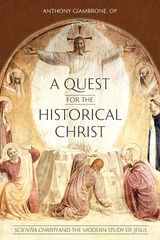
A Quest for the Historical Christ
Scientia Christi and the Modern Study of JesusAnthony Giambrone, OP
Catholic University of America Press, 2021
A Catholic Quest for the Historical Christ brings together a collection of interrelated essays on the historical Jesus and primitive Christology. Sensitive to the diverse, but traditionally Protestant assumptions and perspectives of the "Quest" as well as to the widely lamented disconnect between New Testament exegesis and classical dogmatic theology, an alternative approach is proposed in these pages. Ecumenical and conciliar reference points, along with non-confessional historical methods (e.g. archeology) shape the basic project, which nevertheless assumes some distinctive and important Catholic contours. This particular synthesis injects the voice of a missing interlocutor into an established conversation that has not infrequently been both historically confused and dogmatically (and philosophically) numb.
The book is divided into three sections: Historical Foundations, Theological Perspectives, and Jesus and the Scriptures. While the individual chapters represent independent probes, the cumulative argument and arc of the study drives in clear and concerted directions. After a first approach to the Gospel data, attentive at once to historiographical and historical questions, a series of interventions reorienting the present scholarly discussion are suggested. These various, foundational essays lead, finally, to a sustained mediation on the mind of Christ, considered as a unique reader of the Scriptures: a meditation having its proper reflex and reflection in the way Christians themselves, as readers of the Gospels, participate in the Lord's own encounter with the living Word.
[more]
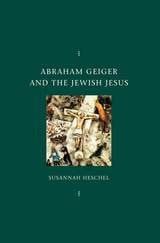
Abraham Geiger and the Jewish Jesus
Susannah Heschel
University of Chicago Press, 1998
Was Jesus the founder of Christianity or a teacher of Judaism? When he argued the latter based on the New Testament, Abraham Geiger ignited an intense debate that began in nineteenth-century Germany but continues to this day.
Geiger, a pioneer of Reform Judaism and a founder of Jewish studies, developed a Jewish version of Christian origins. He contended that Jesus was a member of the Pharisees, a progressive and liberalizing group within first-century Judaism, and that he taught nothing new or original. This argument enraged German Protestant theologians, some of whom produced a tragic counterargument based on racial theory.
In this fascinating book, Susannah Heschel traces the genesis of Geiger's argument and examines the reaction to it within Christian theology. She concludes that Geiger initiated an intellectual revolt by the colonized against the colonizer, an attempt not to assimilate into Christianity by adopting Jesus as a Jew, but to overthrow Christian intellectual hegemony by claiming that Christianity—and all of Western civilization—was the product of Judaism.
[more]
Against Marcellus and On Ecclesiastical History
Kelly Eusebius of Caesarea
Catholic University of America Press, 2018
This is the first English translation of the last two theological works of Eusebius of Caesarea, Against Marcellus and On Ecclesiastical Theology. The first text was composed after the deposition of Marcellus of Ancyra in 336 to justify the action of the council fathers in ordering the deposition on the grounds of heresy, contending that Marcellus was “Sabellian” (or modalist) on the Trinity and a follower of Paul of Samosata (hence adoptionist) in Christology. Relying heavily upon extensive quotations from a treatise Marcellus wrote against Asterius the Sophist, this text provides important information about ecclesiastical politics in the period before and just after the Council of Nicea, and endeavors to demonstrate Marcellus’s erroneous interpretation of several key biblical passages that had been under discussion since before the council. In doing so, Eusebius criticizes Marcellus’s inadequate account of the distinction between the persons of the Trinity, eschatology, and the Church’s teaching about the divine and human identities of Christ.
On Ecclesiastical Theology, composed circa 338/339 just before Eusebius’s death, and perhaps in response to the amnesty for deposed bishops enacted by Constantius after the death of Constantine in 377 and the possibility of Marcellus’s return to his see, continues to lay out the criticisms initially put forward in Against Marcellus, again utilizing quotations from Marcellus’s book against Asterius. However, we see in this text a much more systematic explanation of Eusebius’s objections to the various elements of Marcellus’s theology and what he sees as the proper orthodox articulation of those elements.
Long overlooked for statements at odds with later orthodoxy, even written off as heretical because allegedly “semi-Arian,” recent scholarship has demonstrated the tremendous influence these texts had on the Greek theological tradition in the fourth century, especially on the orthodox understanding of the Trinity. In addition to their influence, they are some of the few complete texts that we have from Greek theologians in the immediate period following the Council of Nicea in 325, thus filling a gap in the materials available for research and teaching in this critical phase of theological development.
[more]
Anti-Apollinarian Writings
Catholic University of America Press, 2016
The translation is interweaved with a commentary to provide the reader with some guidance through the complexities of Gregory's arguments. The introduction includes an overview of the history of Apollinarianism and discusses the extent to which it is possible to reconstruct, from the fragments quoted by Gregory, the arguments of Apolinarius's Apodeixis to which he is responding. It also examines the background to and the chronology of both of Gregory's anti-Apollinarian works, and looks critically at the arguments that they deploy.
[more]
Apologist
Saint John Chrysostom
Catholic University of America Press, 1985
Apologist is the English translation of two of Chrysostom's treatises, written about 378 and 382, aimed at provoking the divinity of Jesus Christ.
[more]