Results by title
15 books match the query 'Jewish ethics'

After Pandemic, After Modernity
The Relational RevolutionGiulio Maspero
St. Augustine's Press, 2022
Without Trinitarian framework ancient and new idols emerge, as the Covid-19 tragedies have shown. Yet post-pandemic must be a moment of clarity and realism, as we can see how necessary it is that humanity place itself in relation to something beyond. The post-modern journey, however, must be in the spirit of Christian humanism or else any so-called progress will no longer be unable to speak authentically of our humanity. That is to say, the relational dimension of human life will be erased right along with the other ills that plague our earth.
Confronting Vulnerability
The Body and the Divine in Rabbinic EthicsJonathan Wyn Schofer
University of Chicago Press, 2010
While imparting their ethical lessons, rabbinic texts often employ vivid images of death, aging, hunger, defecation, persecution, and drought. In Confronting Vulnerability, Jonathan Wyn Schofer carefully examines these texts to find out why their creators thought that human vulnerability was such a crucial tool for instructing students in the development of exemplary behavior.
These rabbinic texts uphold virtues such as wisdom and compassion, propound ideal ways of responding to others in need, and describe the details of etiquette. Schofer demonstrates that these pedagogical goals were achieved through reminders that one’s time on earth is limited and that God is the ultimate master of the world. Consciousness of death and of divine accounting guide students to live better lives in the present. Schofer’s analysis teaches us much about rabbinic pedagogy in late antiquity and also provides inspiration for students of contemporary ethics. Despite their cultural distance, these rabbinic texts challenge us to develop theories and practices that properly address our frailties rather than denying them.
Ethics of Maimonides
Hermann Cohen, Translated by Almut Sh. Bruckstein
University of Wisconsin Press, 2004
Hermann Cohen’s essay on Maimonides’ ethics is one of the most fundamental texts of twentieth-century Jewish philosophy, correlating Platonic, prophetic, Maimonidean, and Kantian traditions. Almut Sh. Bruckstein provides the first English translation and her own extensive commentary on this landmark 1908 work, which inspired readings of medieval and rabbinic sources by Leo Strauss, Franz Rosenzweig, and Emmanuel Levinas.
Cohen rejects the notion that we should try to understand texts of the past solely in the context of their own historical era. Subverting the historical order, he interprets the ethical meanings of texts in the light of a future yet to be realized. He commits the entire Jewish tradition to a universal socialism prophetically inspired by ideals of humanity, peace, and universal justice.
Through her own probing commentary on Cohen’s text, like the margin notes of a medieval treatise, Bruckstein performs the hermeneutical act that lies at the core of Cohen’s argument: she reads Jewish sources from a perspective that recognizes the interpretive act of commentary itself.
Interpreting Maimonides
Studies in Methodology, Metaphysics, and Moral PhilosophyMarvin Fox
University of Chicago Press, 1990

Maimonides' Ethics
The Encounter of Philosophic and Religious MoralityRaymond L. Weiss
University of Chicago Press, 1991
The gulf between classical philosophy and the Torah made the task of Maimonides extraordinarily difficult. Weiss shows that Maimonides subtly preserves the tension between those traditions while producing a practical accommodation between them. To explain how Maimonides was able to accomplish this twofold goal, Weiss takes seriously the multilevel character of Maimonides' works. Weiss interprets Maimonides as a heterodox thinker who, with utter integrity, faces the Law's encounter with philosophy and gives both the Torah and philosophy their due.
Modern Jewish Ethics since 1970
Writings on Methods, Sources, and IssuesEdited by Jonathan K. Crane, Emily A. Filler, and Mira Beth Wasserman
Brandeis University Press, 2025
These deliberate juxtapositions are to encourage scholars and students to develop similar meta-ethical analyses on Jewish ethics, broadly construed. Jewish ethics is not just a set of propositions or principles; nor can it be reduced to a single trajectory of thought or abstracted as an elaborate system of ideas. Jewish ethics is the field of study that engages Jewish texts, ideas, history, and experience in conversations about values and virtues, justice and good judgment, human relations and responsibilities. This volume presents some of those conversations to spark many more.
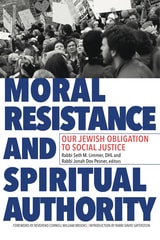
Moral Resistance and Spiritual Authority
Our Jewish Obligation to Social JusticeRabbi Seth M. Limmer, DHL and Rabbi Jonah Dov Pesner
Central Conference of American Rabbis, 2019

Nathan Straus
From Macy's Magnate to International HumanitarianAndrew Fisher
Rutgers University Press, 2026
Nathan Straus (1848–1931) encompassed worlds. He rose from his Jewish German immigrant family’s ruin in Civil War Georgia to become co-owner of Macy’s and Abraham & Straus department stores. He helped build American Zionism and cofounded the American Jewish Congress movement. His public service led to a nomination for New York City mayor.
This, the first comprehensive biography of Straus, details each of these lives but argues that his most historic achievements lay elsewhere—in philanthropy. Inspired by both his Jewish values and no-nonsense pragmatism, Straus designed, funded, and oversaw four Progressive philanthropic initiatives. The greatest—his demonstration and advocacy campaigns for milk pasteurization—saved the lives of countless thousands of infants in New York City and, ultimately, across much of America and western Europe. Straus also founded America’s first TB preventorium for at-risk children: a model for the forty-five more that followed. Partnering with Hadassah, he brought American public health innovations to Mandate Palestine. He provided vast relief for New York City’s jobless in the severe 1890s depression. In all, Straus’s humanitarianism won the acclaim of American presidents and world leaders and the gratitude of millions. We can learn from him today.
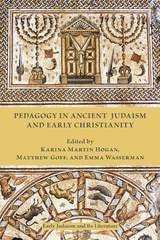
Pedagogy in Ancient Judaism and Early Christianity
Karina Martin Hogan
SBL Press, 2017
Engage fourteen essays from an international group of experts
There is little direct evidence for formal education in the Bible and in the texts of Second Temple Judaism and early Christianity. At the same time, pedagogy and character formation are important themes in many of these texts. This book explores the pedagogical purpose of wisdom literature, in which the concept of discipline (Hebrew musar) is closely tied to the acquisition of wisdom. It examines how and why the concept of musar came to be translated as paideia (education, enculturation) in the Greek translation of the Hebrew Bible (Septuagint), and how the concept of paideia was deployed by ancient Jewish authors writing in Greek. The different understandings of paideia in wisdom and apocalyptic writings of Second Temple Judaism are this book's primary focus. It also examines how early Christians adapted the concept of paideia, influenced by both the Septuagint and Greco-Roman understandings of this concept.
Features
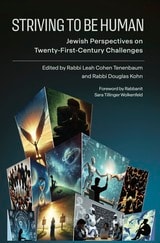
Striving to Be Human
Jewish Perspectives on Twenty-First-Century ChallengesRabbi Leah Cohen Tenenbaum and Rabbi Douglas Kohn
Central Conference of American Rabbis, 2025
In his clarion call for ethical behavior, Rabbi Hillel tells us, “In a place where there is no humanity, strive to be human.” But what exactly does it mean to be human, especially in an age of rapid transformation? Striving to Be Human: Jewish Perspectives on Twenty-First-Century Challenges confronts this question with boldness, hope, and a foundation of Jewish wisdom. The volume begins with “Challenges from Within Us,” addressing such topics as moral justice, belonging, queer theology, and good and evil. In part two, “Challenges from Beyond Us,” the authors delve into artificial intelligence, robotics, reproductive technologies, and the animal-human relationship. The result is a profound conversation about Jewish values and human dignity in our evolving landscape.

The Challenges of Sovereignty
Essays on Israel and ZionismDavid Ellenson
Brandeis University Press, 2026
Key essays by a notable scholar address some of the most pressing questions facing Israel today.
Over the course of his rich career, David Ellenson—one of the most outstanding Jewish scholars, intellectuals, and thinkers of our time—probed the tension between tradition and modernity, especially as reflected in the ceaseless reinterpretation of liturgical and halakhic texts. Alongside that scholarly interest, largely centered on European Jewry, Ellenson produced an impressive body of work on Zionism and Israel.
This volume follows the arc of this body of work from Ellenson’s early articles on the Zionism of American rabbis to his last essay on the struggle between Jewish and democratic impulses in Israeli society. He draws on familiar sources of inquiry—Jewish prayers and legal sources—to chart changes in Israeli religious life and to excavate its theological-political foundation. What emerges is a profound meditation on some of the most important questions that Israel faces today: what does it mean to be Jewish in the state? What role should Halakhah play in a self-defined Jewish state? How should the state treat its non-Jewish minority? How deeply rooted is democracy in the state and its foundational texts? And can the state ever escape seemingly irrepressible internal and external conflict?
The Hebrew Bible and Philosophy of Religion
Jaco Gericke
SBL Press, 2012
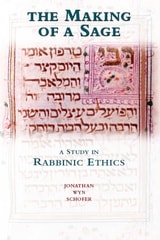
The Making of a Sage
A Study in Rabbinic EthicsJonathan Wyn Schofer
University of Wisconsin Press, 2005
Jonathan Schofer offers the first theoretically framed examination of rabbinic ethics in several decades. Centering on one large and influential anthology, The Fathers According to Rabbi Nathan, Jonathan Schofer situates that text within a broader spectrum of rabbinic thought, while at the same time bringing rabbinic thought into dialogue with current scholarship on the self, ethics, theology, and the history of religions.
Notable Selection, Jordan Schnitzer Book Award for Philosophy and Jewish Thought, Association for Jewish Studies
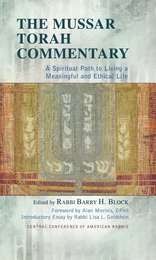
The Mussar Torah Commentary
A Spiritual Path to Living a Meaningful and Ethical LifeRabbi Barry H. Block
Central Conference of American Rabbis, 2020
This Mussar-based commentary is a vital resource for Torah study, offering a thoughtful analysis of each of the 54 weekly parashot. Each essay in this anthology brings a parashah into juxtaposition with one of the Mussar middot (character traits as described within the Jewish school of ethics called Mussar), thereby providing an applied lens of Mussar teachings that helps us to delve deeper into our tradition with increased mindfulness and intention.
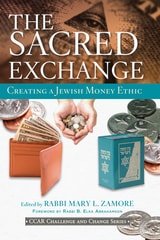
The Sacred Exchange
Creating a Jewish Money EthicRabbi Mary L. Zamore
Central Conference of American Rabbis, 2019
Part of the CCAR Press Challenge and Change series, this anthology creates a rich and varied discussion about the ethics of money. Our use of and relationship with money must reflect our religious values--this book aims to start a comprehensive conversation about how Judaism can guide us in this multi-faceted relationship.