Results by title
8 books match the query 'Jewish ghettos'
... And Heaven Shed No Tears
Henry Armin Herzog
University of Wisconsin Press, 2005
1995 paperback, Saga Publishers / Folio Private
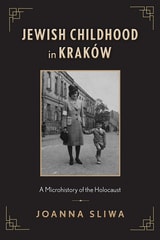
Jewish Childhood in Kraków
A Microhistory of the HolocaustJoanna Sliwa
Rutgers University Press, 2021
Jewish Childhood in Kraków is the first book to tell the history of Kraków in the second World War through the lens of Jewish children’s experiences. Here, children assume center stage as historical actors whose recollections and experiences deserve to be told, analyzed, and treated seriously.
Sliwa scours archives to tell their story, gleaning evidence from the records of the German authorities, Polish neighbors, Jewish community and family, and the children themselves to explore the Holocaust in German-occupied Poland and in Kraków in particular. A microhistory of a place, a people, and daily life, this book plumbs the decisions and behaviors of ordinary people in extraordinary times.
Offering a window onto human relations and ethnic tensions in times of rampant violence, Jewish Childhood in Kraków is an effort both to understand the past and to reflect on the position of young people during humanitarian crises.
Making and Unmaking Literature in the Warsaw, Lodz, and Vilna Ghettos
Sven-Erik Rose
Brandeis University Press, 2025
A study of literature written by Jewish authors while interned in Nazi ghettos emphasizes how authors processed their horrific experiences through poetry and prose.
Published in Association with the United States Holocaust Memorial Museum
This is the first study devoted to how little known but essential authors grappled with the destitution of ghetto existence by writing within, at the limits of, and against an array of literary scenarios, tropes, plot lines, and generic conventions, including those of nature lyric, modernist interior monologue, the realist social novel, the detective story, and the gothic horror tale. Contending with starvation, disease, desperate housing conditions and the looming threat of being murdered, inhabitants of ghettos in Poland nonetheless made them sites of rich Jewish cultural production. Rose’s readings of these literary works reveal how authors asserted their humanity by insisting on writing works of literature. In such radically dehumanizing circumstances, however, their recourse to established literary genres was not naive. Rather, ghetto authors brilliantly meditated on the grotesque incongruities between established literary models and the extreme conditions of ghetto existence.
Prague Palimpsest
Writing, Memory, and the CityAlfred Thomas
University of Chicago Press, 2010
A city of immense literary mystique, Prague has inspired writers across the centuries with its beauty, cosmopolitanism, and tragic history. Envisioning the ancient city in central Europe as a multilayered text, or palimpsest, that has been constantly revised and rewritten—from the medieval and Renaissance chroniclers who legitimized the city’s foundational origins to the modernists of the early twentieth century who established its reputation as the new capital of the avant-garde—Alfred Thomas argues that Prague has become a paradoxical site of inscription and effacement, of memory and forgetting, a utopian link to the prewar and pre-Holocaust European past and a dystopia of totalitarian amnesia.
Considering a wide range of writers, including the city’s most famous son, Franz Kafka, Prague Palimpsest reassesses the work of poets and novelists such as Bohumil Hrabal, Milan Kundera, Gustav Meyrink, Jan Neruda, Vítĕzslav Nezval, and Rainer Maria Rilke and engages with other famous authors who “wrote” Prague, including Guillaume Apollinaire, Ingeborg Bachmann, Albert Camus, Paul Celan, and W. G. Sebald. The result is a comparative, interdisciplinary study that helps to explain why Prague—more than any other major European city—has haunted the cultural and political imagination of the West.
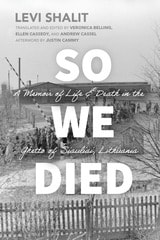
So We Died
A Memoir of Life and Death in the Ghetto of Šiauliai, LithuaniaLevi Shalit, translated and edited by Veronica Belling, Ellen Cassedy, and Andrew Cassel, introduction by Veronica Belling, afterword by Justin Cammy
University of Alabama Press, 2025
In the shadow of death, Levi Shalit wrote to remember—so we would never forget.
So We Died: A Memoir of Life and Death in the Ghetto of Šiauliai, Lithuania (Azoy zaynen mir geshtorbn) is a powerful eyewitness account of the Shavl ghetto during the Nazi occupation of Lithuania. Written in Yiddish by Levi Shalit and available now for the first time in English, the work fills a stark void in historical records.
Shalit divided his work into four sections. In the first, he describes the German invasion of Šiauliai, the murder of thousands of Jews in the city and surrounding countryside, and the forced relocation of the surviving Jews into the Shavl ghetto. In the second, he describes daily life in the ghetto in engrossing detail. In the third, titled “The Masada Book,” Shalit describes ghetto residents’ attempt to organize a resistance group of which he himself was a member. In the fourth, he narrates the transformation of the ghetto into a concentration camp and the seizure and deportation of the community’s children.
Few accounts of the Shavl ghetto survived the war. Shalit’s work offers English-language readers a rare insight into a vital chapter of history. The translators artfully reveal Shalit’s literary prowess and the ways he illuminated the Shavl ghetto’s daily struggles, false hopes, and atrocities.
More than an account of a previously overlooked episode in Holocaust history, So We Died is a testament to the enduring power of the human spirit in the face of unspeakable tragedy. It offers keen insight into a time of war, fascism, and resistance. A must-read for anyone seeking understanding and remembrance.
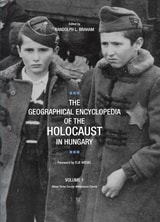
The Geographical Encyclopedia of the Holocaust in Hungary
Randolph L. Braham, Foreword by Elie Wiesel
Northwestern University Press, 2013
Winner of the 2013 National Jewish Book Award
The illustrated three-volume Geographical Encyclopedia of the Holocaust in Hungary is a definitive, authoritative, and magisterial resource, thorough and exhaustive. It documents and chronicles the wartime fate of the Jewish communities in that country where virulent antisemitism is anything but dead, even today. With scores of detailed maps and hundreds of photographs, this reference work is organized alphabetically by county, each prefaced with a map and a contextual history describing its Jewish population up to and into 1944.
Entries track the demographic, cultural, and religious changes in even the smallest communities where Jews lived before their marginalization, dispossession, ghettoization, and, finally, deportation to labor and death camps. The encyclopedia endows scholars and lay researchers with both panoramic and microscopic views of the virtually last-minute destruction of most of the Jews of Hungary, until then the last sizable surviving Jewish community in occupied Europe.
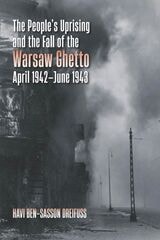
The People's Uprising and the Fall of the Warsaw Ghetto, April 1942–June 1943
Havi Ben-Sasson Dreifuss
Brandeis University Press, 2026
The People’s Uprising and the Fall of the Warsaw Ghetto, April 1942–June 1943 sheds light on the lives, choices, and experiences of the tens of thousands of Jews who were not part of the underground armed resistance but nonetheless supported the famed Warsaw Ghetto Uprising. This riveting and dramatic account focuses on the final year of the Warsaw ghetto, from the Great Deportation in the summer of 1942 through the suppression of the uprising in mid-1943. Drawing on powerful contemporary testimonies, diaries, and documents—many of them previously unexplored—Havi Ben-Sasson Dreifuss
reveals how members of the broader Jewish population struggled to survive, maintain family and community life, and make impossible moral decisions in the face of fear, hunger, and daily violence. Looking beyond the fighters themselves, the book offers a story of devastation, but also of resilience and human dignity.
Published in association with Yad Vashem.
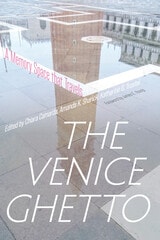
The Venice Ghetto
A Memory Space that TravelsEdited by Chiara Camarda, Amanda K. Sharick, and Katharine G. Trostel
University of Massachusetts Press, 2022
This interdisciplinary collection engages with questions about the history, conditions, and lived experience of the Venice Ghetto, including its legacy as a compulsory, segregated, and enclosed space. Contributors also consider the ghetto's influence on the figure of the Renaissance moneylender, the material culture of the ghetto archive, the urban form of North Africa's mellah and hara, and the ghetto's impact on the writings of Primo Levi and Marjorie Agosín.
In addition to the volume editors, The Venice Ghetto features a foreword from James E. Young and contributions from Shaul Bassi, Murray Baumgarten, Margaux Fitoussi, Dario Miccoli, Andrea Yaakov Lattes, Federica Ruspio, Michael Shapiro, Clive Sinclair, and Emanuela Trevisan Semi.