Results by title

4 books match the query 'Jewish journalists'
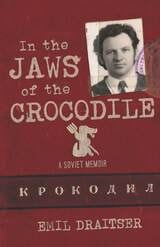
cover of In the Jaws of the Crocodile: A Soviet Memoir

In the Jaws of the Crocodile

A Soviet Memoir

Emil Draitser

University of Wisconsin Press, 2021

Emil Draitser dreamed of becoming a writer. Born to a working-class Jewish family in the USSR on the eve of World War II, he came of age during the Brezhnev era, often considered the nadir of Soviet culture. Bored with an engineering job, he found refuge in writing, attracting the attention of a Moscow editor who encouraged him to try his hand at satire. He spent the next decade contributing to Crocodile, the major Party-sponsored magazine known for its sharp-tongued essays and caustic cartoons. After he got in trouble for criticizing an important Soviet official, he began weighing the heavy decision of whether to emigrate.

In this captivating memoir, Draitser explores what it means to be a satirist in a country lacking freedom of expression. His experience provides a window into the lives of a generation of artists who were allowed to poke fun and make readers laugh, as long as they toed a narrow, state-approved line. In the Jaws of the Crocodile also includes several of Draitser’s wry pieces translated into English for the first time.
[more]
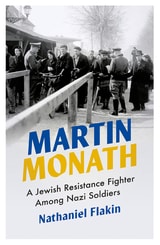
cover of Martin Monath: A Jewish Resistance Fighter Amongst Nazi Soldiers

Martin Monath

A Jewish Resistance Fighter Amongst Nazi Soldiers

Nathaniel Flakin

Pluto Press, 2019

A dramatisation of Martin Monath's short life (1913-1944) would need little artistic embellishment; his identity shrouded in mystery, and executed by the Gestapo - twice - the historical record reads like a detective novel. Pieced together for the first time by Wladek Flakin, this biography tells the story of the Jewish socialist and editor of Arbeiter und Soldat ('Worker and Soldier'), and his efforts to turn German rank-and-file soldiers against their Nazi officers in occupied France. Born in Berlin in 1913, Martin Monath was a child of war and revolution. In the 1930s he became a leader of the socialist Zionist youth organisation Hashomer Hatzair in Germany. Fleeing from Berlin to Brussels in 1939, he joined the underground Trotskyist party led by Abraham Leon, and soon became a leading member of the Fourth International in Europe. His relocation to Paris in 1943 saw the birth of Arbeiter und Soldat and his work organising illegal cells of German soldiers for a revolutionary struggle against the Nazis. Drawing on extensive archival research, Flakin uses letters, testimonies and unpublished documents to bring Monath's story to life - weaving a tale rich with conviction and betrayal, ideology and espionage.
[more]
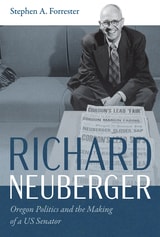
cover of Richard Neuberger: Oregon Politics and the Making of a US Senator

Richard Neuberger

Oregon Politics and the Making of a US Senator

Stephen A. Forrester

Oregon State University Press, 2025

Richard L. Neuberger is a consequential but often forgotten figure in Oregon history, largely due to his early death at forty-seven, near the end of his only term in the United States Senate. But his life and legacy continue to inspire Oregonians and influence politicians.

In 1954, Neuberger was the first Democrat elected to the Senate from Oregon in forty years. His election moved Oregon from a solidly Republican state to one where liberal Democrats could control the legislature as well as statewide offices. He was an especially productive freshman, on both Oregon natural resource issues and national matters. Neuberger was also only the second Jewish person elected to the Senate following passage of the 17th Amendment, which required the direct election of senators.

Prior to entering politics, Neuberger was best known as a journalist. He was a prolific freelance writer, publishing 750 magazine articles and six books. In 1933, at the age of twenty-one, he visited Germany and penned the first firsthand account of Brownshirt violence written by an American; his editor at The Nation called it “an epoch-making article.”

Neuberger was ahead of his time in his advocacy of conservation, in his political partnership with his wife Maurine—who successfully ran for his Senate seat after his untimely death in 1960—and in his outspoken liberal advocacy at a time when Oregon was considerably more conservative than it is today. Tom McCall, later one of the most influential governors in the state’s history, considered Neuberger his role model as a conservationist.

In this definitive biography—more than forty years in the making—Stephen Forrester documents Neuberger’s extraordinary life and career, highlighting a legacy that includes shaping Oregon’s renowned conservation policies and developing the state’s modern Democratic party.
[more]
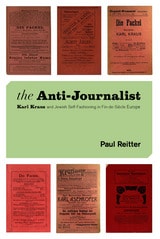
cover of The Anti-Journalist: Karl Kraus and Jewish Self-Fashioning in Fin-de-Siècle Europe

The Anti-Journalist

Karl Kraus and Jewish Self-Fashioning in Fin-de-Siècle Europe

Paul Reitter

University of Chicago Press, 2008

In turn-of-the-century Vienna, Karl Kraus created a bold new style of media criticism, penning incisive satires that elicited both admiration and outrage. Kraus’s spectacularly hostile critiques often focused on his fellow Jewish journalists, which brought him a reputation as the quintessential self-hating Jew. The Anti-Journalist overturns this view with unprecedented force and sophistication, showing how Kraus’s criticisms form the center of a radical model of German-Jewish self-fashioning, and how that model developed in concert with Kraus’s modernist journalistic style.
Paul Reitter’s study of Kraus’s writings situates them in the context of fin-de-siècle German-Jewish intellectual society. He argues that rather than stemming from anti-Semitism, Kraus’s attacks constituted an innovative critique of mainstream German-Jewish strategies for assimilation. Marshalling three of the most daring German-Jewish authors—Kafka, Scholem, and Benjamin—Reitter explains their admiration for Kraus’s project and demonstrates his influence on their own notions of cultural authenticity.
 
The Anti-Journalist is at once a new interpretation of a fascinating modernist oeuvre and a heady exploration of an important stage in the history of German-Jewish thinking about identity.
[more]