Results by title
59 books match the query 'Jewish women' and 6 start with a
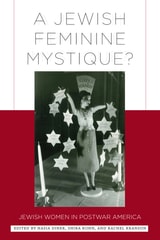
A Jewish Feminine Mystique?
Jewish Women in Postwar AmericaEdited by Hasia R. Diner, Shira Kohn, and Rachel Kranson
Rutgers University Press, 2010
As workers with or without pay, social justice activists, community builders, entertainers, and businesswomen, most Jewish women championed responsibilities outside their homes. Jewishness played a role in shaping their choices, shattering Friedan's assumptions about how middle-class women lived in the postwar years. Focusing on ordinary Jewish women as well as prominent figures such as Judy Holliday, Jennie Grossinger, and Herman Wouk's fictional Marjorie Morningstar, leading scholars explore the wide canvas upon which American Jewish women made their mark after the Second World War.
A Letter to Harvey Milk
Short StoriesLesléa Newman
University of Wisconsin Press, 2004
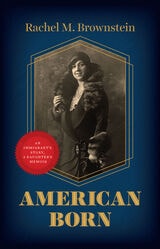
American Born
An Immigrant's Story, a Daughter's MemoirRachel M. Brownstein
University of Chicago Press, 2023
When she arrived alone in New York in 1924, eighteen-year-old Reisel Thaler resembled the other Yiddish-speaking immigrants from Eastern Europe who accompanied her. Yet she already had an American passport tucked in her scant luggage. Reisel had drawn her first breath on the Lower East Side of Manhattan in 1905, then was taken back to Galicia (in what is now Poland) by her father before she turned two. She was, as she would boast to the end of her days, “American born.”
The distinguished biographer and critic Rachel M. Brownstein began writing about her mother Reisel during the Trump years, dwelling on the tales she told about her life and the questions they raised about nationalism, immigration, and storytelling. For most of the twentieth century, Brownstein’s mother gracefully balanced her identities as an American and a Jew. Her values, her language, and her sense of timing inform the imagination of the daughter who recalls her in her own old age. The memorializing daughter interrupts, interprets, and glosses, sifting through alternate versions of the same stories using scenes, songs, and books from their time together.
But the central character of this book is Reisel, who eventually becomes Grandma Rose—always watching and judging, singing, baking, and bustling. Living life as the heroine of her own story, she reminds us how to laugh despite tragedy, find our courage, and be our most unapologetically authentic selves.
Amy Levy
Critical EssaysLinda Hunt Beckman
Ohio University Press, 2000
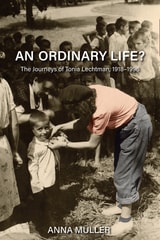
An Ordinary Life?
The Journeys of Tonia Lechtman, 1918–1996Anna Müller
Ohio University Press, 2024
One woman’s national, political, ethnic, social, and personal identities impart an extraordinary perspective on the histories of Europe, Polish Jews, Communism, activism, and survival during the twentieth century.
Tonia Lechtman was a Jew, a loving mother and wife, a Polish patriot, a committed Communist, and a Holocaust survivor. Throughout her life these identities brought her to multiple countries—Poland, Palestine, Spain, France, Germany, Switzerland, and Israel—during some of the most pivotal and cataclysmic decades of the twentieth century. In most of those places, she lived on the margins of society while working to promote Communism and trying to create a safe space for her small children.
Born in Łódź in 1918, Lechtman became fascinated with Communism in her early youth. In 1935, to avoid the consequences of her political activism during an increasingly antisemitic and hostile political environment, the family moved to Palestine, where Tonia met her future husband, Sioma. In 1937, the couple traveled to Spain to participate in the Spanish Civil War. After discovering she was pregnant, Lechtman relocated to France while Sioma joined the International Brigades. She spent the Second World War in Europe, traveling with two small children between France, Germany, and Switzerland, at times only miraculously avoiding arrest and being transported east to Nazi camps. After the war, she returned to Poland, where she planned to (re)build Communist Poland. However, soon after her arrival she was imprisoned for six years. In 1971, under pressure from her children, Lechtman emigrated from Poland to Israel, where she died in 1996.
In writing Lechtman’s biography, Anna Müller has consulted a rich collection of primary source material, including archival documentation, private documents and photographs, interviews from different periods of Lechtman’s life, and personal correspondence. Despite this intimacy, Müller also acknowledges key historiographical questions arising from the lacunae of lost materials, the selective preservation of others, and her own interpretive work translating a life into a life story.
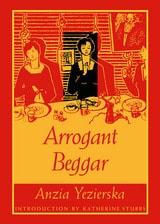
Arrogant Beggar
Anzia Yezierska
Duke University Press, 1996
The second half of the novel takes Adele back to her ghetto origins as she explores an alternative model of philanthropy by opening a restaurant that combines the communitarian ideals of Old World shtetl tradition with the contingencies of New World capitalism. Within the context of this radical message, Yezierska revisits the themes that have made her work famous, confronting complex questions of ethnic identity, assimilation, and female self-realization.
Katherine Stubbs’s introduction provides a comprehensive and compelling historical, social, and literary context for this extraordinary novel and discusses the critical reaction to its publication in light of Yezierska’s biography and the once much-publicized and mythologized version of her life story. Unavailable for over sixty years, Arrogant Beggar will be enjoyed by general readers of fiction and be of crucial importance for feminist critics, students of ethnic literature. It will also prove an exciting and richly rewarding text for students and scholars of Jewish studies, immigrant literature, women’s writing, American history, and working-class fiction.