Results by title
2 books match the query 'Jewish-Arab relations in motion pictures'

Identity Politics on the Israeli Screen
By Yosefa Loshitzky
University of Texas Press, 2002
2002 — A Choice Outstanding Academic Book
The struggle to forge a collective national identity at the expense of competing plural identities has preoccupied Israeli society since the founding of the state of Israel. In this book, Yosefa Loshitzky explores how major Israeli films of the 1980s and 1990s have contributed significantly to the process of identity formation by reflecting, projecting, and constructing debates around Israeli national identity.
Loshitzky focuses on three major foundational sites of the struggle over Israeli identity: the Holocaust, the question of the Orient, and the so-called (in an ironic historical twist of the "Jewish question") Palestinian question. The films she discusses raise fundamental questions about the identity of Jewish Holocaust survivors and their children (the "second generation"), Jewish immigrants from Muslim countries or Mizrahim (particularly the second generation of Israeli Mizrahim), and Palestinians. Recognizing that victimhood marks all the identities represented in the films under discussion, Loshitzky does not treat each identity group as a separate and coherent entity, but rather attempts to see the conflation, interplay, and conflict among them.
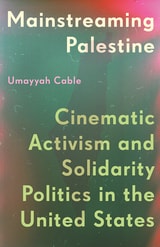
Mainstreaming Palestine
Cinematic Activism and Solidarity Politics in the United StatesUmayyah Cable
University of Minnesota Press, 2025
A history of cinema’s role in popularizing the politics of Palestinian liberation
For decades, Arab American activists and allies have used film, video, and multimedia to mobilize support for the Palestinian cause in the United States. In this detailed history of cinema’s role within the broader solidarity movement, Umayyah Cable analyzes the various strands of cinematic activism that have helped move Palestinian liberation politics from the periphery and into the mainstream.
Cable charts the shifting discourse around Palestine as it has been shaped by grassroots film production and alternative media distribution networks as well as more conventional outlets. Ranging from the circulation of educational filmstrips by the Association of Arab American University Graduates in the 1970s to the treatment of Palestinian solidarity at contemporary Hollywood awards ceremonies and film festivals, Mainstreaming Palestine tells the story of how cinema has promoted Palestinian liberation and solidarity politics. While highlighting various public controversies and struggles against censorship, Cable also acknowledges the drawbacks of the Palestinian cause being subsumed by the mainstream, discussing how activism risks becoming fashionable, undermining the radical potential of the very tools that helped bring it there.
Combining archival research, ethnographic observation and interviews, text analysis, and visual analysis of film, video, and multimedia, Mainstreaming Palestine encourages readers to critically assess the relationship between the politics of liberation and the all-consuming engine of contemporary capitalism. By underscoring the impact of visual media on the evolution of the Palestinian solidarity discourse, this book offers both a treatise on the practical power of cinema and a necessary historicization of an urgent issue in American politics.
Retail e-book files for this title are screen-reader friendly with images accompanied by short alt text and/or extended descriptions.