Results by title
5 books match the query 'Jews, Russian'
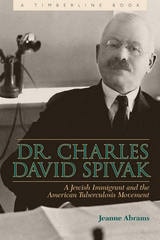
Dr. Charles David Spivak
A Jewish Immigrant and the American Tuberculosis MovementJeanne Abrams
University Press of Colorado, 2009
Born in Russia in 1861, Spivak immigrated to the United States in 1882 and received his medical degree from Philadelphia's Jefferson Medical College by 1890. In 1896, his wife's poor health brought them to Colorado. Determined to find a cure, Spivak became one of the most charismatic and well-known leaders in the American Tuberculosis Movement. His role as director of Denver's Jewish Consumptives' Relief Society sanatorium allowed his personal philosophies to strongly influence policies. His unique blend of Yiddishkeit, socialism, and secularism - along with his belief in treating the "whole" patient - became a model for integrating medical, social, and rehabilitation services that was copied across the country.
Not only a national leader in the crusade against tuberculosis but also a luminary in the American Jewish community, Dr. Charles Spivak was a physician, humanitarian, writer, linguist, journalist, administrator, social worker, ethnic broker, and medical, public health, and social crusader. Abrams's biography will be a welcome addition to anyone interested in the history of medicine, Jewish life in America, or Colorado history.
In My Father'S Study
Ben Orlove
University of Iowa Press, 1995
In 1921 Solomon Orlovski, a Russian Jew born in 1904, emigrated to America and transformed himself into Robert Orlove, a pattern maker in two senses of the term: during the day, he worked in the fur trade in New York and Chicago, making patterns for toys and hats; in his private life he became a self-taught artist who created prints, sketches, and collages in his study. More than sixty years later his son Ben—an anthropologist educated at Harvard and Berkeley—walked through the doorway of the deceased Robert's study and began to explore more than a half century of his father's experiences, thoughts, and emotions as well as his own very different life. His wry, sensitive combination of biography, memoir, and autobiography taps a remarkably rich vein of individual and collective experience in our diverse society.
Ben Orlove's dual narrative constitutes a family history of notable breadth and immediacy. By turns passionate and cool, dramatic and analytic, he excavates his father Robert's lifetime accumulation of diaries, letters, clippings, photographs, and artworks to create a convincing, deeply satisfying portrait that link both father and son.
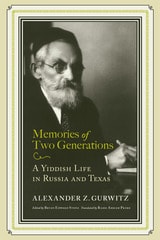
Memories of Two Generations
A Yiddish Life in Russia and TexasAlexander Z. Gurwitz, Edited and Introduced by Bryan Edward Stone
University of Alabama Press, 2022
The 1935 autobiography of Alexander Ziskind Gurwitz, an Orthodox Jew whose lively recounting of his life in Tsarist Russia and his immigration to San Antonio, Texas, in 1910 captures turbulent changes in early twentieth-century Jewish history
In 1910, at the age of fifty-one, Alexander Ziskind Gurwitz made the bold decision to emigrate with his wife and four children from southeastern Ukraine in Tsarist Russia to begin a new life in Texas. In 1935, in his seventies, Gurwitz composed a retrospective autobiography, Memories of Two Generations, that recounts his personal story both of the rich history of the lost Jewish world of Eastern Europe and of the rambunctious development of frontier Jewish communities in the United States.
In both Europe and America, Gurwitz inhabited an almost exclusively Jewish world. As a boy, he studied in traditional yeshivas and earned a living as a Hebrew language teacher and kosher butcher. Widely travelled, Gurwitz recalls with wit and insight daily life in European shtetls, providing perceptive and informative comments about Jewish religion, history, politics, and social customs. Among the book’s most notable features is his first-hand, insider’s account of the yearly Jewish holiday cycle as it was observed in the nineteenth century, described as he experienced it as a child.
Gurwitz’s account of his arrival in Texas forms a cornerstone record of the Galveston Immigration Movement; this memoir represents the only complete narrative of that migration from an immigrant’s point of view. Gurwitz’s descriptions about the development of a thriving Orthodox community in San Antonio provide an important and unique primary source about a facet of American Jewish life that is not widely known.
Gurwitz wrote his memoir in his preferred Yiddish, and this translation into English by Rabbi Amram Prero captures the lyrical style of the original. Scholar and author Bryan Edward Stone’s special introduction and illuminating footnotes round out a superb edition that offers much to experts and general readers alike.
The New Jewish Diaspora
Russian-Speaking Immigrants in the United States, Israel, and GermanyGitelman, Zvi
Rutgers University Press, 2016
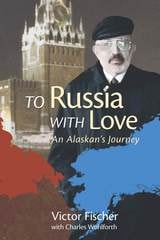
To Russia with Love
An Alaskan's JourneyVictor Fischer with Charles Wohlforth
University of Alaska Press, 2012
Son of the famous American journalist Louis Fischer, who corresponded from Germany and then Moscow, and the Russian writer Markoosha Fischer, Victor Fischer grew up in the shadow of Hitler and Stalin, watching his friends’ parents disappear after political arrests. Eleanor Roosevelt personally engineered the Fischer family’s escape from Russia, and soon after Victor was serving in the United States Army in World War II and fighting opposite his childhood friends in the Russian and German armies.