Results by title
7 books match the query 'Job Hunting'
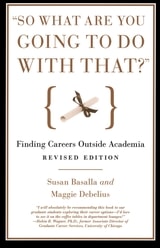
"So What Are You Going to Do with That?"
Finding Careers Outside AcademiaSusan Basalla and Maggie Debelius
University of Chicago Press, 2007
With “So What Are You Going to Do with That?” Susan Basalla and Maggie Debelius—Ph.D.’s themselves—answer all those questions with a resounding “Yes!” A witty, accessible guide full of concrete advice for anyone contemplating the jump from scholarship to the outside world, “So What Are You Going to Do with That?” covers topics ranging from career counseling to interview etiquette to translating skills learned in the academy into terms an employer can understand and appreciate. Packed with examples and stories from real people who have successfully made this daunting—but potentially rewarding— transition, and written with a deep understanding of both the joys and difficulties of the academic life, this fully revised and up-to-date edition will be indispensable for any graduate student or professor who has ever glanced at her CV, flipped through the want ads, and wondered, “What if?”
“I will absolutely be recommending this book to our graduate students exploring their career options—I’d love to see it on the coffee tables in department lounges!”—Robin B. Wagner, former associate director for graduate career services, University of Chicago

"So What Are You Going to Do with That?"
Finding Careers Outside Academia, Third EditionSusan Basalla and Maggie Debelius
University of Chicago Press, 2014
In this third edition of “So What Are You Going to Do with That?”, thoroughly revised with new advice for students in the sciences, Susan Basalla and Maggie Debelius—PhDs themselves—answer all those questions with a resounding “Yes!” A witty, accessible guide full of concrete advice for anyone contemplating the jump from scholarship to the outside world, “So What Are You Going to Do with That?” covers topics ranging from career counseling to interview etiquette to how to translate skills learned in the academy into terms an employer can understand and appreciate. Packed with examples and stories from real people who have successfully made this daunting—but potentially rewarding—transition, and written with a deep understanding of both the joys and difficulties of the academic life, this fully updated guide will be indispensable for any graduate student or professor who has ever glanced at his or her CV, flipped through the want ads, and wondered, “What if?”
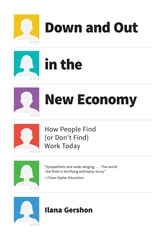
Down and Out in the New Economy
How People Find (or Don’t Find) Work TodayIlana Gershon
University of Chicago Press, 2017
Finding a job used to be simple. Now . . . well, it’s complicated. In today’s economy, you can’t just be an employee looking to get hired—you have to market yourself as a business, one that can help another business achieve its goals.
That’s a radical transformation in how we think about work and employment, says Ilana Gershon. And with Down and Out in the New Economy, she digs deep into that change and what it means, not just for job seekers, but for businesses and our very culture. In telling this story, Gershon covers all parts of the employment spectrum: she interviews hiring managers about how they assess candidates; attends personal branding seminars; talks with managers at companies around the United States to suss out regional differences—like how Silicon Valley firms look askance at the lengthier employment tenures of applicants from the Midwest. And she finds that not everything has changed: though the technological trappings may be glitzier, in a lot of cases, who you know remains more important than what you know.
Rich in the voices of people deeply involved with all parts of the employment process, Down and Out in the New Economy offers a snapshot of the quest for work today—and a pointed analysis of its larger meaning.
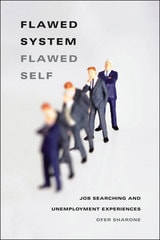
Flawed System/Flawed Self
Job Searching and Unemployment ExperiencesOfer Sharone
University of Chicago Press, 2013
Flawed System/Flawed Self delves beneath these staggering numbers to explore the world of job searching and unemployment across class and nation. Through in-depth interviews and observations at job-search support organizations, Ofer Sharone reveals how different labor-market institutions give rise to job-search games like Israel’s résumé-based “spec games”—which are focused on presenting one’s skills to fit the job—and the “chemistry games” more common in the United States in which job seekers concentrate on presenting the person behind the résumé. By closely examining the specific day-to-day activities and strategies of searching for a job, Sharone develops a theory of the mechanisms that connect objective social structures and subjective experiences in this challenging environment and shows how these different structures can lead to very different experiences of unemployment.
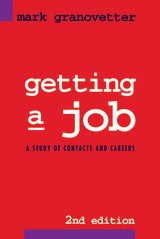
Getting a Job
A Study of Contacts and CareersMark Granovetter
University of Chicago Press, 1995
This second edition is updated with a new Afterword and includes Granovetter's influential article "Economic Action and Social Structure: The Problems of Embeddedness."
"Who would imagine that a book with such a prosaic title as 'getting a job' could pose such provocative questions about social structure and even social policy? In a remarkably ingenious and deceptively simple analysis of data gathered from a carefully designed sample of professional, technical, and managerial employees . . . Granovetter manages to raise a number of critical issues for the economic theory of labor markets as well as for theories of social structure by exploiting the emerging 'social network' perspective."—Edward O. Laumann, American Journal of Sociology
"This short volume has much to offer readers of many disciplines. . . . Granovetter demonstrates ingenuity in his design and collection of data."—Jacob Siegel, Monthly Labor Review
"A fascinating exploration, for Granovetter's principal interest lies in utilizing sociological theory and method to ascertain the nature of the linkages through which labor market information is transmitted by 'friends and relatives.'"—Herbert Parnes, Industrial and Labor Relations Review

Studies of Labor Market Intermediation
Edited by David H. Autor
University of Chicago Press, 2009
From the traditional craft hiring hall to the Web site Monster.com, a multitude of institutions exist to facilitate the matching of workers with firms. The diversity of such Labor Market Intermediaries (LMIs) encompasses criminal records providers, public employment offices, labor unions, temporary help agencies, and centralized medical residency matches. Studies of Labor Market Intermediation analyzes how these third-party actors intercede where workers and firms meet, thereby aiding, impeding, and, in some cases, exploiting the matching process.
By building a conceptual foundation for analyzing the roles that these understudied economic actors serve in the labor market, this volume develops both a qualitative and quantitative sense of their significance to market operation and worker welfare. Cross-national in scope, Studies of Labor Market Intermediation is distinctive in coalescing research on a set of market institutions that are typically treated as isolated entities, thus setting a research agenda for analyzing the changing shape of employment in an era of rapid globalization and technological change.
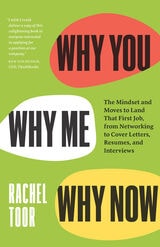
Why You, Why Me, Why Now
The Mindset and Moves to Land That First Job, from Networking to Cover Letters, Resumes, and InterviewsRachel Toor
University of Chicago Press, 2024
Searching for a job can be hard and demoralizing work. In Why You, Why Me, Why Now, Rachel Toor delivers some good news. The most important thing is within your control—a mindset that shows you know the goals of the organization you want to work for and that you’re ready and eager to contribute. Toor provides, with compassion and enthusiasm, strategies to make it easy for hiring managers to say “yes.” Through useful and funny anecdotes, she offers advice from professionals across industries and focuses on the attitude applicants can adopt to find success. Revealing traits employers seek, Toor shows how to craft winning cover letters, ways to tailor resumes for each job, and practical tips to get past AI screening. She also explains how to use LinkedIn and gives tips on preparing for interviews. Throughout, the book features Toor’s notes on writing well to help in landing a first job and beyond. Encouraging, entertaining, and blunt, this is a job-search guide like no other.