Results by title

7 books match the query 'Johannesburg'
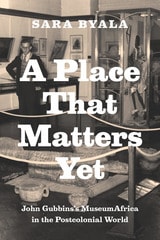
cover of A Place That Matters Yet: John Gubbins's MuseumAfrica in the Postcolonial World

A Place That Matters Yet

John Gubbins's MuseumAfrica in the Postcolonial World

Sara Byala

University of Chicago Press, 2013
A Place That Matters Yet unearths the little-known story of Johannesburg’s MuseumAfrica, a South African history museum that embodies one of the most dynamic and fraught stories of colonialism and postcolonialism, its life spanning the eras before, during, and after apartheid. Sara Byala, in examining this story, sheds new light not only on racism and its institutionalization in South Africa but also on the problems facing any museum that is charged with navigating colonial history from a postcolonial perspective.
 
Drawing on thirty years of personal letters and public writings by museum founder John Gubbins, Byala paints a picture of a uniquely progressive colonist, focusing on his philosophical notion of “three-dimensional thinking,” which aimed to transcend binaries and thus—quite explicitly—racism. Unfortunately, Gubbins died within weeks of the museum’s opening, and his hopes would go unrealized as the museum fell in line with emergent apartheid politics. Following the museum through this transformation and on to its 1994 reconfiguration as a post-apartheid institution, Byala showcases it as a rich—and problematic—archive of both material culture and the ideas that surround that culture, arguing for its continued importance in the establishment of a unified South Africa.
[more]
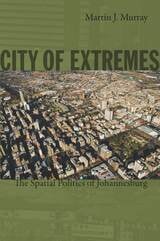
cover of City of Extremes: The Spatial Politics of Johannesburg

City of Extremes

The Spatial Politics of Johannesburg

Martin J. Murray

Duke University Press, 2011

City of Extremes is a powerful critique of urban development in greater Johannesburg since the end of apartheid in 1994. Martin J. Murray describes how a loose alliance of city builders—including real estate developers, large-scale property owners, municipal officials, and security specialists—has sought to remake Johannesburg in the upbeat image of a world-class city. By creating new sites of sequestered luxury catering to the comfort, safety, and security of affluent urban residents, they have produced a new spatial dynamic of social exclusion, effectively barricading the mostly black urban poor from full participation in the mainstream of urban life. This partitioning of the cityscape is enabled by an urban planning environment of limited regulation or intervention into the prerogatives of real estate capital.

Combining insights from urban studies, cultural geography, and urban sociology with extensive research in South Africa, Murray reflects on the implications of Johannesburg’s dual character as a city of fortified enclaves that proudly displays the ostentatious symbols of global integration and the celebrated “enterprise culture” of neoliberal design, and as the “miasmal city” composed of residual, peripheral, and stigmatized zones characterized by signs of a new kind of marginality. He suggests that the “global cities” paradigm is inadequate to understanding the historical specificity of cities in the Global South, including the colonial mining town turned postcolonial megacity of Johannesburg.
[more]
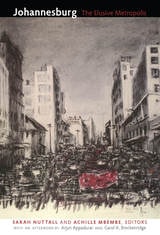
cover of Johannesburg: The Elusive Metropolis

Johannesburg

The Elusive Metropolis

Sarah Nuttall and Achille Mbembe, eds.

Duke University Press, 2008

Johannesburg: The Elusive Metropolis is a pioneering effort to insert South Africa’s largest city into urban theory, on its own terms. Johannesburg is Africa’s premier metropolis. Yet theories of urbanization have cast it as an emblem of irresolvable crisis, the spatial embodiment of unequal economic relations and segregationist policies, and a city that responds to but does not contribute to modernity on the global scale. Complicating and contesting such characterizations, the contributors to this collection reassess classic theories of metropolitan modernity as they explore the experience of “city-ness” and urban life in post-apartheid South Africa. They portray Johannesburg as a polycentric and international city with a hybrid history that continually permeates the present. Turning its back on rigid rationalities of planning and racial separation, Johannesburg has become a place of intermingling and improvisation, a city that is fast developing its own brand of cosmopolitan culture.

The volume’s essays include an investigation of representation and self-stylization in the city, an ethnographic examination of friction zones and practices of social reproduction in inner-city Johannesburg, and a discussion of the economic and literary relationship between Johannesburg and Maputo, Mozambique’s capital. One contributor considers how Johannesburg’s cosmopolitan sociability enabled the anticolonial projects of Mohandas Ghandi and Nelson Mandela. Journalists, artists, architects, writers, and scholars bring contemporary Johannesburg to life in ten short pieces, including reflections on music and megamalls, nightlife, built spaces, and life for foreigners in the city.

Contributors: Arjun Appadurai, Carol A. Breckenridge, Lindsay Bremner, David Bunn, Fred de Vries, Nsizwa Dlamini, Mark Gevisser, Stefan Helgesson, Julia Hornberger, Jonathan Hyslop, Grace Khunou, Frédéric Le Marcis, Xavier Livermon, John Matshikiza, Achille Mbembe, Robert Muponde, Sarah Nuttall, Tom Odhiambo, Achal Prabhala, AbdouMaliq Simone
[more]
cover of Johannesburg: The Elusive Metropolis, Volume 16

Johannesburg

The Elusive Metropolis, Volume 16

Sarah Nuttall and Achille Mbembe, eds.

Duke University Press, 0

This issue of Public Culture attempts to overturn perceptions that frame Africa as an object apart from the rest of the world. By placing the city of Johannesburg—the preeminent metropolis of the African continent and a city facing a complicated legacy of racial strife and wealth accumulation—at the heart of new critical urban theory, Johannesburg: The Elusive Metropolis broadens discussions of modernity, cosmopolitanism, and urban renewal to include Africa. The issue brings Johannesburg into direct dialogue with other world cities, creating a space for the interrogation and investigation of the metropolis in a properly global sense.

Contributors to this issue—a mix of scholars, urban planners, and artists, many of whom hail from South Africa—reveal Johannesburg to be a polycentric and international city that has developed its own cosmopolitan culture. In a detailed study of three streets in the modern precinct of Melrose Arch, one essay shows how the thoroughly commodified and marketed Johannesburg cityscape has shaped the cultural sensitivities, aesthetics, and urban subjectivities of its inhabitants, at times even overriding the historical memory of apartheid. Another essay, focusing on the emergence of a new urban culture, examines how the city itself becomes a crucial site for the remixing and reassembling of racial identities. By tracking the movement of people with AIDS to various locations in the city to seek relief and treatment, another essay reveals an urban geography very different from what is seen from the highways. Finally, through interviews and commentaries, journalists, artists, and architects of Johannesburg offer reflections on the geography and shifting culture of the city and its townships, on the complicated relationship between Johannesburg and other African cities, and on the search for an architectural style that adequately expresses the complexity of this cosmopolitan city.

Contributors. Lindsay Bremner, Nsizwa Dlamini, Mark Gevisser, Grace Khunou, Frédéric Le Marcis, John Matshikiza, Achille Mbembe, Sarah Nuttall, Rodney Place, AbdouMaliq Simone, Michael Watts
[more]
cover of Reconfiguring Racial Capitalism: South Africa in the Chinese Century

Reconfiguring Racial Capitalism

South Africa in the Chinese Century

Mingwei Huang

Duke University Press, 2024
In Reconfiguring Racial Capitalism, Mingwei Huang traces the development of new forms of racial capitalism in the twenty-first century. Through fieldwork in one of the “China malls” that has emerged along Johannesburg’s former mining belt, Huang identifies everyday relations of power and difference between Chinese entrepreneurs and African migrant workers in these wholesale shops. These relations, Huang contends, replicate and perpetuate global structures of white supremacy, anti-Blackness, capitalism, and colonialism, even when whiteness is not present. Huang argues that this dynamic reflects the sedimented legacies and continued operation of white supremacy and colonialism, which have been transformed in the shift of capitalism’s center of gravity toward China and the Global South. These new forms of racial capitalism and empire layer onto and extend histories of exploitation and racialization in South Africa. Taking a palimpsestic approach, Huang offers tools for understanding this shift and decentering contemporary Western conceptions of race, empire, and racial capitalism in the Chinese Century.
[more]
cover of The Infrastructures of Security: Technologies of Risk Management in Johannesburg

The Infrastructures of Security

Technologies of Risk Management in Johannesburg

Martin J. Murray

University of Michigan Press, 2022

Much of the South African government’s response to crime—especially in Johannesburg—has been to rely increasingly on technology. This includes the widespread use of video cameras, Artificial Intelligence, machine-learning, and automated systems, effectively replacing human watchers with machine watchers. The aggregate effect of such steps is to determine who is, and isn’t, allowed to be in public spaces—essentially another way to continue segregation.

In The Infrastructures of Security, author Martin J. Murray concentrates on not only the turn toward technological solutions to managing the risk of crime through digital (and software-based) surveillance and automated information systems, but also the introduction of somewhat bizarre and fly-by-night experimental “answers” to perceived risk and danger. Digitalized surveillance is significant for two reasons: first, it enables monitoring to take place across wide "geographical distances with little time delay"; and second, it allows for the active sorting, identification, and "tracking of bodies, behaviors, and characteristics of subject populations on a continuous, real-time basis." These new software-based surveillance technologies represent monitoring, tracking, and information gathering without walls, towers, or guards.
[more]
cover of Wake Up, This Is Joburg

Wake Up, This Is Joburg

Words by Tanya Zack, Photographs by Mark Lewis

Duke University Press, 2022

A single image taken from a high-rise building in inner-city Johannesburg uncovers layers of history—from its premise and promise of gold to its current improvisations. It reveals the city as carcass and as crucible, where informal agents and processes spearhead its rapid reshaping and transformation. In Wake Up, This Is Joburg, writer Tanya Zack and photographer Mark Lewis offer a stunning portrait of Johannesburg and personal stories of some of the city’s ordinary, odd, and outrageous residents. Their photos and essays take readers into meat markets where butchers chop cow heads; the eclectic home of an outsider artist that features turrets and full of manikins; long-abandoned gold pits beneath the city, where people continue to mine informally; and lively markets, taxi depots, and residential high-rises. Sharing people’s private and work lives and the extraordinary spaces of the metropolis, Zack and Lewis show that Johannesburg’s urban transformation occurs not in a series of dramatic, wide-scale changes but in the everyday lives, actions, and dreams of individuals.
[more]