Results by title
5 books match the query 'John Steinbeck'

After The Grapes Of Wrath
Essays On John Steinbeck In Honor of Tetsumaro HayashiDonald V. Coers
Ohio University Press, 1994
Traditionally, the critical reputation of Nobel Prize-winning American novelist John Steinbeck (1902-1968) has rested on his achievements of the 1930s, especially In Dubious Battle (1936), Of Mice and Men (19370, The Long Valley (1938), and, of course, The Grapes of Wrath (1939), one of the most powerful – and arguable on of the greatest – American novels of this century.
Book reviewers and academic critics often turned antagonistic toward Steinbeck when he no longer produced work with the sweeping reach and social consciousness of The Grapes of Wrath. He was accused of selling out, or co-opting his talent, when in fact the inordinate public success of Grapes and especially its attendant notoriety had caused a backlash for Steinbeck. As a result he became self-conscious about his own ability, and suspicious of that “clumsy vehicle,” the novel. The very act of researching and writing Grapes, which occupied him fully for several years and which he had already conceived as his final book on proletarian themes, changed him drastically.
No longer willing to be the chronicler of Depression-era subjects, Steinbeck went afield to find new roots, new sources, new forms. For example, in the six years following the publication of Grapes, Steinbeck completed a suit of love poems; a full-length novel (bastardized by Alfred Hitchcock in his 1943 film, Lifeboat); a nonfiction scientific book, Sea of Cortez: A Leisurely Journal of Travel and Research (with Edward F. Ricketts); a documentary film, The Forgotten Village; a documentary book to help the war effort, Bombs Away: The Story of a Bomber Team; a series of articles he wrote as a war correspondent for the New York Herald Tribune (later collected as Once There Was a War); and two novels, The Moon Is Down and Cannery Row.
Steinbeck came to define himself less as a novelist and more as a man of letters, a restless experimenter with form and subject matter, and a prophetic postmodernist whose key subject for the rest of his career was the dilemma of individual choice and ethical consciousness. Thus, Steinbeck’s later fiction, from The Moon Is Down (1942) through The Winter of Our Discontent (1962), and his later nonfiction, from Sea of Cortez (1941) through Travels with Charley (1962) and America and Americans (1966), often shows a different set of stylistic, thematic, and philosophical bearings from his earlier work and underscores his dramatic shift toward “individual thinking.” A full appreciation of Steinbeck’s mid-career metamorphosis and, consequently, of his later achievement requires a corresponding shift in critical approach – a departure from the traditional New Critical norms. Instead of marginalizing these works, all the contributors to this volume agree that Steinbeck’s later publications merit – indeed, demand – closer scrutiny.
Written especially for this collection in honor of Professor Tetsumaro Hayashi, the distinguished founder and editor-in-chief of the Steinbeck Quarterly, on his retirement from Ball State University and his move to Kwassui Women’s College in Nagasaki, Japan, these essays explore new ways of addressing Steinbeck’s later work and career, and include forays into subjects as diverse as ethnicity and music. They range from treatment of his post-structuralist use of language in Sea of Cortez and his involvement as a speech writer for Franklin Delano Roosevelt’s reelection bid in 1944 to the influence of Charles Darwin’s theories of sexual selection in The Wayward Bus, his revision of the myth of Cain in The Winter of Our Discontent, and his employment of Arthurian quest values in his last book, America and Americans.
For this group of critics – which includes respected veteran Steinbeck scholars Robert DeMott, John Ditsky, Mimi Gladstein, Cliff Lewis, Robert Morsberger, Susan Shillinglaw, and Roy Simmonds, as well as talented new voices Debra Barker, Kevin Hearle, Michael Meyer, Brian Railsback, Eiko Shiraga, and Geralyn Strecker – The Moon is Down and The Wayward Bus loom as significant works in the post 1930s re-evaluation (two essays each appear on these works). The book also includes Donald Coers’s interview with the writer’s widow, Elaine Steinbeck, the first of its kind ever published. After The Grapes of Wrath opens with eminent Americanist Warren French’s appreciation of Professor Hayashi’s distinguished career and his influence in Steinbeck studies; a bibliography of Hayashi’s major publication concludes this honorary gathering.
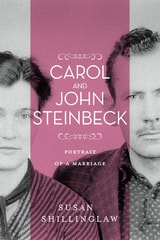
Carol and John Steinbeck
Portrait of a MarriageSusan Shillinglaw
University of Nevada Press, 2024
John Steinbeck
The Years of Greatness, 1936-1939Tetsumaro Hayashi
University of Alabama Press, 1993
Revisiting the remarkable years that produced Steinbeck's greatest literary achievements.
John Steinbeck: The Years of Greatness, 1936–1939, edited by Tetsumaro Hayashi, offers a compelling scholarly exploration of the brief but extraordinary period during which John Steinbeck produced some of the most influential works in American literary history. Drawn from papers presented at the Third International Steinbeck Congress, this collection of essays examines the creative, intellectual, and social forces that shaped Steinbeck's remarkable achievements during the late 1930s.
The contributors investigate Steinbeck's major works of the period, including In Dubious Battle, Of Mice and Men, and The Grapes of Wrath, situating them within the social and economic realities of the Great Depression and the evolving landscape of twentieth-century American literature. Particular attention is given to Steinbeck's portrayal of labor, migration, community, social justice, and the experiences of working-class Americans. The volume also presents innovative studies of female characters and relationships in Steinbeck's fiction, drawing on newly available research materials and correspondence to illuminate previously overlooked dimensions of his work.
By combining historical context, literary analysis, and fresh critical perspectives, this collection deepens appreciation for Steinbeck's artistry and enduring cultural significance. An essential resource for scholars and students alike, it offers valuable insights into the years that established Steinbeck as one of America's most important and widely studied authors.
The Novels of John Steinbeck
A Critical StudyHoward Levant
University of Missouri Press, 1983
Too often, Steinbeck’s work has been studied piecemeal, even when the intention was for a rounded view. In this study, Howard Levant analyzes the patterns in Steinbeck’s work, taking an approach that permits a judgment of each novel in the context of a greater appreciation of the shape of Steinbeck’s long career.
The Short Novels of John Steinbeck
Critical Essays with a Checklist to Steinbeck CriticismJackson J. Benson, ed.
Duke University Press, 1990
The essays examine the six most popular short novels—Tortilla Flat, The Red Pony, Of Mice and Men, The Moon Is Down, Cannery Row, and The Pearl—in addition to the three usually thought of as less successful—Burning Bright, Sweet Thursday, and The Short Reign of Pippin IV. Because most of Steinbeck’s short novels were adapted and presented as plays or screenplays, many of the essays deal with dramatic or film versions of the short novels as well as with the fiction. The collection concludes with a comprehensive checklist of criticism of the short novels.
Contributors. Richard Astro, Jackson J. Benson, Carroll Britch, John Ditsky, Joseph Fontenrose, Warren French, Robert Gentry, Mimi Reisel Gladstein, William Goldhurst, Tetsumaro Hayashi, Robert S. Hughes Jr., Howard Levant, Clifford Lewis, Peter Lisca, Anne Loftis, Charles R. Metzger, Michael J. Meyer, Robert E. Morsberger, Louis Owens, Roy S. Simmonds, Mark Spilka, John Timmerman