Results by title

6 books match the query 'Johnston, Bill'
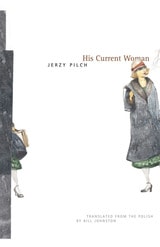
cover of His Current Woman

His Current Woman

Jerzy Pilch

Northwestern University Press, 2002
Pawel Kohoutek, veterinarian and womanizer, looks out the window one morning to see his mistress approaching his house. That's bad. She is hauling her suitcase (containing her books) and her backpack (containing everything else she owns). That's worse. So Kohoutek does the only thing he can: He hides his current woman in the attic of the family slaughterhouse. Farce ensues as Kohoutek attempts to hide the woman from his eccentric family, their lodgers, and various offbeat visitors. A best-seller in Jerzy Pilch's native Poland, His Current Woman is an enjoyable literary send-up of what often passes for love.
[more]
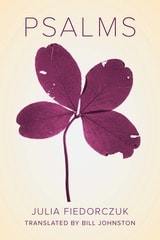
cover of Psalms

Psalms

Julia Fiedorczuk

University of Wisconsin Press, 2023

Fiedorczuk was inspired by her readings of the original Hebrew Psalms, as well as by the process of learning to sing. In her poems she captures the heartache and joy of the Biblical Psalms, but in the context of modern life. She addresses climate change, loss of biodiversity, the upheavals of migration, and, in her most recent poems, the return of war to Europe: “Even when bombs are falling you ought to write / perhaps even especially when people lost / in the woods are saying cold, she is so cold.”

Fiedorczuk writes of the natural world, the built environment, motherhood, brotherhood, and of vast and tiny passages of time. And as she does, she discovers a new voice, singing to soothe and inspire.


whose
flower made from a clod of pain will enfold
the milky way with its claws
of time, its pelt of stars?
—Excerpt from “Psalm XVII”
[more]
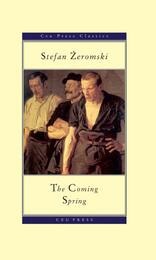
cover of The Coming Spring

The Coming Spring

Stefan Zeromski

Central European University Press, 2007
The Coming Spring (Przedwiosnie), Zeromski's last novel, tells the story of Cezary Baryka, a young Pole who finds himself in Baku, Azerbaijan, then a predominantly Armenian city, as the Russian Revolution breaks out. He becomes embroiled in the chaos caused by the revolution, and barely escapes with his life. Then, he and his father set off on a horrendous journey west to reach Poland. His father dies en route, but Cezary makes it to the newly independent Poland. Cezary sees the suffering of the poor, yet his experiences in the newly formed Soviet Union make him suspicious of socialist and communist solutions. He is an outsider among both the gentry and the working classes, and he cannot find where he belongs. Furthermore, he has unsuccessful and tragic love relations. The novel ends when, despite his profound misgivings, he takes up political action on behalf of the poor. Zeromski, whose vivid, assured style is instantly recognizable, was a writer with a strong social conscience, taking up the concerns of the poor and downtrodden.
[more]
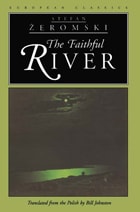
cover of The Faithful River

The Faithful River

Stefan Zeromski

Northwestern University Press, 1999
Originally published in 1912, this lyrical novel is set in a manor house in central Poland during the January Uprising of 1863 to 1864, when a volunteer Polish army futilely fought the Russian occupation. A wounded soldier appears outside the house and is cared for by Salomea, the young ward of the absent owners, who has been left in the manor with an aged servant. As the two strive to conceal the soldier's presence during brutal and invasive visits by the Russians, Salomea finds herself falling in love with her patient.
[more]
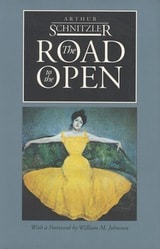
cover of The Road to the Open

The Road to the Open

Arthur Schnitzler

Northwestern University Press, 1991
Turn-of-the-century Vienna was the scene of tremendous social and artistic upheaval. Arthur Schnitzler's novel The Road to the Open brilliantly captures the complex world of Freud, Mahler, Strauss, and Klimt, dealing masterfully with the basic issues of Austrian anti-Semitism, the Viennese intellectual community, post-Wagnerian music, and the psychology of Vienna's middle class.
[more]
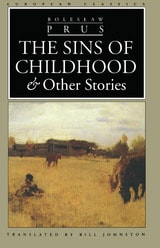
cover of The Sins of Childhood and Other Stories

The Sins of Childhood and Other Stories

Boleslav Prus

Northwestern University Press, 1996

This is the first English-language collection of stories by the nineteenth-century writer Boleslaw Prus, who has been called the greatest Polish novelist of all time. This new book, containing twelve of his classic short pieces, explores the depth of thought, human warmth, powers of observation, and technical excellence for which he has been justly praised.
[more]