Results by title
5 books match the query 'Jones, Stephen Graham'
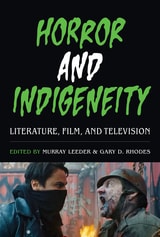
Horror and Indigeneity
Literature, Film, and TelevisionEdited by Murray Leeder and Gary D. Rhodes
University of Texas Press, 2026
A collection of essays about Indigeneity and horror in cinema, literature, and beyond.
How did Indigeneity come to be horrifying? Think of the “Indian burial ground” trope, a staple of 1970s horror cinema, not to mention decades of Western films and fictions that made “savage Indians” the face of fear in popular culture. Can horror do something else in the hands of Indigenous people? Creators such as Eden Robinson and Jeff Barnaby have self-consciously turned to horror to tell new kinds of stories, stories that question who is a monster and what constitutes the monstrous.
Horror and Indigeneity explores representations of Indigenous people in settler horror texts and in the growing corpus of horror by Indigenous writers and filmmakers. Widely spanning time periods and media, the contributors to this edited volume address themes such as cannibalism, eco-horror, historical trauma, and contemporary antiracism as they relate to classical horror cinema and recent works such as The Dead Can’t Dance, Lovecraft Country, and Stephen Graham Jones’s The Only Good Indians. Also featuring interviews with Jones and director T. J. Cuthand, Horror and Indigeneity rethinks the terror of the Other in potent and provocactive terms.
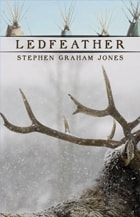
Ledfeather
Stephen Graham Jones
University of Alabama Press, 2008
A story of life, death, love, and the ties that bind us not only to what has been, but what will be.
After burning up the blacktop in New Mexico with The Fast Red Road and rewriting Indian history on the Great Plains with The Bird is Gone, Stephen Graham Jones now takes us to Montana. Set on a Blackfeet Indian reservation, Ledfeather lays bare the life of one Indian boy, Doby Saxon: his near-death experience, his suicide attempts, his brief glimpse of victory, and the unnecessary death of one of his best friends.
But through Doby emerges a connection to the past, to an Indian Agent who served the United States government over a century before. This revelation leads to another and another until it becomes clear that the decisions of this single Indian agent have impacted the lives of generations of Blackfeet Indians—and the life of Doby Saxon, a boy standing in the middle of the road at night, his hands balled into fists, the reservation wheeling all around him like the whole of Blackfeet history collapsing in on him.
Jones’s beautifully complex novel is a story of life, death, love, and the ties that bind us not only to what has been, but what will be: the power of one moment, the weight of one decision, the inevitability of one outcome, and the price of one life.

Refrigerated Music for a Gleaming Woman
StoriesAimee Parkison, Foreword by Stephen Graham Jones
University of Alabama Press, 2017
A darkly comical horror lurks beneath the surface of everyday events in Refrigerated Music for a Gleaming Woman, a seductively poetic story collection of unusual brilliance and rare humor.
In Aimee Parkison’s Refrigerated Music for a Gleaming Woman, lovers find unexpected romance in cramped spaces, fast food addicts struggle through cheeseburger addiction, and the splendor of nature competes with the violence of television. All the while, a complicated and precarious present dawns onto a new world where wealthy women wear children’s eyes as jewelry and those in need of money hawk their faces only to forever mourn what parts of themselves they have sold to survive.
Open the refrigerator door. Inside are antique jars. Open them to hear the music: Beethoven playing piano; slaves singing for freedom in plantation fields; mothers humming lullabies through the night to smallpox babies, knowing this song is the last sound their children will ever hear.
As Stephen Graham Jones notes in his foreword to this prize-winning collection, “The best books . . . fold you into a darkness sparkling with life. They lock you in the refrigerator but they also pipe in some music that never repeats, and when the door starts to open, you cling tight to it, so you can have just a few minutes more. This book, it’ll be over far too fast for you, yes. But even were it five times as thick as it is now, it would still be too short. Remember, though, the best books, they’re loops. They never stop. This one still hasn’t, for me.”
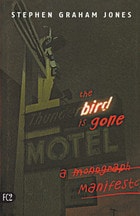
The Bird is Gone
A ManifestoStephen Graham Jones
University of Alabama Press, 2003
A lost pipe holds the power to rewrite a nation.
Cleverly blending alternate history, mystery, and indigenous resurgence, Stephen Graham Jones’s The Bird Is Gone unfolds in a transformed Great Plains where a visionary conservation act has made the land truly “Indian again.” Fourteen years later, a motley crew led by LP Deal converges in a bowling alley within Indian Territories, on a quest for a forgotten treaty pipe—sealed in a locker and flushed into oblivion—that could return all of America to Indigenous hands. Surreal, suspenseful, and richly original, this manifesto of resistance challenges readers to reconsider power, history, and the stakes of reclaiming a stolen world.
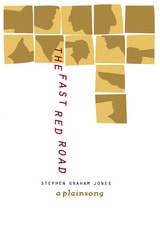
The Fast Red Road
A PlainsongStephen Graham Jones
University of Alabama Press, 2000
A road trip through myth, memory, and madness.
The Fast Red Road—A Plainsong is a novel which plunders, in a gleeful, two-fisted fashion, the myth and pop-culture surrounding the American Indian. It is a story fueled on pot fumes and blues, borrowing and distorting the rigid conventions of the traditional western. Indians, cowboys, and outlaws are as interchangeable as their outfits; men strike poses from Gunsmoke, and horses are traded for Trans-Ams. Pidgin, the half-blood protagonist, inhabits a world of illusion—of aliens, ghosts, telekinesis, and water-pistol violence—where television offers redemption, and “the Indian always gets it up the ass.”
Having escaped the porn factories of Utah, Pidgin heads for Clovis, NM to bury his father, Cline. But the body is stolen at the funeral, and Pidgin must recover it. With the aid of car thief Charlie Ward, he criscrosses a wasted New Mexico, straying through bars, junkyards, and rodeos, evading the cops, and tearing through barriers "Dukestyle." "Charlie Ward slid his thin leather belt from his jeans and held it out the window, whipping the cutlass faster, faster, his dyed black hair unbraiding in the fifty mile per hour wind, and they never stopped for gas." Along the way, Pidgin escapes a giant coyote, survives a showdown with Custer, and encounters the remnants of the Goliard Tribe—a group of radicals to which Cline belonged.
Pidgin's search allows him to reconcile the death of his father with five hundred years of colonial myth-making, and will eventually place him in a position to rewrite history. Jones tells his tale in lean, poetic prose. He paints a bleak, fever-burnt west—a land of strip-joints, strip-malls, and all you can eat beef-fed-beef stalls, where the inhabitants speak a raw, disposable lingo. His vision is dark yet frighteningly recognizable. In the tradition of Gerald Vizenor's Griever, The Fast Red Road—A Plainsong blazes a trail through the puppets and mirrors of myth, meeting the unexpected at every turn, and proving that the past—the texture of the road—can and must be changed.