Results by title
2 books match the query 'Jordan, Jamon'

Dealmaking Detroit
Two Essays About White Privilege, Private Gain, and Public LossJamon Jordan and Craig Regester, with an introduction by Stephen M. Ward
Disobedience Press, 2027
Who profits from Detroit’s “reinvention”?
In two incisive essays, historian Jamon Jordan and lecturer and labor activist Craig Regester dismantle the facile, corporate narratives surrounding Detroit’s past, present, and future.
Jordan reveals how racial hierarchy has consistently shaped the making and unmaking of the city. He traces a direct line from 19th-century laws requiring “negroes” to pay $500 just to exist in Michigan, through generations of White managers overseeing Black auto workers, to mid-century “redevelopment” plans that displaced and demolished thousands of homes and 350 businesses in Black neighborhoods—and into the present day, where a banner celebrates White capitalist saviors for rescuing Detroit from failure.
Building on this trajectory, Regester scrutinizes the upcoming University of Michigan Center for Innovation in Detroit, a foregone conclusion and joint venture between a public university and a pair of billionaires. Though funded with $100 million in taxpayer dollars, neither the university, the state, nor the developers seriously considered community visions for how the center should serve Detroiters. Regester exposes how the avarice and technocentric whims of the ultra-rich increasingly compromise the public service missions of major research universitie
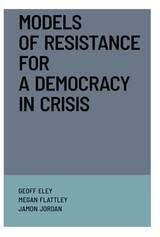
Models of Resistance for a Democracy in Crisis
Geoff Eley
Disobedience Press, 2026
Models of Resistance for a Democracy in Crisis features three historians who examine how political opposition, anti-racist struggle, and artistic intervention serve as vital blueprints for safeguarding our precarious democracy.
Geoff Eley deconstructs Trump-era politics by identifying a dual crisis: the withering of democratic practices and a pervasive cynicism toward government. By analyzing how Germans of the 1930s might have resisted fascism, he reveals the specific forms of opposition needed to uphold democratic accountability today.
Jamon Jordan traces a lineage of anti-racist protest, from the rebellions of the enslaved to the legal and moral defiance of the abolitionist movement. By weaving public tactics, such as demonstrations and boycotts, with the enduring labor of building Black-led institutions and preserving cultural traditions, Jordan reveals a comprehensive framework for contemporary activists.
Megan Flattley examines how artworks challenge repressive regimes. These creative interventions bear witness to traumatic and unjust conditions, use cultural institutions as cover for political action, and stage provocations in public spaces to reveal latent violence and advocate for social change.