59 books match the query 'Joseph, Gilbert M.' and 4 start with a
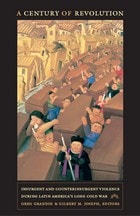
cover of A Century of Revolution: Insurgent and Counterinsurgent Violence during Latin America's Long Cold War

A Century of Revolution

Insurgent and Counterinsurgent Violence during Latin America's Long Cold War

Greg Grandin and Gilbert M. Joseph, eds.

Duke University Press, 2010

Latin America experienced an epochal cycle of revolutionary upheavals and insurgencies during the twentieth century, from the Mexican Revolution of 1910 through the mobilizations and terror in Central America, the Southern Cone, and the Andes during the 1970s and 1980s. In his introduction to A Century of Revolution, Greg Grandin argues that the dynamics of political violence and terror in Latin America are so recognizable in their enforcement of domination, their generation and maintenance of social exclusion, and their propulsion of historical change, that historians have tended to take them for granted, leaving unexamined important questions regarding their form and meaning. The essays in this groundbreaking collection take up these questions, providing a sociologically and historically nuanced view of the ideological hardening and accelerated polarization that marked Latin America’s twentieth century. Attentive to the interplay among overlapping local, regional, national, and international fields of power, the contributors focus on the dialectical relations between revolutionary and counterrevolutionary processes and their unfolding in the context of U.S. hemispheric and global hegemony. Through their fine-grained analyses of events in Chile, Colombia, Cuba, El Salvador, Guatemala, Mexico, Nicaragua, and Peru, they suggest a framework for interpreting the experiential nature of political violence while also analyzing its historical causes and consequences. In so doing, they set a new agenda for the study of revolutionary change and political violence in twentieth-century Latin America.

Contributors. Michelle Chase, Jeffrey L. Gould, Greg Grandin, Lillian Guerra, Forrest Hylton, Gilbert M. Joseph, Friedrich Katz, Thomas Miller Klubock, Neil Larsen, Arno J. Mayer, Carlota McAllister, Jocelyn Olcott, Gerardo Rénique, Corey Robin, Peter Winn
[more]
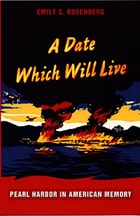
cover of A Date Which Will Live: Pearl Harbor in American Memory

A Date Which Will Live

Pearl Harbor in American Memory

Emily S. Rosenberg

Duke University Press, 2005

December 7, 1941—the date of Japan’s surprise attack on the U.S. fleet at Pearl Harbor—is "a date which will live" in American history and memory, but the stories that will live and the meanings attributed to them are hardly settled. In movies, books, and magazines, at memorial sites and public ceremonies, and on television and the internet, Pearl Harbor lives in a thousand guises and symbolizes dozens of different historical lessons. In A Date Which Will Live, historian Emily S. Rosenberg examines the contested meanings of Pearl Harbor in American culture.

Rosenberg considers the emergence of Pearl Harbor’s symbolic role within multiple contexts: as a day of infamy that highlighted the need for future U.S. military preparedness, as an attack that opened a "back door" to U.S. involvement in World War II, as an event of national commemoration, and as a central metaphor in American-Japanese relations. She explores the cultural background that contributed to Pearl Harbor’s resurgence in American memory after the fiftieth anniversary of the attack in 1991. In doing so, she discusses the recent “memory boom” in American culture; the movement to exonerate the military commanders at Pearl Harbor, Admiral Husband Kimmel and General Walter Short; the political mobilization of various groups during the culture and history "wars" of the 1990s, and the spectacle surrounding the movie Pearl Harbor. Rosenberg concludes with a look at the uses of Pearl Harbor as a historical frame for understanding the events of September 11, 2001.
[more]
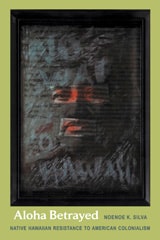
cover of Aloha Betrayed: Native Hawaiian Resistance to American Colonialism

Aloha Betrayed

Native Hawaiian Resistance to American Colonialism

Noenoe K. Silva

Duke University Press, 2004
In 1897, as a white oligarchy made plans to allow the United States to annex Hawai'i, native Hawaiians organized a massive petition drive to protest. Ninety-five percent of the native population signed the petition, causing the annexation treaty to fail in the U.S. Senate. This event was unknown to many contemporary Hawaiians until Noenoe K. Silva rediscovered the petition in the process of researching this book. With few exceptions, histories of Hawai'i have been based exclusively on English-language sources. They have not taken into account the thousands of pages of newspapers, books, and letters written in the mother tongue of native Hawaiians. By rigorously analyzing many of these documents, Silva fills a crucial gap in the historical record. In so doing, she refutes the long-held idea that native Hawaiians passively accepted the erosion of their culture and loss of their nation, showing that they actively resisted political, economic, linguistic, and cultural domination. Drawing on Hawaiian-language texts, primarily newspapers produced in the nineteenth century and early twentieth, Silva demonstrates that print media was central to social communication, political organizing, and the perpetuation of Hawaiian language and culture. A powerful critique of colonial historiography, Aloha Betrayed provides a much-needed history of native Hawaiian resistance to American imperialism.
[more]
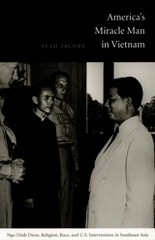
cover of America's Miracle Man in Vietnam: Ngo Dinh Diem, Religion, Race, and U.S. Intervention in Southeast Asia

America's Miracle Man in Vietnam

Ngo Dinh Diem, Religion, Race, and U.S. Intervention in Southeast Asia

Seth Jacobs

Duke University Press, 2004

America’s Miracle Man in Vietnam rethinks the motivations behind one of the most ruinous foreign-policy decisions of the postwar era: America’s commitment to preserve an independent South Vietnam under the premiership of Ngo Dinh Diem. The so-called Diem experiment is usually ascribed to U.S. anticommunism and an absence of other candidates for South Vietnam’s highest office. Challenging those explanations, Seth Jacobs utilizes religion and race as categories of analysis to argue that the alliance with Diem cannot be understood apart from America’s mid-century religious revival and policymakers’ perceptions of Asians. Jacobs contends that Diem’s Catholicism and the extent to which he violated American notions of “Oriental” passivity and moral laxity made him a more attractive ally to Washington than many non-Christian South Vietnamese with greater administrative experience and popular support.

A diplomatic and cultural history, America’s Miracle Man in Vietnam draws on government archives, presidential libraries, private papers, novels, newspapers, magazines, movies, and television and radio broadcasts. Jacobs shows in detail how, in the 1950s, U.S. policymakers conceived of Cold War anticommunism as a crusade in which Americans needed to combine with fellow Judeo-Christians against an adversary dangerous as much for its atheism as for its military might. He describes how racist assumptions that Asians were culturally unready for democratic self-government predisposed Americans to excuse Diem’s dictatorship as necessary in “the Orient.” By focusing attention on the role of American religious and racial ideologies, Jacobs makes a crucial contribution to our understanding of the disastrous commitment of the United States to “sink or swim with Ngo Dinh Diem.”

[more]