Results by title
5 books match the query 'Joseph Smith'
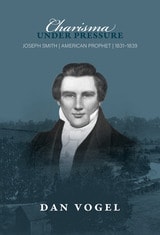
Charisma under Pressure
Joseph Smith, American Prophet, 1831–1839Dan Vogel
Signature Books, 2023
But just who was Joseph Smith? What motivated him? In examining Smith’s life during his Ohio and Missouri sojourns, Vogel seeks to answer those questions. But, Vogel is quick to note, “There are, in fact, many possible constructions of Joseph Smith, and depending on how one assesses the evidence for his truth-claims, a completely different Joseph Smith emerges. But this is probably as Smith wanted it.”
During this period, Smith established a temple, printing presses, additional scripture, expanded church offices, and built a bank—all indicating a sense of permanence and strength for his young church at one level while causing its near collapse at another.
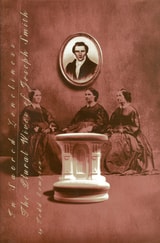
In Sacred Loneliness
The Plural Wives of Joseph SmithTodd Compton
Signature Books, 1997
The majority of Smith’s wives were younger than he, and one-third were between fourteen and twenty years of age. Another third were already married, and some of the husbands served as witnesses at their own wife’s polyandrous wedding. In addition, some of the wives hinted that they bore Smith children—most notably Sylvia Sessions’s daughter Josephine—although the children carried their stepfather’s surname.
For all of Smith’s wives, the experience of being secretly married was socially isolating, emotionally draining, and sexually frustrating. Despite the spiritual and temporal benefits, which they acknowledged, they found their faith tested to the limit of its endurance. After Smith’s death in 1844, their lives became even more “lonely and desolate.” One even joined a convent. The majority were appropriated by Smith’s successors, based on the Old Testament law of the Levirate, and had children by them, though they considered these guardianships unsatisfying. Others stayed in the Midwest and remarried, while one moved to California. But all considered their lives unhappy, except for the joy they found in their children and grandchildren.
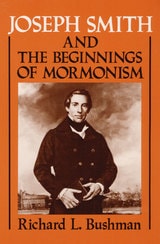
Joseph Smith and the Beginnings of Mormonism
Richard L. Bushman
University of Illinois Press, 1984
Winner of the David Woolley Evans and Beatrice Evans Biography Award and a History Book Club selection, 1985.
The core of Mormon belief was a conviction about actual events. The test of faith was not adherence to a certain confession of faith but belief that Christ was resurrected, that Joseph Smith saw God, that the Book of Mormon was true history, and that Peter, James, and John restored the apostleship. Mormonism was history, not philosophy.
It is as history that Richard L. Bushman analyzes the emergence of Mormonism in the early nineteenth century. Bushman, however, brings to his study a unique set of credentials--he is both a prize-winning historian and a faithful member of the Latter-day Saints church. For Mormons and non-Mormons alike, his book provides a very special perspective on an endlessly fascinating subject.
Building upon previous accounts and incorporating recently discovered contemporary sources, Bushman focuses on the first twenty-five years of Joseph Smith's life--up to his move to Kirtland, Ohio, in 1831. Bushman shows how the rural Yankee culture of New England and New York--especially evangelical revivalism, Christian rationalism, and folk magic--both influenced and hindered the formation of Smith's new religion.
Mormonism, Bushman argues, must be seen not only as the product of this culture, but also as an independent creation based on the revelations of its charismatic leader. In the final analysis, it was Smith's ability to breathe new life into the ancient sacred stories and to make a sacred story out of his own life which accounted for his own extraordinary influence. By presenting Smith and his revelations as they were viewed by the early Mormons themselves, Bushman leads us to a deeper understanding of their faith.
Joseph Smith
History, Methods, and MemoryRonald O. Barney
University of Utah Press, 2020
Ronald O. Barney, a former editor of the Joseph Smith Papers, applies new interpretations to Smith in history and memory, re-examining both his writings and contemporary accounts of him. The book explores the best methodologies for appraising the historical record, including a review of Smith’s world and its contextual background, an analysis of his foundational experiences, and a characterization of Smith as a man and prophet. Though the premise of re-evaluation may be unsettling to traditionalists, a modern reconsideration of the historical record’s entire range of sources is necessary to fashion a strategy for evaluating Smith and his enduring but complex legacy.
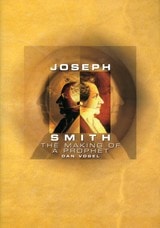
Joseph Smith
The Making of a ProphetDan Vogel
Signature Books, 2004
Vogel weaves together strands of evidence into a complete fabric including, among other aspects of Smith’s environment, the content of his daily dictation of scriputre and revelation—all contributing to a nearly complete view of what occurred on any given day in Smith’s lfie. The result is as much intellectual history as traditional biography. Readers will feel engaged in the dramatic, formative events in the prophet’s life against a backdrop of theology, local and national politics, Smith family dynamics, organizational issues, and interpersonal relations. One can form a mental picture, and many will find themselves carrying on an internal dialogue about the issues raised.
Vogel addresses the following broad themes:
1. The home that Joseph Smith was raised in was religiously divided. His mother’s family was orthodox and partly mystical; his father’s family tended toward rationalism and skepticism. Joseph’s maternal grandfather published an account of seeing a heavenly light and hearing Jesus’ voice. Joseph’s paternal grandfather promoted Thomas Paine’s skeptical critique of the Bible, The Age of Reason.
2. When Andrew Jackson was elected U.S. president in 1828, it was a key transitional period in American history. Jackson was a Mason and an advocate of secularism, which alarmed evangelical Protestants.
3. The Smith family experienced a series of financial setbacks and lost their farm in 1825. Joseph felt disinherited and saw no way of escape—no chance for his family to regain its former standing in the community.
4. Joseph found solace in religion. In the early 1820s, he had a powerful conversion experience and felt that Jesus had forgiven him of his sins. This inspired him to share the gospel message with others, particularly with his own family. About the same time, Smith found a talent for preaching and delivered “passable” Methodist sermons at a nearby revival.
5. Over time, Joseph became aware that people trusted him and that he could be an influence for good or ill, that even through nefarious means, God worked through him when his heart was right. He realized this when he led groups in search of Spanish treasure in New York and Pennsylvania. Although no treasure was found, the men sincerely believed that Smith had a spiritual gift and could see where casks of gold were hidden in the earth. This training ground in spiritual leadership was invaluable because the prophet learned how to create an environment for belief—one in which people could exercise faith and be converted to Christ through the sensible influence of the Spirit, all prior to the overarching work of restoring primitive Christianity.