Results by title
5 books match the query 'Jr'
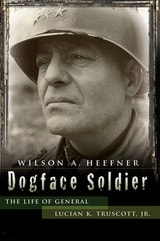
Dogface Soldier
The Life of General Lucian K. Truscott, Jr.Wilson A. Heefner
University of Missouri Press, 2026
Yet no definitive history of his life has been compiled. Wilson Heefner corrects that with the first authoritative biography of this distinguished American military leader. Heefner has undertaken impressive research in primary sources—as well as interviews with family members and former associates—to shed new light on this overlooked hero. He presents Truscott as a soldier who was shaped by his upbringing, civilian and military education, family life, friendships, and evolving experiences as a commander both in and out of combat.
Heefner’s brisk narrative explores Truscott’s career through his three decades in the Army and defines his roles in key operations. It also examines Truscott’s postwar role as military governor of Bavaria, particularly in improving living conditions for Jewish displaced persons, removing Nazis from civil government, and assisting in the trials of German war criminals. And it offers the first comprehensive examination of his subsequent career in the Central Intelligence Agency, where he served as senior CIA representative in West Germany during the early days of the Cold War, and later as CIA Director Allen Dulles’s deputy director for coordination in Washington.
Dogface Soldier is a portrait of a man who earned a reputation for being honest, forthright, fearless, and aggressive, both as a military officer and in his personal life—a man who, at the dedication ceremony for the Anzio-Nettuno American cemetery in 1945, turned away from the crowd and to the thousands of crosses stretching before him to address those buried there. Heefner has written a definitive biography of a great soldier and patriot.
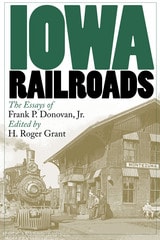
Iowa Railroads
The Essays of Frank P. Donovan, Jr.H. Roger Grant
University of Iowa Press, 2000
What began as a study of the Minneapolis & St. Louis Railway stretched into more than a dozen contributions on Hawkeye state railroad topics. By 1969 Donovan had examined Iowa's “Little Three”: Chicago Great Western, Illinois Central, and Minneapolis & St. Paul as well as the state's “Big Four”: Chicago & North Western; Chicago, Burlington & Quincy; Chicago, Milwaukee, St. Paul & Pacific; and Chicago, Rock Island & Pacific. In addition to these seven core carriers, Donovan covered the state's less prominent railroads: Atchison, Topeka & Santa Fe; Great Northern; and Union Pacific and Wabash. Moreover, he contributed an issue on Iowa's principal interurbans, most of which survived into the 1950s as electric-powered freight-only short lines. In uniting Donovan's articles into a single volume, Iowa Railroads provides the most complete history of Iowa's rail heritage.

Rare Integrity
A Portrait of L. W. Payne, Jr.Hansen Alexander
University of North Texas Press, 1986
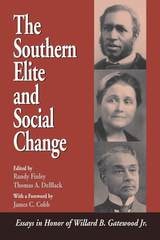
The Southern Elite and Social Change
Essays in Honor of Willard B. Gatewood, Jr.Randy Finley
University of Arkansas Press, 2002
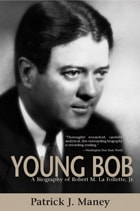
Young Bob
A Biography of Robert M. La Follette, Jr.Patrick J. Maney
Wisconsin Historical Society Press, 2002
United States senator "Young Bob" La Follette entered politics as a young reformer in the shadow of his legendary father, "Fighting Bob" La Follette. He made his own mark as a key architect of Roosevelt’s New Deal and as a champion of labor rights and civil liberties. But in 1946 he was unexpectedly unseated by Joseph McCarthy, whose rise to Cold War notoriety foreshadowed La Follette’s despair and suicide in 1953. This new edition updates the only full scale biography of La Follette,Jr., the first to exploit his voluminous collection of personal papers. Patrick J. Maney makes clear that Young Bob’s story is as relevant today as it was when he died. His life stands as dramatic evidence of how one of the most respected politicians of his time bridged the political spectrum and was admired by both liberals like FDR and Harry Truman and conservatives like Robert Taft and Richard Nixon.