Results by title
5 books match the query 'Jr .'
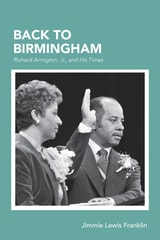
Back To Birmingham
Richard Arrington, Jr., and His TimesJimmie Lewis Franklin
University of Alabama Press, 1989
During the 1960s, Birmingham, Alabama was the central battleground in the struggle for human rights in the American South. As one of the most segregated cities in the United States, the city of Birmingham became infamous for its suppression of civil rights and for official and vigilante violence against its African American citizens, most notoriously the use of explosives in the Sixteenth Street Baptist Church bombing and the bombing of the home of Reverend Fred Shuttlesworth.
In October of 1979, Birmingham elected its first Black mayor, Richard Arrington Jr. He was born in the rural town of Livingston, Alabama. His family moved to Birmingham when he was a child. A man of quiet demeanor, he was nevertheless destined to bring to fruition many of the fundamental changes that the Civil Rights Movement had demanded. This is his story. Not a conventional political or Civil Rights history, Back to Birmingham is the story of a man who demonstrated faith in his region and people. The work illuminates Arrington's sense of place, a quality that enables a person to claim sentimentally a portion of the natural and human environment. Franklin passionately underscores the importance of the attachment of Southern Blacks to their land and place.
Back to Birmingham will appeal to both the general reader and the serious student of American society. The book endeavors to bridge the gap between popular and scholarly history. It is guided by the assumption that Americans of whatever description can find satisfaction in comprehending social change and that they are buoyed by the individual triumph of those who beat the odds.

Dirty Eddie's War
Based on the World War II Diary of Harry "Dirty Eddie" March, Jr.Lee Cook
University of North Texas Press, 2021
Indians and Anthropologists
Vine Deloria, Jr., and the Critique of AnthropologyThomas Biolsi
University of Arizona Press, 1997
CONTENTS
Introduction: What's Changed, What Hasn't, Thomas Biolsi & Larry J. Zimmerman
Part One--Deloria Writes Back
Vine Deloria, Jr., in American Historiography, Herbert T. Hoover
Growing Up on Deloria: The Impact of His Work on a New Generation of Anthropologists, Elizabeth S. Grobsmith
Educating an Anthro: The Influence of Vine Deloria, Jr., Murray L. Wax
Part Two--Archaeology and American Indians
Why Have Archaeologists Thought That the Real Indians Were Dead and What Can We Do about It?, Randall H. McGuire
Anthropology and Responses to the Reburial Issue, Larry J. Zimmerman
Part Three-Ethnography and Colonialism
Here Come the Anthros, Cecil King
Beyond Ethics: Science, Friendship and Privacy, Marilyn Bentz
The Anthropological Construction of Indians: Haviland Scudder Mekeel and the Search for the Primitive in Lakota Country, Thomas Biolsi
Informant as Critic: Conducting Research on a Dispute between Iroquoianist Scholars and Traditional Iroquois, Gail Landsman
The End of Anthropology (at Hopi)?, Peter Whiteley
Conclusion: Anthros, Indians and Planetary Reality, Vine Deloria, Jr.
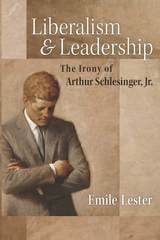
Liberalism and Leadership
The Irony of Arthur Schlesinger, Jr.Emile Lester
University of Michigan Press, 2019
Most scholars and pundits today view Franklin Delano Roosevelt and John F. Kennedy as aggressive liberal leaders, while viewing Schlesinger’s famous histories of their presidencies as celebrations of their steadfast progressive leadership. A more careful reading of Schlesinger’s work demonstrates that he preferred an ironic political outlook emphasizing the virtues of restraint, patience, and discipline. For Schlesinger, Roosevelt and Kennedy were liberal heroes and models as much because they respected the constraints on their power and ideals as because they tested traditional institutions and redefined the boundaries of presidential power.
Aggressive liberalism involves the use of inspirational rhetoric and cunning political tactics to expand civil liberties and insure economic equality. Schlesinger’s emphasis on the crucial role that irony has played and should play in liberalism poses a challenge to the aggressive liberalism advocated by liberal activists, political thinkers, and pundits. That his counsel was grounded in conservative insights as well as liberal values makes it accessible to leaders across the political spectrum.
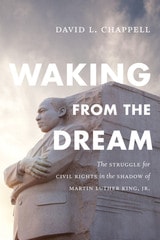
Waking from the Dream
The Struggle for Civil Rights in the Shadow of Martin Luther King, Jr.David L. Chappell
Duke University Press, 2016