Results by title
3 books match the query 'Judaea (Region)'
The Last Century in the History of Judah
The Seventh Century BCE in Archaeological, Historical, and Biblical PerspectivesFilip Čapek
SBL Press, 2019
An incomparable interdisciplinary study of the history of Judah
Experts from a variety of disciplines examine the history of Judah during the seventh century BCE, the last century of the kingdom’s existence. This important era is well defined historically and archaeologically beginning with the destruction layers left behind by Sennacherib’s Assyrian campaign (701 BCE) and ending with levels of destruction resulting from Nebuchadnezzar’s Babylonian campaign (588-586 BCE). Eleven essays develop the current ongoing discussion about Judah during this period and extend the debate to include further important insights in the fields of archaeology, history, cult, and the interpretation of Old Testament texts.
Features
- A new chronological frame for the Iron Age IIB-IIC
- Close examinations of archaeology, texts, and traditions related to the reigns of Hezekiah, Manasseh, and Josiah
- An evaluation of the religious, cultic, and political landscape < /UL>
The Middle Maccabees
Archaeology, History, and the Rise of the Hasmonean KingdomAndrea M. Berlin
SBL Press, 2021
A focused, interdisciplinary examination of a tumultuous, history-making era
The Middle Maccabees lays out the charged, complicated beginnings of the independent Jewish state founded in the second century BCE. Contributors offer focused analyses of the archaeological, epigraphic, numismatic, and textual evidence, framed within a wider world of conflicts between the Ptolemies of Egypt, the Seleucids of Syria, and the Romans. The result is a holistic view of the Hasmonean rise to power that acknowledges broader political developments, evolving social responses, and the particularities of local history. Contributors include Uzi ‘Ad, Donald T. Ariel, Andrea M. Berlin, Efrat Bocher, Altay Coşkun, Benedikt Eckhardt, Gerald Finkielsztejn, Christelle Fischer-Bovet, Yuval Gadot, Erich Gruen, Sylvie Honigman, Jutta Jokiranta, Paul J. Kosmin, Uzi Leibner, Catharine Lorber, Duncan E. MacRae, Dvir Raviv, Helena Roth, Débora Sandhaus, Yiftah Shalev, Nitsan Shalom, Danny Syon, Yehiel Zelinger, and Ayala Zilberstein.
Features
- Up-to-date, generously illustrated essays analyzing the relevant archaeological remains
- A revised understanding of how local and imperial histories overlapped and intersected
- New analysis of the book of 1 Maccabees as a tool of Hasmonean strategic interest
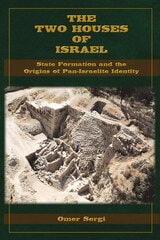
The Two Houses of Israel
State Formation and the Origins of Pan-Israelite IdentityOmer Sergi
SBL Press, 2023
The Two Houses of Israel: State Formation and the Origins of Pan-Israelite Identity bridges the gap between the biblical narrative of the great united monarchy ruled by David and Solomon and archaeological and historical reconstructions of a gradual, independent formation of Israel and Judah. Based on a thorough examination of the material remains and settlement patterns in the southern Levant during the Late Bronze Age and the Iron Age and on a review of the relevant historical sources, this book provides a detailed reconstruction of the ways in which Israel and Judah were formed as territorial polities and specifically how the house of David rose to power in Jerusalem and Judah. Omer Sergi further situates the stories of Saul and David in their accurate social and historical context in order to illuminate the historical conception of the united monarchy and the pan-Israelite ideology out of which it grew. Sergi provides a new history of the early Israelite monarchies, their formation, and the ways in which these social and political developments were commemorated in the cultural memory of generations to come.