Results by title

5 books match the query 'Judaism and philosophy'
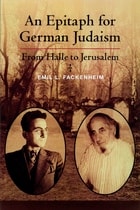
cover of An Epitaph for German Judaism: From Halle to Jerusalem

An Epitaph for German Judaism

From Halle to Jerusalem

Emil Fackenheim

University of Wisconsin Press, 2007

     Emil Fackenheim’s life work was to call upon the world at large—and on philosophers, Christians, Jews, and Germans in particular—to confront the Holocaust as an unprecedented assault on the Jewish people, Judaism, and all humanity. In this memoir, to which he was making final revisions at the time of his death, Fackenheim looks back on his life, at the profound and painful circumstances that shaped him as a philosopher and a committed Jewish thinker.
     Interned for three months in the Sachsenhausen concentration camp after Kristallnacht, Fackenheim was released and escaped to Scotland and then to Canada, where he lived in a refugee internment camp before eventually becoming a congregational rabbi and then, for thirty-five years, a professor of philosophy. He recalls here what it meant to be a German Jew in North America, the desperate need to respond to the crisis in Europe and to cope with its overwhelming implications for Jewish identity and community. His second great turning point came in 1967, as he saw Jews threatened with another Holocaust, this time in Israel. This crisis led him on a pilgrimage to Jerusalem and ultimately back to Germany, where he continued to grapple with the question, How can the Jewish faith—and the Christian faith—exist after the Holocaust?


“An ‘epoch-making’ autobiography.”—Arnold Ages, Jewish Tribune

 
[more]
cover of Hasidism on the Margin: Reconciliation, Antinomianism, and Messianism

Hasidism on the Margin

Reconciliation, Antinomianism, and Messianism

Shaul Magid

University of Wisconsin Press, 2003

Hasidism on the Margin explores one of the most provocative and radical traditions of Hasidic thought, the school of Izbica and Radzin that Rabbi Gershon Henokh originated in nineteenth-century Poland. Shaul Magid traces the intellectual history of this strand of Judaism from medieval Jewish philosophy through centuries of Kabbalistic texts to the nineteenth century and into the present. He contextualizes the Hasidism of Izbica-Radzin in the larger philosophy and history of religions and provides a model for inquiry into other forms of Hasidism.

[more]
cover of Jewish Philosophical Politics in Germany, 1789–1848

Jewish Philosophical Politics in Germany, 1789–1848

Sven-Erik Rose

Brandeis University Press, 2014

In this book Rose illuminates the extraordinary creativity of Jewish intellectuals as they reevaluated Judaism with the tools of a German philosophical tradition fast emerging as central to modern intellectual life. While previous work emphasizes the “subversive” dimensions of German-Jewish thought or the “inner antisemitism” of the German philosophical tradition, Rose shows convincingly the tremendous resources German philosophy offered contemporary Jews for thinking about the place of Jews in the wider polity. Offering a fundamental reevaluation of seminal figures and key texts, Rose emphasizes the productive encounter between Jewish intellectuals and German philosophy. He brings to light both the complexity and the ambivalence of reflecting on Jewish identity and politics from within a German tradition that invested tremendous faith in the political efficacy of philosophical thought itself.
[more]
cover of Persecution and the Art of Writing

Persecution and the Art of Writing

Leo Strauss

University of Chicago Press, 1988
The essays collected in Persecution and the Art of Writing all deal with one problem—the relation between philosophy and politics. Here, Strauss sets forth the thesis that many philosophers, especially political philosophers, have reacted to the threat of persecution by disguising their most controversial and heterodox ideas.
[more]
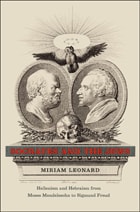
cover of Socrates and the Jews: Hellenism and Hebraism from Moses Mendelssohn to Sigmund Freud

Socrates and the Jews

Hellenism and Hebraism from Moses Mendelssohn to Sigmund Freud

Miriam Leonard

University of Chicago Press, 2012

"What has Athens to do with Jerusalem?” Asked by the early Christian Tertullian, the question was vigorously debated in the nineteenth century. While classics dominated the intellectual life of Europe, Christianity still prevailed and conflicts raged between the religious and the secular. Taking on the question of how the glories of the classical world could be reconciled with the Bible, Socrates and the Jews explains how Judaism played a vital role in defining modern philhellenism.

Exploring the tension between Hebraism and Hellenism, Miriam Leonard gracefully probes the philosophical tradition behind the development of classical philology and considers how the conflict became a preoccupation for the leading thinkers of modernity, including Matthew Arnold, Moses Mendelssohn, Kant, Marx, Nietzsche, and Freud. For each, she shows how the contrast between classical and biblical traditions is central to writings about rationalism, political subjectivity, and progress. Illustrating how the encounter between Athens and Jerusalem became a lightning rod for intellectual concerns, this book is a sophisticated addition to the history of ideas.
[more]