Results by title
3 books match the query 'Judaism and politics'

Jewish Legal Theories
Writings on State, Religion, and MoralityEdited by Leora Batnitzky and Yonatan Brafman
Brandeis University Press, 2018
Contemporary arguments about Jewish law uniquely reflect both the story of Jewish modernity and a crucial premise of modern conceptions of law generally: the claim of autonomy for the intellectual subject and practical sphere of the law. Jewish Legal Theories collects representative modern Jewish writings on law and provides short commentaries and annotations on these writings that situate them within Jewish thought and history, as well as within modern legal theory. The topics addressed by these documents include Jewish legal theory from the modern nation-state to its adumbration in the forms of Orthodox, Conservative, and Reform Judaism in the German-Jewish context; the development of Jewish legal philosophy in Eastern Europe beginning in the eighteenth century; Ultra-Orthodox views of Jewish law premised on the rejection of the modern nation-state; the role of Jewish law in Israel; and contemporary feminist legal theory.
[more]
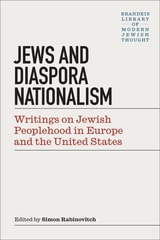
Jews and Diaspora Nationalism
Writings on Jewish Peoplehood in Europe and the United StatesEdited by Simon Rabinovitch
Brandeis University Press, 2012
The question of how to preserve, construct or transform Jewish peoplehood consumed Jewish intellectuals in the late nineteenth and early twentieth centuries. Despite a rich array of writing from Jewish nationalists, liberals, and socialists about the vitality of Jewish existence in the diaspora, the key works have never been collected in a single volume, and few reliable English translations exist. This anthology brings together a variety of thinkers who offered competing visions of peoplehood within the established and developing Jewish diaspora centers of Europe and America. Writing in Russian, Yiddish, Hebrew, French, and English, these Jewish intellectuals sought to recast Jewish existence, whether within multiethnic empires, liberal democracies, or socialist forms of government, in national terms. Volume editor Simon Rabinovitch provides an introductory essay, as well as short introductions and annotations to each document that contextualize and make accessible this wealth of primary sources for scholars and students.
[more]

The Correspondence of Hannah Arendt and Gershom Scholem
Hannah Arendt and Gershom Scholem
University of Chicago Press, 2017
Few people thought as deeply or incisively about Germany, Jewish identity, and the Holocaust as Hannah Arendt and Gershom Scholem. And, as this landmark volume reveals, much of that thinking was developed in dialogue, through more than two decades of correspondence.
Arendt and Scholem met in 1932 in Berlin and quickly bonded over their mutual admiration for and friendship with Walter Benjamin. They began exchanging letters in 1939, and their lively correspondence continued until 1963, when Scholem’s vehement disagreement with Arendt’s Eichmann in Jerusalem led to a rupture that would last until Arendt’s death a dozen years later. The years of their friendship, however, yielded a remarkably rich bounty of letters: together, they try to come to terms with being both German and Jewish, the place and legacy of Germany before and after the Holocaust, the question of what it means to be Jewish in a post-Holocaust world, and more. Walter Benjamin is a constant presence, as his life and tragic death are emblematic of the very questions that preoccupied the pair. Like any collection of letters, however, the book also has its share of lighter moments: accounts of travels, gossipy dinner parties, and the quotidian details that make up life even in the shadow of war and loss.
In a world that continues to struggle with questions of nationalism, identity, and difference, Arendt and Scholem remain crucial thinkers. This volume offers us a way to see them, and the development of their thought, anew.
[more]