Results by title
5 books match the query 'Judge'
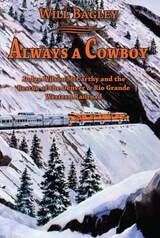
Always a Cowboy
Judge Wilson McCarthy and the Rescue of the Denver & Rio Grande Western RailroadWill Bagley
Utah State University Press, 2008
Cowboy, judge, federal official, then business executive, Wilson McCarthy mirrored change and growth in the twentieth-century West. Leading the Denver & Rio Grande back from the brink saved a vital link in the national transportation system. The D&RGW ran over and through the scenic Rockies, developing mineral resources, fighting corporate wars, and helping build communities. The Depression brought it to its knees. Accepting federal assignment to save the line, McCarthy turned it into a paragon of mid-century railroading, represented by the streamlined, Vista-Domed California Zephyr, although success hauling freight was of more economic importance. Prior to that, McCarthy’s life had taken him from driving livestock in Canada to trying to drive the national economy as a director of the Reconstruction Finance Corporation, the first line of federal attack on the Depression. Always a Cowboy positions McCarthy’s story in a rich historical panorama..
Will Bagley is the author of Blood of the Prophets: Brigham Young and the Massacre at Mountain Meadows
Judge and Jury in Imperial Brazil, 1808–1871
Social Control and Political Stability in the New StateBy Thomas Flory
University of Texas Press, 1981
In nineteenth-century Brazil the power of the courts rivaled that of the central government, bringing to it during its first half century of independence a stability unique in Latin America. Thomas Flory analyzes the Brazilian lower-court system, where the private interests of society and the public interests of the state intersected.
Justices of the peace—lay judges elected at the parish level—played a special role in the early years of independence, for the post represented the triumph of Brazilian liberalism’s commitment to localism and decentralization. However, as Flory shows by tracing the social history and performance of parish judges, the institution actually intensified conflict within parishes to the point of destabilizing the local regime and proved to be so independent of national interests that it all but destroyed the state.
By the 1840s the powers of the office were passed to state appointees, particularly the district judges. Flory recognizes these professional magistrates as a new elite who served as brokers between the state and the poorly articulated landowner elite, and his account of their rise reveals the mechanisms of state integration.
In focusing on the judiciary, Flory has isolated a crucial aspect of Brazil’s early history, one with broad implications for the study of nineteenth-century Latin America as a whole. He combines social, intellectual, and political perspectives—as well as national-level discussion with scrutiny of parish-level implementation—and so makes sense of a complicated, little-studied period. The study clearly shows the progression of Brazilian social thought from a serene liberal faith in the people as a nation to an abiding, very modern distrust of that nation as a threat to the state.

Rousseau, Judge of Jean-Jacques
DialoguesJean-Jacques Rousseau
Dartmouth College Press, 2012

The Inspector Barlach Mysteries
The Judge and His Hangman and SuspicionFriedrich Dürrenmatt
University of Chicago Press, 2006
The Role of the Judge in International Trade Regulation
Experience and Lessons for the WTOThomas Cottier and Petros C. Mavroidis, Editors
University of Michigan Press, 2003
The book develops along three lines: the first a search for cases submitted to the WTO where the judge exceeded its authority; the second a comparison of the WTO with the operations of national judicial systems having different levels of integration, specifically the United States (federal level) and the EC (quasi-federal level); and the third an exploration of directions for the future of dispute settlement in the WTO.
Reflecting the diversity of its contributors, this book addresses questions of economics, political science, and law, bringing an unusual level of multidisciplinarity to this topic and context. It is designed for both academic readers and practitioners, who will find it full of practical insights as well as rich and detailed analysis.
Thomas Cottier is Professor of European and International Economic Law, University of Bern, and Managing Director, World Trade Institute, University of Bern.
Petros C. Mavroidis is Professor of Law, University of Neuchâtel. He formerly worked in the Legal Affairs Division of the World Trade Organization.
Patrick Blatter is Mavroidiss scientific collaborator.