Results by title
31 books match the query 'Judicial Power'
2011 Supplement to The American Indian Law Deskbook
CWAG Conference of Western Attorneys General
University Press of Colorado, 2011
The 2011 Supplement reviews cases issued, as well as statutes and administrative rules adopted, from July 2010 through June 2011. It additionally covers law review articles published between spring 2010 and spring 2011.
A Supreme Court Unlike Any Other
The Deepening Divide Between the Justices and the PeopleKevin J. McMahon
University of Chicago Press, 2024
A data-rich examination of the US Supreme Court's unprecedented detachment from the democratic processes that buttress its legitimacy.
Today’s Supreme Court is unlike any other in American history. This is not just because of its jurisprudence but also because the current Court has a tenuous relationship with the democratic processes that help establish its authority. Historically, this “democracy gap” was not nearly as severe as it is today. Simply put, past Supreme Courts were constructed in a fashion far more in line with the promise of democracy—that the people decide and the majority rules.
Drawing on historical and contemporary data alongside a deep knowledge of court battles during presidencies ranging from FDR to Donald Trump, Kevin J. McMahon charts the developments that brought us here. McMahon offers insight into the altered politics of nominating and confirming justices, the shifting pool of Supreme Court hopefuls, and the increased salience of the Court in elections. A Supreme Court Unlike Any Other is an eye-opening account of today’s Court within the context of US history and the broader structure of contemporary politics.
A Supreme Court Unlike Any Other
The Deepening Divide Between the Justices and the PeopleKevin J. McMahon
University of Chicago Press, 2024
This is an auto-narrated audiobook version of this book.
A data-rich examination of the US Supreme Court's unprecedented detachment from the democratic processes that buttress its legitimacy.
Today’s Supreme Court is unlike any other in American history. This is not just because of its jurisprudence but also because the current Court has a tenuous relationship with the democratic processes that help establish its authority. Historically, this “democracy gap” was not nearly as severe as it is today. Simply put, past Supreme Courts were constructed in a fashion far more in line with the promise of democracy—that the people decide and the majority rules.
Drawing on historical and contemporary data alongside a deep knowledge of court battles during presidencies ranging from FDR to Donald Trump, Kevin J. McMahon charts the developments that brought us here. McMahon offers insight into the altered politics of nominating and confirming justices, the shifting pool of Supreme Court hopefuls, and the increased salience of the Court in elections. A Supreme Court Unlike Any Other is an eye-opening account of today’s Court within the context of US history and the broader structure of contemporary politics.
Administering Justice
Placing the Chief Justice in American State PoliticsRichard L. Vining Jr. and Teena Wilhelm
University of Michigan Press, 2023
Administering Justice examines the leadership role of chief justices in the American states, including how those duties require chief justices to be part of the broader state political environment. Vining and Wilhelm focus extensively on the power of chief justices as public spokespersons, legislative liaisons, and reform leaders. In contrast to much existing research on chief justices in the states, this study weighs their extrajudicial responsibilities rather than intracourt leadership. By assessing the content of State of the Judiciary remarks delivered over a period of sixty years, Vining and Wilhelm are able to analyze the reform agendas advanced by chief justices and determine what factors influence the likelihood of success. These analyses confirm that chief justices engage with state politics in meaningful ways and that reactions to their proposals are influenced by ideological congruence with other political elites and the scope of their requests. Administering Justice also examines the chief justice position as an institution, provides a collective profile of its occupants, and surveys growing diversity among court leaders.
American Indian Law Deskbook, Fourth Edition
Conference of Western Attorneys General Conference of Western Attorneys General
University Press of Colorado, 2008
Included are:
-The evolution of federal statutory Indian law and the judicial foundations of federal Indian policy.
-An extensive compilation and analysis of federal and state court decisions.
- Reservation and Indian lands ownership and property interests.
-The parameters of criminal jurisdiction in Indian country.
-Concepts of tribal sovereignty and jurisdiction relating to a number of specific areas, including tribal courts, hunting and fishing, environmental regulation, water rights, gaming, and child welfare.
-Cooperative approaches used by the states and tribes for resolving jurisdictional disputes and promoting better relations.
Thorough, scholarly, and balanced, the American Indian Law Deskbook, Fourth Edition is an invaluable reference for a wide range of people working with Indian tribes, including attorneys, legal scholars, government officials, social workers, state and tribal jurists, and historians. This revised edition includes information from more recent court decisions, federal statutes, administrative regulations, and law reviews.

Bioethics in the Courts
Analyszing the Bioethical Jurisprudence of International and National CourtsJudit Sandor
Central European University Press, 2027
Brandishing the First Amendment
Commercial Expression in AmericaTamara R. Piety
University of Michigan Press, 2013
Over the past two decades, corporations and other commercial entities have used strategic litigation to win more expansive First Amendment protections for commercial speech—from the regulation of advertising to the role corporate interests play in the political process, most recently debated in the Supreme Court case of Citizens United v. Federal Election Commission. Tamara R. Piety, a nationally known critic of commercial and corporate speech, argues that such an expansion of First Amendment speech rights imperils public health, safety, and welfare; the reliability of commercial and consumer information; the stability of financial markets; and the global environment.
Beginning with an evaluation of commonly evoked philosophical justifications for freedom of expression, Piety determines that, while these are appropriate for the protection of an individual’s rights, they should not be applied too literally to commercial expression because the corporate person is not the moral equivalent of the human person. She then gathers evidence from public relations and marketing, behavioral economics, psychology, and cognitive studies to show how overly permissive extensions of First Amendment protections to commercial expression limit governmental power to address some of the major social, economic, and environmental challenges of our time.
“The timeliness of the topic and the provision of original positions are sure to make the book a valuable contribution that should draw much attention.”
—Kevin W. Saunders, Michigan State University
Choosing State Supreme Court Justices
Merit Selection and the Consequences of Institutional ReformGreg Goelzhauser
Temple University Press, 2016
Since 1940, more than half of all states have switched at least in part from popular election or elite appointment to experiment with merit selection in choosing some or all of their state supreme court justices. Under merit selection, a commission—often comprising some combination of judges, attorneys, and the general public—is tasked with considering applications from candidates vying to fill a judicial vacancy. Ostensibly, the commission forwards the best candidates to the governor, who ultimately appoints them. Presently, numerous states are debating whether to adopt or abolish merit selection.
In his short, sharp book, Choosing State Supreme Court Justices, Greg Goelzhauser utilizes new data on more than 1,500 state supreme court justices seated from 1960 through 2014 to answer the question, Does merit selection produce better types of judges? He traces the rise of merit selection and explores whether certain judicial selection institutions favor candidates who have better qualifications, are more diverse, and have different types of professional experience.
Goelzhauser’s results ultimately contribute to the broader debate concerning comparative institutional performance with respect to state judicial selection.
Fear and the First Amendment
Controversial Cases of the Roberts CourtKevin A. Johnson and Craig R. Smith
University of Alabama Press, 2024
DISTINGUISHED PUBLICATION AWARD FOR THE NATIONAL COMMUNICATION ASSOCIATION'S COMMUNICATION AND LAW DIVISION
The First Amendment: protected by law, threatened by fear in the Roberts Supreme Court.
In Fear and the First Amendment: Controversial Cases of the Roberts Court, Kevin A. Johnson and Craig R. Smith offer a deeply considered examination of the ways fear figures in First Amendment questions. Bringing together literature on theories of fear in rhetorical and philosophical traditions, Johnson and Smith focus on the rulings from the Roberts Court, which form a pivotal era of dramatic precedents. Each chapter analyzes one or more First Amendment cases and a variety of related fears—whether evidentiary or not—that pertain to a given case.
These cases include Morse v. Frederick, which takes up the competing fears of school administrators’ loss of authority and students’ loss of free speech rights. The authors touch on corporate funding of elections in Citizens United v. Federal Elections Commission, from the fear of corporate influence on electoral politics to corporate fears of alienating their consumers by backing political candidates. They explore religious freedom and fears of homosexuality in Christian Legal Society v. Martinez. Similarly, in Snyder v. Phelps, the authors delve further into fears of God, death, emotional distress, failing as a parent, and losing one’s reputation. Next, they investigate parents’ anxieties about violence in video games in Brown v. Entertainment Merchants Association. Finally, Johnson and Smith examine the role of fear in indecent, obscene, and graphic communication in three cases: FCC v. Fox Television Stations, Ashcroft v. American Civil Liberties Union, and United States v. Stevens.
Together these cases reveal fear to be an endemic factor in the rhetoric of First Amendment cases. This fascinating and original work will appeal to current legal practitioners and students of law, rhetoric, philosophy, and the First Amendment.

Fifty-Eight Lonely Men
Southern Federal Judges and School DesegregationJ. W. Peltason
University of Illinois Press, 1971
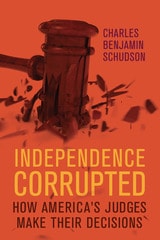
Independence Corrupted
How America's Judges Make Their DecisionsCharles Benjamin Schudson
University of Wisconsin Press, 2018
As political attacks on judges increase, Schudson calls for reforms to protect judicial independence and for vigilance to ensure justice for all. Independence Corrupted is invaluable for students and scholars, lawyers and judges, and all citizens concerned about the future of America's courts.
Inside Appellate Courts
The Impact of Court Organization on Judicial Decision Making in the United States Courts of AppealsJonathan Matthew Cohen
University of Michigan Press, 2002
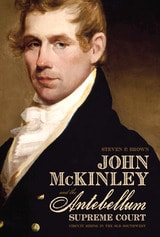
John McKinley and the Antebellum Supreme Court
Circuit Riding in the Old SouthwestSteven P. Brown
University of Alabama Press, 2012
A Southern voice on a national bench—McKinley’s legacy in antebellum law.
John McKinley and the Antebellum Supreme Court offers the first comprehensive biography of Justice John McKinley (1780–1852), a largely forgotten figure in American legal history who played a pivotal role during a formative period of the U.S. Supreme Court. Steven P. Brown rescues McKinley from historical obscurity, presenting a compelling portrait of a man deeply embedded in the political, legal, and financial life of the early 19th-century South.
Born in Kentucky and later settling in northern Alabama, McKinley served in both the U.S. Senate and House of Representatives before being appointed to the Supreme Court by President Martin Van Buren in 1837. His tenure on the bench coincided with the creation of the Ninth Circuit, a vast and challenging judicial territory encompassing Alabama, Arkansas, Louisiana, and Mississippi. Brown details McKinley’s arduous circuit-riding duties, which required extensive travel and exposed him to the legal complexities of a rapidly expanding frontier.
More than a biography, the book provides a penetrating analysis of antebellum legal culture, Alabama state politics, and the internal workings of the Supreme Court during a time of national transformation. Brown challenges the prevailing view of McKinley as a mediocre jurist, arguing instead that his contributions—particularly his dissents defending states’ rights—deserve renewed scholarly attention. With rich historical context and meticulous research, John McKinley and the Antebellum Supreme Court sheds light on the burdens of justice in a divided nation and the legacy of a justice whose career mirrored the tensions of his time.
Judicial Merit Selection
Institutional Design and Performance for State CourtsGreg Goelzhauser
Temple University Press, 2019
The judicial selection debate continues. Merit selection is used by a majority of states but remains the least well understood method for choosing judges. Proponents claim that it emphasizes qualifications and diversity over politics, but there is little empirical evidence regarding its performance.
In Judicial Merit Selection, Greg Goelzhauser amasses a wealth of data to examine merit selection’s institutional performance from an internal perspective. While his previous book, Choosing State Supreme Court Justices, compares outcomes across selection mechanisms, here he delves into what makes merit selection unique—its use of nominating commissions to winnow applicants prior to gubernatorial appointment.
Goelzhauser’s analyses include a rich case study from inside a nominating commission’s proceedings as it works to choose nominees; the use of public records to examine which applicants commissions choose and which nominees governors choose; evaluation of which attorneys apply for consideration and which judges apply for promotion; and examination of whether design differences across systems impact performance in the seating of qualified and diverse judges.
The results have critical public policy implications.
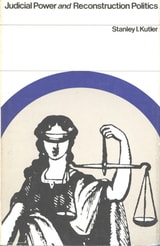
Judicial Power and Reconstruction Politics
Stanley I. Kutler
University of Chicago Press, 1968
This book investigates the political and public standing of the Supreme Court following the Dred Scott decision. Arguing against interpretations by previous historians, Kutler asserts instead that the "Chase Court" was neither enfeebled by the decision itself, nor by congressional Republicans during reconstruction. Instead, Kutler suggests that during reconstruction, the Court was characterized by forcefulness and judicious restraint rather than timidity and cowardice, holding a creative and determining role rather than abdicating its rightful powers. This volume assembles a series of essays by Kutler arguing for this characterization. Provocative and persuasive at turns, this collection of essays provides a bold and innovative reinterpretation of the Supreme Court after the Civil War.
Judicial Rhapsodies
Rhetoric and Fundamental Rights in the Supreme CourtDoug Coulson
Amherst College Press, 2023
First examining the classical origins of divisions between law and rhetoric, Coulson tracks what he calls an epideictic register—highly affective forms of expression that utilize hyperbole, amplification, and vocabularies of praise—through a surprising number of landmark Supreme Court opinions. Judicial Rhapsodies recovers and revalues these instances as significant to establishing and maintaining shared perspectives that form the basis for common experience and cooperation.
“Judicial Rhapsodies is both compelling and important. Coulson brings his well-developed knowledge of rhetoric to bear on one of the most central (and most democratically fraught) means of governance in the United States: the Supreme Court opinion. He demonstrates that the epideictic, far from being a dispensable or detestable element of judicial rhetoric, is an essential feature of how the Court operates and seeks to persuade.” —Keith Bybee, Syracuse University
Judicial Territory
Law, Capital, and the Expansion of American EmpireShaina Potts
Duke University Press, 2024
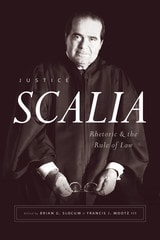
Justice Scalia
Rhetoric and the Rule of LawEdited by Brian G. Slocum and Francis J. Mootz III
University of Chicago Press, 2019
In this edited collection, leading scholars from law, political science, philosophy, rhetoric, and linguistics look at the ways Scalia framed and stated his arguments. Focusing on rhetorical strategies rather than the logic or validity of Scalia’s legal arguments, the contributors collectively reveal that Scalia enacted his rigidly conservative vision of the law through his rhetorical framing.
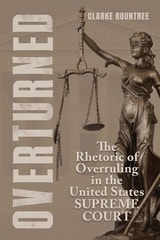
Overturned
The Rhetoric of Overruling in the United States Supreme CourtClarke Rountree
University of Alabama Press, 2025
A timely and lively summary and analysis of the Supreme Court’s justifications for overruling nearly 300 prior rulings in its history
An audacious US Supreme Court is overturning a number of long-standing precedents, and Overturned offers a lively account of the court’s history of overturning prior cases and examples and analyses of 300 cases overruled in its history.
The immense controversy surrounding the case of Dobbs v. Jackson Women’s Health Organization in 2022, which overruled Roe v. Wade and erased the constitutional right to abortion in the United States, has focused public attention on how and why the Supreme Court knocks down long-established precedents.
In his vivid and accessible style, scholar Clarke Rountree recounts the rhetorical pirouettes and linguistic acrobatics the court has deployed to explain its reversal of Dobbs and numerous other landmark decisions. He reviews strategies the court uses to undermine a previous court’s standing without undermining its own. He analyzes overrulings across time, by type (constitutional cases versus statutory and common law cases), by the ages of the overturned precedents, with changes in the court’s membership, and through other variables.
Rountree gives engrossing accounts of pivotal overrulings in the past, such as when Lincoln’s Treasury Secretary Salmon Chase used the Legal Tender Act in 1862 to raise money for the Civil War then ruled the same law unconstitutional in 1870 when he served as chief justice. Rountree retells Thomas Edison’s attempt to monopolize the burgeoning film industry, which was stopped only when the Supreme Court overturned an earlier patent-rights case in 1917. Finally, Rountree applies his myriad insights to the politically fraught Dobbs case.
Overturned makes a valuable contribution to law, rhetoric, politics, and history, and readers interested in the role and function of America’s highest court will find Rountree’s account fast-paced, lively, and engaging.
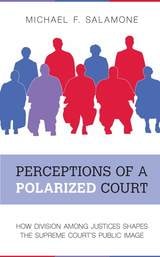
Perceptions of a Polarized Court
How Division among Justices Shapes the Supreme Court's Public ImageMichael F. Salamone
Temple University Press, 2018
Like our divided nation, the Supreme Court is polarized. But does a split among Supreme Court justices—particularly when it occurs along ideological lines—hurt public perception and the Court’s ability to muster popular support for its rulings? Michael Salamone’s Perceptions of a Polarized Court offers the first comprehensive, empirical analysis of how divisiveness affects the legitimacy of the Court’s decisions.
Salamone looks specifically at the Roberts Court years—which are characterized by unprecedented ideological and partisan polarization among the justices—to evaluate the public consequences of divided Supreme Court rulings. He also analyzes both the media’s treatment of Supreme Court decisions and public opinion toward the Court’s rulings to show how public acceptance is (or is not) affected.
Salmone contends that judicial polarization has had an impact on the manner in which journalists report on the Supreme Court. However, contrary to expectation, Court dissent may help secure public support by tapping into core democratic values.
The Cloaking of Power
Montesquieu, Blackstone, and the Rise of Judicial ActivismPaul O. Carrese
University of Chicago Press, 2003
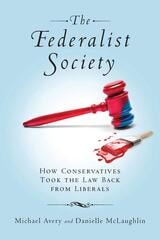
The Federalist Society
How Conservatives Took the Law Back from LiberalsMichael Avery
Vanderbilt University Press, 2013
Today the Society claims that 45,000 conservative lawyers and law students are involved in its activities. Four Supreme Court Justices--Antonin Scalia, Clarence Thomas, John Roberts, and Samuel Alito--are current or former members. Every single federal judge appointed in the two Bush presidencies was either a Society member or approved by members. During the Bush years, young Federalist Society lawyers dominated the legal staffs of the Justice Department and other important government agencies.
The Society has lawyer chapters in every major city in the United States and student chapters in every accredited law school. Its membership includes economic conservatives, social conservatives, Christian conservatives, and libertarians, who differ with each other on significant issues, but who cooperate in advancing a broad conservative agenda.
How did this happen? How did this group of conservatives succeed in moving their theories into the mainstream of legal thought?
What is the range of positions of those associated with the Federalist Society in areas of legal and political controversy? The authors survey these stances in separate chapters on
• regulation of business and private property
• race and gender discrimination and affirmative action
• personal sexual autonomy, including abortion and gay rights
• American exceptionalism and international law
The Foundational Role of the United States Supreme Court
Reinforcing Legitimacy Through Internal ReformTessa van Buchem
Central European University Press, 2027
The Foundational Role of the United States Supreme Court
Reinforcing Legitimacy Through Internal ReformTessa van Buchem
Central European University Press, 2027
The Judicial Power of the Purse
How Courts Fund National Defense in Times of CrisisNancy Staudt
University of Chicago Press, 2011
Congress and the president are not the only branches that deal with fiscal issues in times of war. In this innovative book, Nancy Staudt focuses on the role of federal courts in fiscal matters during warfare and high-cost national defense emergencies. There is, she argues, a judicial power of the purse that becomes evident upon examining the budgetary effects of judicial decision making. The book provides substantial evidence that judges are willing—maybe even eager—to redirect private monies into government hands when the country is in peril, but when the judges receive convincing cues that ongoing wartime activities undermine the nation’s interests, they are more likely to withhold funds from the government by deciding cases in favor of private individuals and entities who show up in court.
In stark contrast with conventional legal, political, and institutional thought that privileges factors associated with individual preferences, The Judicial Power of the Purse sheds light on environmental factors in judicial decision making and will be an excellent read for students of judicial behavior in political science and law.
The Pioneers of Judicial Behavior
Nancy Maveety, Editor
University of Michigan Press, 2002
The Power of Judges
David Neuberger and Peter Riddell
Haus Publishing, 2018
In this lucid account of the judiciary, David Neuberger and Peter Riddell lead us through an array of topics both philosophical and logistical, including the relationships between morality and law and between Parliament and the judiciary. They explain the effects of cuts in legal aid and shed light on complex and controversial subjects like assisted dying and the complexities of combating mass terrorism while protecting personal liberty. Given that many of these issues span national borders, the book also compares the United Kingdom’s legal system with its counterparts in the United States and Germany.
Full of insights, The Power of Judges is an informative and accessible account of the United Kingdom’s judicial system, its contribution to running the country, and the challenges it faces—including the many threats to its effectiveness.
The Puzzle of Judicial Behavior
Lawrence Baum
University of Michigan Press, 1997
Understanding the Age of Transitional Justice
Crimes, Courts, Commissions, and ChroniclingAdler, Nanci
Rutgers University Press, 2018
When Courts and Congress Collide
The Struggle for Control of America's Judicial SystemCharles Gardner Geyh
University of Michigan Press, 2009
"This is quite simply the best study of judicial independence that I have ever read; it is erudite, historically aware, and politically astute."
-Malcolm M. Feeley, Claire Sanders Clements Dean's Professor, Boalt Hall School of Law, University of California at Berkeley
"Professor Geyh has written a wise and timely book that is informed by the author's broad and deep experience working with the judicial and legislative branches, by the insights of law, history and political science, and by an appreciation of theory and common sense."
-Stephen B. Burbank, David Berger Professor for the Administration of Justice, University of Pennsylvania Law School
With Congress threatening to "go nuclear" over judicial appointments, and lawmakers accusing judges of being "arrogant, out of control, and unaccountable," many pundits see a dim future for the autonomy of America's courts. But do we really understand the balance between judicial independence and Congress's desire to limit judicial reach? Charles Geyh's When Courts and Congress Collide is the most sweeping study of this question to date, and an unprecedented analysis of the relationship between Congress and our federal courts.
Efforts to check the power of the courts have come and gone throughout American history, from the Jeffersonian Congress's struggle to undo the work of the Federalists, to FDR's campaign to pack the Supreme Court, to the epic Senate battles over the Bork and Thomas nominations. If legislators were solely concerned with curbing the courts, Geyh suggests, they would use direct means, such as impeaching uncooperative judges, gerrymandering their jurisdictions, stripping the bench's oversight powers, or slashing judicial budgets. Yet, while Congress has long been willing to influence judicial decision-making indirectly by blocking the appointments of ideologically unacceptable nominees, it has, with only rare exceptions, resisted employing more direct methods of control. When Courts and Congress Collide is the first work to demonstrate that this balance is governed by a "dynamic equilibrium": a constant give-and-take between Congress's desire to control the judiciary and its respect for historical norms of judicial independence.
It is this dynamic equilibrium, Geyh says, rather than what the Supreme Court or the Constitution says about the separation of powers, that defines the limits of the judiciary's independence. When Courts and Congress Collide is a groundbreaking work, requiring all of us to consider whether we are on the verge of radically disrupting our historic balance of governance.
Charles Gardner Geyh is Professor of Law and Charles L. Whistler Faculty Fellow at Indiana University at Bloomington. He has served as director of the American Judicature Society's Center for Judicial Independence, reporter to the American Bar Association Commission on Separation of Powers and Judicial Independence, and counsel to the Judiciary Committee of the U.S. House of Representatives.