Results by title
4 books match the query 'Judicial discretion'
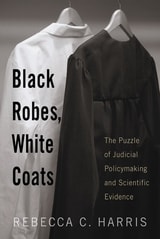
Black Robes, White Coats
The Puzzle of Judicial Policymaking and Scientific EvidenceRebecca C. Harris
Rutgers University Press, 2008
Combining political analysis, scientific reasoning, and an in-depth study of specific state supreme court cases, Black Robes, White Coats is an interdisciplinary examination of the tradition of "gatekeeping," the practice of deciding the admissibility of novel scientific evidence. Rebecca Harris systematically examines judicial policymaking in three areas forensic DNA, polygraphs, and psychological syndrome evidence to answer the question: Why is scientific evidence treated differently among various jurisdictions? These decisions have important implications for evaluating our judicial system and its ability to accurately develop scientific policy.
While the interaction of these professions occurs because the white coats often develop and ascertain knowledge deemed very useful to the black robes, Harris concludes that the black robes are well positioned to render appropriate rulings and determine the acceptability of harnessing a particular science for legal purposes.
First book to systematically gather and analyze judicial decisions on scientific admissibility
Analyzes several key cases including Arizona v. Bible and Kansas v. Marks
Includes examples of evidence in three appendices: forensic DNA, polygraph evidence, and syndrome evidence
Presents an original model of the gatekeeping process
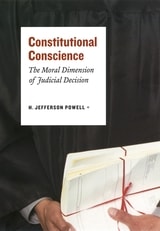
Constitutional Conscience
The Moral Dimension of Judicial DecisionH. Jefferson Powell
University of Chicago Press, 2008
Powell argues that almost every controversial decision has more than one constitutionally defensible resolution. In such cases, he goes on to contend, the language and ideals of the Constitution require judges to decide in good faith, exercising what Powell calls the constitutional virtues: candor, intellectual honesty, humility about the limits of constitutional adjudication, and willingness to admit that they do not have all the answers. Constitutional Conscience concludes that the need for these qualities in judges—as well as lawyers and citizens—is implicit in our constitutional practices, and that without them judicial review would forfeit both its own integrity and the credibility of the courts themselves.
Penchant for Prejudice
Unraveling Bias in Judicial Decision-MakingLinda G. Mills
University of Michigan Press, 1999
Statutes in Court
The History and Theory of Statutory InterpretationWilliam D. Popkin
Duke University Press, 1999
Popkin begins by discussing the British origins of statutory interpretation in this country. He then maps the evolving conceptions of the judicial role in the United States from Revolutionary times through the twentieth century before presenting his “ordinary judging” theory—one that asks the judge to use modest judicial discretion to assist the legislature in implementing good government. Claiming that theory cannot account for everything a judge does when determining statutory meaning or writing an opinion, Popkin shows how judges who strive to be conscientious in interpreting the law are often hampered by the lack of both a framework in which to fit their approach and a well-understood common vocabulary to explain what they do. Statutes in Court fills that gap.
This work will be valuable to anyone concerned about the judicial role in the interpretation of laws—from judiciary officials and law professors to legal historians and political scientists.