Results by title

2 books match the query 'Judicial review of administrative acts'
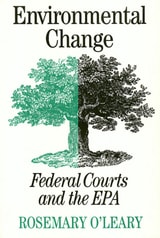
cover of Environmental Change

Environmental Change

Rosemary O'Leary

Temple University Press, 1995

Environmental Change examines the impact of hundreds of federal court decisions on the policies and administration of the EPA since its inception in 1970. Having surveyed over 2,000 federal court decisions, Rosemary O'Leary presents case studies of five important policy areas: water quality, pesticides, toxic substances, air quality, and hazardous wastes.

Compliance with court orders, O'Leary discovered, has become one of the EPA's top priorities, at times overshadowing congressional mandates and the authority of EPA administrators.

For an agency often caught between the White House and Congressional agendas, the competing interests of industry and environmental groups, and turf battles with other federal agencies, O'Leary argues, judicial decision making is crucial in the public policy process.

Environmental Change offers valuable information in the fields of public policy and environmental law.
[more]
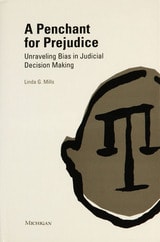
cover of Penchant for Prejudice: Unraveling Bias in Judicial Decision-Making

Penchant for Prejudice

Unraveling Bias in Judicial Decision-Making

Linda G. Mills

University of Michigan Press, 1999

A Penchant for Prejudice combines a detailed empirical study of the decision-making practices of judges with a sophisticated theoretical argument which exposes contemporary myths about judging and suggests methods of incorporating the inevitable bias that is detected in this and other studies. Based on a unique study of the decisions of Social Security judges, the book challenges the meaning of judicial impartiality. Linda G. Mills finds that, in practice, bias is a consistent dimension of what is considered "impartial" decision-making. The results reveal that impartiality as the legal system now defines it, is itself a form of bias, and that a historically and contextually sensitive definition of bias, one which takes account of the communities and cultures that come to be judged in the legal system, must overcome the modern dualistic notion of imparitality as the exclusion of bias in order to respond to needs of the diversity of applicants and the judges who adjudicate their claims. According to Mills, the judicial bias she found reflected in her study seems not only to essentialize and stereotype applicants but also prevents judges from engaging vulnerable claimants in a way that the legal process positively demands. A Penchant for Prejudice will be of interest to students and scholars of law, judicial decisionmaking, and discrimination. Linda G. Mills is Assistant Professor of Social Welfare and Law, University of California, Los Angeles.
[more]