Results by title
4 books match the query 'Jullien, François'
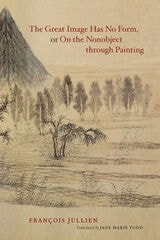
The Great Image Has No Form, or On the Nonobject through Painting
François Jullien
University of Chicago Press, 2009
In premodern China, elite painters used imagery not to mirror the world around them, but to evoke unfathomable experience. Considering their art alongside the philosophical traditions that inform it, The Great Image Has No Form explores the “nonobject”—a notion exemplified by paintings that do not seek to represent observable surroundings.
François Jullien argues that this nonobjectifying approach stems from the painters’ deeply held belief in a continuum of existence, in which art is not distinct from reality. Contrasting this perspective with the Western notion of art as separate from the world it represents, Jullien investigates the theoretical conditions that allow us to apprehend, isolate, and abstract objects. His comparative method lays bare the assumptions of Chinese and European thought, revitalizing the questions of what painting is, where it comes from, and what it does. Provocative and intellectually vigorous, this sweeping inquiry introduces new ways of thinking about the relationship of art to the ideas in which it is rooted.
The Impossible Nude
François Jullien
University of Chicago Press, 2007
The undraped human form is ubiquitous in Western art and even appears in the art of India and Japan. Only in China, François Jullien argues, is the nude completely absent. In this enthralling extended essay, he explores the different conceptions of the human body that underlie this provocative disparity.
Contrasting nakedness (which implies a diminished state) with nudity (which represents a complete presence), Jullien explores the traditional European vision of the nude as a fixed point of fusion where form joins truth. He then shows that the absence of the nude in Chinese art evinces an understanding of the human body as changeable and transitory. Viewed in light of each other, these differing concepts allow for a new way of thinking about form, the ideal, and beauty, enabling us to delve deeper into the relationship between art and the ideas that lie at its roots. Beautifully illustrated and gracefully translated into English for the first time, The Impossible Nude will fascinate anyone interested in art history, Chinese art, or aesthetics.
The Philosophy of Living
François Jullien
Seagull Books, 2015
Living holds us between two places. It expresses what is most elementary—to be alive—and the absoluteness of our aspiration—finally living! But could we desire anything other than to live? In The Philosophy of Living, François Jullien meditates on Far Eastern thought and philosophy to analyze concepts that can be folded into a complete philosophy of living, including the idea of the moment, the ambiguity of the in-between, and what he calls the “transparency of morning.” Jullien here develops a strategy of living that goes beyond morality and dwells in the space between health and spirituality.
This Strange Idea of the Beautiful
François Jullien
Seagull Books, 2016
An exploration of what it means when we say something is beautiful.
Bringing together ideas of beauty from both Eastern and Western philosophy, François Jullien challenges the assumptions underlying our commonly agreed-upon definition of what is beautiful and offers a new way of beholding art. Jullien argues that the Western concept of beauty was established by Greek philosophy and became consequently embedded within the very structure of European languages. And due to its relationship to language, this concept has determined ways of thinking about beauty that often go unnoticed or unchecked in discussions of Western aesthetics. Moreover, through globalization, Western ideals of beauty have even spread to cultures whose ancient traditions are based upon radically different aesthetic foundations; yet, these cultures have adopted such views without question and without recognizing the cultural assumptions they contain.