Results by title

5 books match the query 'Junn, Jane'
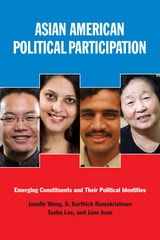
cover of Asian American Political Participation: Emerging Constituents and Their Political Identities

Asian American Political Participation

Emerging Constituents and Their Political Identities

Janelle S. Wong

Russell Sage Foundation, 2012
Asian Americans are a small percentage of the U.S. population, but their numbers are steadily rising—from less than a million in 1960 to more than 15 million today. They are also a remarkably diverse population—representing several ethnicities, religions, and languages—and they enjoy higher levels of education and income than any other U.S. racial group. Historically, socioeconomic status has been a reliable predictor of political behavior. So why has this fast-growing American population, which is doing so well economically, been so little engaged in the U.S. political system? Asian American Political Participation is the most comprehensive study to date of Asian American political behavior, including such key measures as voting, political donations, community organizing, and political protests. The book examines why some groups participate while others do not, why certain civic activities are deemed preferable to others, and why Asian socioeconomic advantage has so far not led to increased political clout. Asian American Political Participation is based on data from the authors’ groundbreaking 2008 National Asian American Survey of more than 5,000 Chinese, Indian, Vietnamese, Korean, Filipino, and Japanese Americans. The book shows that the motivations for and impediments to political participation are as diverse as the Asian American population. For example, native-born Asians have higher rates of political participation than their immigrant counterparts, particularly recent adult arrivals who were socialized outside of the United States. Protest activity is the exception, which tends to be higher among immigrants who maintain connections abroad and who engaged in such activity in their country of origin. Surprisingly, factors such as living in a new immigrant destination or in a city with an Asian American elected official do not seem to motivate political behavior—neither does ethnic group solidarity. Instead, hate crimes and racial victimization are the factors that most motivate Asian Americans to participate politically. Involvement in non-political activities such as civic and religious groups also bolsters political participation. Even among Asian groups, socioeconomic advantage does not necessarily translate into high levels of political participation. Chinese Americans, for example, have significantly higher levels of educational attainment than Japanese Americans, but Japanese Americans are far more likely to vote and make political contributions. And Vietnamese Americans, with the lowest levels of education and income, vote and engage in protest politics more than any other group. Lawmakers tend to favor the interests of groups who actively engage the political system, and groups who do not participate at high levels are likely to suffer political consequences in the future. Asian American Political Participation demonstrates that understanding Asian political behavior today can have significant repercussions for Asian American political influence tomorrow.
[more]
cover of Education and Democratic Citizenship in America

Education and Democratic Citizenship in America

Norman H. Nie, Jane Junn, and Kenneth Stehlik-Barry

University of Chicago Press, 1996

Formal education is crucial for creating enlightened and active citizens. The better educated are more engaged, more knowledgeable, and more politically tolerant. Despite a dramatic increase in education attainment over the last quarter century, political engagement has not risen at a commensurate level. How and why education affects citizenship in these ways has until now been a puzzle.

Norman H. Nie, Jane Junn, and Kenneth Stehlik-Barry provide answers by uncovering the causal relationship between education and democratic citizenship. They argue that citizenship encompasses both political engagement in pursuit of interests and commitment to democratic values that temper what citizens can do to win in politics. Education affects the two dimensions in distinct ways. Especially significant is the influence of education on political engagement through occupational prominence and position in social networks. Formal education orders the distribution of social position and connections and creates an uneven political playing field.
[more]
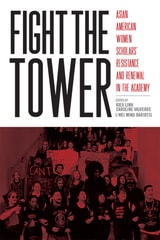
cover of Fight the Tower: Asian American Women Scholars’  Resistance and Renewal in the Academy

Fight the Tower

Asian American Women Scholars’ Resistance and Renewal in the Academy

Kieu Linh Caroline Valverde

Rutgers University Press, 2020

Asian American women scholars experience shockingly low rates of tenure and promotion because of the particular ways they are marginalized by the intersectionalities of race and gender in academia. Although Asian American studies critics have long since debunked the model minority myth that constructs Asian Americans as the ideal academic subject, university administrators still treat Asian American women in academia as though they will simply show up and shut up. Consequently, because silent complicity is expected, power holders will punish and oppress Asian American women severely when they question or critique the system.

However, change is in the air. Fight the Tower is a continuation of the Fight the Tower movement, which supports women standing up for their rights to claim their earned place in academia and to work for positive change for all within academic institutions. The essays provide powerful portraits, reflections, and analyses of a population often rendered invisible by the lies that sustain intersectional injustices in order to operate an oppressive system.
[more]
cover of The Future of American Democratic Politics: Principles and Practices

The Future of American Democratic Politics

Principles and Practices

Pomper, Gerald M

Rutgers University Press, 2003

In this book, fifteen major scholars assess the current state of American democracy, offering a spirited dialogue on the future of democratic politics. Contributors focus on three principles fundamental to democracyequality, liberty, and participation. They examine these principles within the context of the basic institutions of American democracy: Congress and the state legislatures, the president, political parties, interest groups, and the Supreme Court. They raise questions regarding the checks and balances among formal governmental institutions as well as the role of political parties and interest groups.

Topics discussed include the incomplete mobilization of the electorate, the debates over campaign finance reform and term limits, the Supreme Courts activist role in the Florida recount, the dangers of teledemocracy and state initiatives, the separation of political participation from residential location, "identity politics," the clash of "negative" and "positive" liberty, and the prospects for personal freedom in an era of terrorist threats.

This timely collection covers the issues relevant to the future of American democracy today not only for lawmakers, students, and historians, but for any concerned citizen.
[more]
cover of The Politics of Belonging: Race, Public Opinion, and Immigration

The Politics of Belonging

Race, Public Opinion, and Immigration

Natalie Masuoka and Jane Junn

University of Chicago Press, 2013

The United States is once again experiencing a major influx of immigrants. Questions about who should be admitted and what benefits should be afforded to new members of the polity are among the most divisive and controversial contemporary political issues.

Using an impressive array of evidence from national surveys, The Politics of Belonging illuminates patterns of public opinion on immigration and explains why Americans hold the attitudes they do. Rather than simply characterizing Americans as either nativist or nonnativist, this book argues that controversies over immigration policy are best understood as questions over political membership and belonging to the nation. The relationship between citizenship, race, and immigration drive the politics of belonging in the United States and represents a dynamism central to understanding patterns of contemporary public opinion on immigration policy. Beginning with a historical analysis, this book documents why this is the case by tracing the development of immigration and naturalization law, institutional practices, and the formation of the American racial hierarchy. Then, through a comparative analysis of public opinion among white, black, Latino, and Asian Americans, it identifies and tests the critical moderating role of racial categorization and group identity on variation in public opinion on immigration.

[more]