Results by title
9 books match the query 'Just war doctrine'
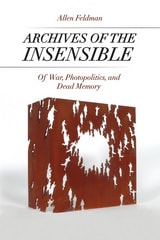
Archives of the Insensible
Of War, Photopolitics, and Dead MemoryAllen Feldman
University of Chicago Press, 2015
Excavating a scenography of trials—formal or covert, orchestrated or improvised, criminalizing or criminal—Feldman shows how the will to truth disappears into the very violence it interrogates. He maps the sensory inscriptions and erasures of war, highlighting war as a media that severs factuality from actuality to render violence just. He proposes that war promotes an anesthesiology that interdicts the witness of a sensory and affective commons that has the capacity to speak truth to war. Feldman uses layered deconstructive description to decelerate the ballistical tempo of war to salvage the embodied actualities and material histories that war reduces to the ashes of collateral damage, the automatism of drones, and the opacities of black sites. The result is a penetrating work that marries critical visual theory, political philosophy, anthropology, and media archeology into a trenchant dissection of emerging forms of sovereignty and state power that war now makes possible.
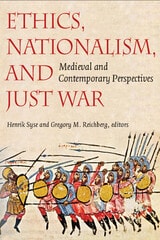
Ethics, Nationalism, and Just War
Medieval and Contemporary PerspectivesHenrik Syse
Catholic University of America Press, 2007
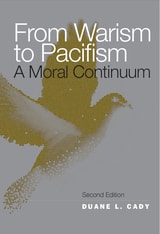
From Warism to Pacifism
A Moral ContinuumAuthored by Duane Cady
Temple University Press, 2010
Duane Cady views warism and pacifism as polar extremes on a continuum that embraces a full spectrum of ethical positions on the morality of war and peace. Realizing that he could not intellectually defend the notions of just-war theory, he found that he was a reluctant pacifist. In this new edition of From Warism to Pacifism, Cady continues to expose the pervasive, subconscious warism that is the dominant ideology in modern Western culture. He explores the changes over the last twenty years—from the end of the Cold War to the ongoing “war on terror,” as well as Barack Obama winning the Nobel Prize for Peace.
Like racism and sexism, the uncritical presumption that war is morally justifiable, even morally required, misguides our attitudes and institutions. In its place, Cady proposes the development of a positive concept of peace. Citing common objections to pacifist values, he describes peace as something more than the mere absence of war and demonstrates that pacifism is a defensible position.
Interpretations of Conflict
Ethics, Pacifism, and the Just-War TraditionRichard B. Miller
University of Chicago Press, 1991
Miller's study of the ethics of war could not be more timely.
Miller brings together the opposed traditions of pacifism and
just-war theory and puts them into a much-needed dialogue
on the ethics of war.
Beginning with the duty of nonviolence as a point of
convergence between the two rival traditions, Miller provides
an opportunity for pacifists and just-war theorists to refine
their views in a dialectical exchange over a set of ethical
and social questions. From the interface of these two long-
standing and seemingly incompatible traditions emerges a
surprisingly fruitful discussion over a common set of values,
problems, and interests: the presumption against harm, the
relation of justice and order, the ethics of civil
disobedience, the problem of self-righteousness in moral
discourse about war, the ethics of nuclear deterrence, and
the need for practical reasoning about the morality of war.
Miller pays critical attention to thinkers such as Augustine
and Thomas Aquinas, as well as to modern thinkers like H.
Richard Niebuhr, Paul Ramsey, Martin Luther King, Jr., James
Douglass, the Berrigans, William O'Brien, Michael Walzer, and
James Childress. He demonstrates how pacifism and just-war
tenets can be joined around both theoretical and practical
issues.
Interpretations of Conflict is a work of massive
scholarship and careful reasoning that should interest
philosophers, theologians, and religious ethicists alike. It
enhances our moral literacy about injury, suffering, and
killing, and offers a compelling dialectical approach to
ethics in a pluralistic society.
Richard B. Miller is assistant professor of religious
studies at Indiana University.
Just War, Second Edition
Richard J. Regan
Catholic University of America Press, 2013
Just War
Principles and CasesRichard J. Regan
Catholic University of America Press, 1996
Justice After War
<i>Jus Post Bellum</i> in the 21st CenturyDavid Chiwon Kwon
Catholic University of America Press, 2023
Walking Away from Nuremberg
Just War and the Doctrine of Command ResponsibilityLawrence P. Rockwood
University of Massachusetts Press, 2007
In September 1994, Lawrence P. Rockwood, then a counterintelligence officer with the U.S. Army's Tenth Mountain Division, was deployed to Haiti as part of Operation Restore Democracy, the American-led mission to oust the regime of Raoul Cedras and reinstall President Jean-Bertrand Aristide. Shortly after arriving in-country, Captain Rockwood began receiving reports of human rights abuses at the local jails, including the murder of political prisoners. He appealed to his superiors for permission to take action but was repeatedly turned down. Eventually, after filing a formal complaint with an army inspector general, he set off to inspect the jails on his own. The next day, Captain Rockwood found himself on a plane headed back to the United States, where he was tried by court-martial, convicted on several counts, and discharged from military service.
In this book, Rockwood places his own experience within the broader context of the American military doctrine of “command responsibility”—the set of rules that holds individual officers directly responsible for the commission of war crimes under their authority. He traces the evolution of this doctrine from the Civil War, where its principles were first articulated as the “Lieber Code,” through the Nuremberg trials following World War II, where they were reaffirmed and applied, to the present. Rockwood shows how in the past half-century the United States has gradually abandoned its commitment to these standards, culminating in recent Bush administration initiatives that in effect would shield American commanders and officials from prosecution for many war crimes. The Abu Ghraib and Guantánamo prison abuse scandals, the recently disclosed illegal CIA detention centers, the unprecedented policy of tolerating acts considered as torture by both international standards and U.S. military doctrine, and the recent cover-ups of such combat-related war crimes as the Haditha massacre of November 2005, all reflect an “official anti-humanitarian” trend, Rockwood argues, that is at odds with our nation's traditions and principles.
Women and War
Jean Bethke Elshtain
University of Chicago Press, 1995