Results by title
4 books match the query 'Justice, Daniel Heath'
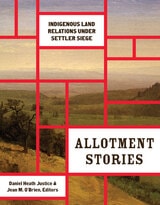
Allotment Stories
Indigenous Land Relations under Settler SiegeDaniel Heath Justice
University of Minnesota Press, 2021
More than two dozen stories of Indigenous resistance to the privatization and allotment of Indigenous lands
Land privatization has been a longstanding and ongoing settler colonial process separating Indigenous peoples from their traditional homelands, with devastating consequences. Allotment Stories delves into this conflict, creating a complex conversation out of narratives of Indigenous communities resisting allotment and other dispossessive land schemes.
From the use of homesteading by nineteenth-century Anishinaabe women to maintain their independence to the role that roads have played in expropriating Guam’s Indigenous heritage to the links between land loss and genocide in California, Allotment Stories collects more than two dozen chronicles of white imperialism and Indigenous resistance. Ranging from the historical to the contemporary and grappling with Indigenous land struggles around the globe, these narratives showcase both scholarly and creative forms of expression, constructing a multifaceted book of diverse disciplinary perspectives. Allotment Stories highlights how Indigenous peoples have consistently used creativity to sustain collective ties, kinship relations, and cultural commitments in the face of privatization. At once informing readers while provoking them toward further research into Indigenous resilience, this collection pieces back together some of what the forces of allotment have tried to tear apart.
Contributors: Jennifer Adese, U of Toronto Mississauga; Megan Baker, U of California, Los Angeles; William Bauer Jr., U of Nevada, Las Vegas; Christine Taitano DeLisle, U of Minnesota–Twin Cities; Vicente M. Diaz, U of Minnesota–Twin Cities; Sarah Biscarra Dilley, U of California, Davis; Marilyn Dumont, U of Alberta; Munir Fakher Eldin, Birzeit U, Palestine; Nick Estes, U of New Mexico; Pauliina Feodoroff; Susan E. Gray, Arizona State U; J. Kēhaulani Kauanui, Wesleyan U; Rauna Kuokkanen, U of Lapland and U of Toronto; Sheryl R. Lightfoot, U of British Columbia; Kelly McDonough, U of Texas at Austin; Ruby Hansen Murray; Tero Mustonen, U of Eastern Finland; Darren O’Toole, U of Ottawa; Shiri Pasternak, Ryerson U; Dione Payne, Te Whare Wānaka o Aoraki–Lincoln U; Joseph M. Pierce, Stony Brook U; Khal Schneider, California State U, Sacramento; Argelia Segovia Liga, Colegio de Michoacán; Leanne Betasamosake Simpson; Jameson R. Sweet, Rutgers U; Michael P. Taylor, Brigham Young U; Candessa Tehee, Northeastern State U; Benjamin Hugh Velaise, Google American Indian Network.
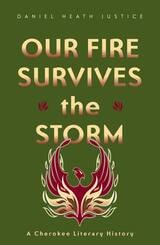
Our Fire Survives the Storm
A Cherokee Literary HistoryDaniel Heath Justice
University of Minnesota Press, 2006
Through cycles of war and peace, resistance and assimilation, trauma and regeneration, Cherokees have long debated what it means to be Cherokee through protest writings, memoirs, fiction, and retellings of traditional stories. Justice employs the Chickamauga consciousness of resistance and Beloved Path of engagement—theoretical approaches that have emerged out of Cherokee social history—to interpret diverse texts composed in English, a language embraced by many as a tool of both access and defiance.
Justice’s analysis ultimately locates the Cherokees as a people of many perspectives, many bloods, mingled into a collective sense of nationhood. Just as the oral traditions of the Cherokee people reflect the living realities and concerns of those who share them, Justice concludes, so too is their literary tradition a textual testament to Cherokee endurance and vitality.
Daniel Heath Justice is assistant professor of aboriginal literatures at the University of Toronto.
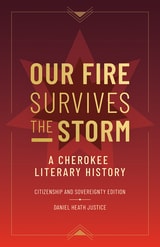
Our Fire Survives the Storm
A Cherokee Literary History, Citizenship and Sovereignty EditionDaniel Heath Justice
University of Minnesota Press, 2026
The twentieth-anniversary edition of the path-clearing study of Cherokee writing in English, with an emphatic refocus on voices from the three Cherokee tribal nations
This Citizenship and Sovereignty Edition of Our Fire Survives the Storm is a thoroughly updated, nationhood-focused, twentieth-anniversary revision of Daniel Heath Justice’s influential study of Cherokee writing in English. Through politically astute and historically grounded readings of diverse texts by citizens of the Cherokee Nation, United Keetoowah Band of Cherokee Indians, and Eastern Band of Cherokee Indians, Justice connects Cherokee literature to Indigenous sovereignty, nationhood, and collective futurity.
Guided by a reparative vision that directly contends with the outdated literary legacies of the book’s first edition, this revision confronts the ongoing harms of unsubstantiated and false Cherokee heritage claims on literary studies, replacing readings of primary texts by unverified claimants with those of Cherokee citizen writers. As Justice addresses issues of accountability, he engages with the past two decades of Indigenous scholarship, fully updating terminology, concepts, and scholarly resources. He expands and deepens the intellectual and historical context for Cherokee literary production introduced in the first edition, and he discusses Cherokee writing and community in the mid-twentieth century, the Cherokee Freedmen’s long struggle for justice, and the future of Cherokee nationhood.
Highlighting the work of authors who illustrate the transformative collective discourses of what it means to be Cherokee, Justice examines the richness of Cherokee literary expression through motifs of roots, removal, and nationhood in traditional stories, speeches, legal and governance documents, memoirs, short stories, novels, and plays. An invitation to reflective criticism, this new edition of Our Fire Survives the Storm is grounded in the belief that Indigenous nationhood is a necessary ethical response to the violence of the settler imaginary.
Retail e-book files for this title are screen-reader friendly with images accompanied by short alt text and/or extended descriptions.
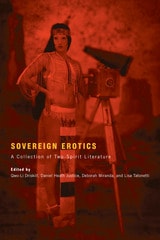
Sovereign Erotics
A Collection of Two-Spirit LiteratureEdited by Qwo-Li Driskill, Daniel Heath Justice, Deborah Miranda, and Lisa Tatonetti
University of Arizona Press, 2011
This landmark collection strives to reflect the complexity of identities within Native Gay, Lesbian, Bisexual, Transgender, Queer, and Two-Spirit (GLBTQ2) communities. Gathering together the work of established writers and talented new voices, this anthology spans genres (fiction, nonfiction, poetry, and essay) and themes (memory, history, sexuality, indigeneity, friendship, family, love, and loss) and represents a watershed moment in Native American and Indigenous literatures, Queer studies, and the intersections between the two.
Collaboratively, the pieces in Sovereign Erotics demonstrate not only the radical diversity among the voices of today’s Indigenous GLBTQ2 writers but also the beauty, strength, and resilience of Indigenous GLBTQ2 people in the twenty-first century.
Contributors: Indira Allegra, Louise Esme Cruz, Paula Gunn Allen, Qwo-Li Driskill, Laura Furlan, Janice Gould, Carrie House, Daniel Heath Justice, Maurice Kenny, Michael Koby, M. Carmen Lane, Jaynie Lara, Chip Livingston, Luna Maia, Janet McAdams, Deborah Miranda, Daniel David Moses, D. M. O’Brien, Malea Powell, Cheryl Savageau, Kim Shuck, Sarah Tsigeyu Sharp, James Thomas Stevens, Dan Taulapapa McMullin, William Raymond Taylor, Joel Waters, and Craig Womack