Results by title
5 books match the query 'Justice for All'
And Justice for All
Families & the Criminal Justice System: Groves Monographs on Marriage and Family (Volume 4)Tessa le Roux
Michigan Publishing Services, 0
Groves Monographs on Marriage and Family is an edited book series based on the annual meetings of the Groves Conference on Marriage and Family, an interdisciplinary, interprofessional organization of limited invited membership founded in 1934. Groves Monographs publishes work on the leading edges of theory development and empirical research in the field of family studies. Individual volumes are edited by the chairs of the annual Groves Conferences and include peer-reviewed chapters by the conference presenters and invited authors. Topics are timely and provocative with diverse themes.
And Justice for All?
The Claims of Human Rights, Volume 103Ian Balfour and Eduardo Cadava, eds.
Duke University Press, 0
Grappling with the philosophical and theoretical questions at the heart of human rights, these essays take into consideration current political configurations such as sovereignty, genocide, humanitarian intervention, and the neglected domain of cultural rights (the right to a cultural identity). Drawing on Enlightenment thinking about human rights at the same time that they analyze the central concepts at work there—including the “humanity of man” and the nature of rights or of law—the contributors make a necessary intervention in a world system that Enlightenment thinkers could scarcely have envisioned.
Contributors. Etienne Balibar, Rony Brauman, Wendy Brown, Rebecca Comay, Jacques Derrida, Paul Downes, Werner Hamacher, Thomas Keenan, Susan Maslan, Jacques Rancière, Bruce Robbins, Avital Ronell, Gayatri Chakravorty Spivak, Elsa Stamatopoulou, Slavoj Zizek
Justice for All
Selected Writings of Lloyd A. BarbeeLloyd A Barbee
Wisconsin Historical Society Press, 2017
Civil rights leader and legislator Lloyd A. Barbee frequently signed his correspondence with "Justice for All," a phrase that embodied his life’s work of fighting for equality and fairness. An attorney most remembered for the landmark case that desegregated Milwaukee Public Schools in 1972, Barbee stood up for justice throughout his career, from defending University of Wisconsin students who were expelled after pushing the school to offer black history courses, to representing a famous comedian who was arrested after stepping out of a line at a protest march. As the only African American in the Wisconsin legislature from 1965 to 1977, Barbee advocated for fair housing, criminal justice reform, equal employment opportunities, women’s rights, and access to quality education for all, as well as being an early advocate for gay rights and abortion access.
This collection features Barbee’s writings from the front lines of the civil rights movement, along with his reflections from later in life on the challenges of legislating as a minority, the logistics of coalition building, and the value of moving the needle on issues that would outlast him. Edited by his daughter, civil rights lawyer Daphne E. Barbee-Wooten, these documents are both a record of a significant period of conflict and progress, as well as a resource on issues that continue to be relevant to activists, lawmakers, and educators.
Liberty and Justice for All?
Rethinking Politics in Cold War AmericaKathleen G. Donohue
University of Massachusetts Press, 2012
From the congressional debate over the “fall of China” to the drama of the Army–McCarthy hearings to the kitchen faceoff between Richard Nixon and Nikita Khrushchev, the political history of the early Cold War was long dominated by studies of presidential administrations, anticommunism, and foreign policy. In Liberty and Justice for All? a group of distinguished historians representing a variety of disciplinary perspectives—social history, cultural history, intellectual history, labor history, urban history, women's history, African American studies, and media studies—expand on the political history of the early Cold War by rethinking the relationship between politics and culture. How, for example, did folk music help to keep movement culture alive throughout the 1950s? How did the new medium of television change fundamental assumptions about politics and the electorate? How did American experiences with religion in the 1950s strengthen the separation of church and state? How did race, class, and gender influence the relationship between citizens and the state? These are just some of the questions addressed in this wide-ranging set of essays.
In addition to volume editor Kathleen G. Donohue, contributors include Howard Brick, Kari Frederickson, Andrea Friedman, David Greenberg, Grace Elizabeth Hale, Jennifer Klein, Laura McEnaney, Kevin M. Schultz, Jason Scott Smith, Landon R. Y. Storrs, and Jessica Weiss.
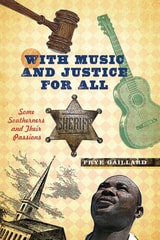
With Music and Justice for All
Some Southerners and Their PassionsFrye Gaillard
Vanderbilt University Press, 2008
But Gaillard examines the South from other angles as well--the religious heritage, for example, that once led Flannery O'Connor to write about a "Christ-haunted" South. We meet Billy Graham, the greatest evangelist of his time, who admitted in the course of interviews with Gaillard that his ministry represented a "very narrow gift." There are profiles here of the Southern Baptist renegade Will Campbell and former President Jimmy Carter, whose commitment to his own understanding of Christianity has sometimes led him into controversy. Gaillard writes also about the revealing power of Southern music--how the great Johnny Cash, for example, became a force for reconciliation in America. In the final section of the book we meet some of the characters Gaillard has covered through the years, including John T. Scopes, whose final public appearance Gaillard wrote about as a young reporter in Nashville.