Results by title
8 books match the query 'Kafka'
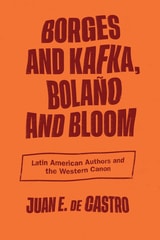
Borges and Kafka, Bolaño and Bloom
Latin American Authors and the Western CanonJuan E. De Castro
Vanderbilt University Press, 2022
Borges and Kafka, Bolaño and Bloom is a parsing not simply of these authors' reactions to a canon, but of the notion of canon writ large and the inequities and erasures therein. It concludes with a look at the testimonial and autobiographical writings of Rigoberta Menchú and Lurgio Gavilán, who arguably represent the trajectory of Indigenous testimonial and autobiographical writing during the last forty years, noting how their texts represent alternative ways of relating to national and, on occasion, Western cultures. This study is a new attempt to map writers' diverse ways of thinking about locality and universality from within and without what is known as the canon.

Kafka and Cultural Zionism
Dates in PalestineIris Bruce
University of Wisconsin Press, 2007
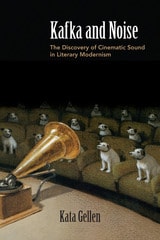
Kafka and Noise
The Discovery of Cinematic Sound in Literary ModernismKata Gellen
Northwestern University Press, 2019
Kafka and Noise offers a method for pursuing intermedial research in the humanities—namely, via the productive "misapplication" of theoretical tools, which exposes the contours, conditions, and expressive possibilities of the media in question. This book will be of interest to scholars of modernism, literature, cinema, and sound, as well as to anyone wishing to explore how artistic and technological media shape our experience of the world and the possibilities for representing it.
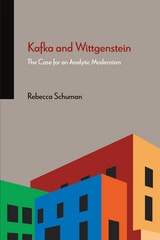
Kafka and Wittgenstein
The Case for an Analytic ModernismRebecca Schuman
Northwestern University Press, 2015
In Kafka and Wittgenstein, Rebecca Schuman undertakes the first ever book-length scholarly examination of Ludwig Wittgenstein’s philosophy of language alongside Franz Kafka’s prose fiction. In groundbreaking readings, she argues that although many readers of Kafka are searching for what his texts mean, in this search we are sorely mistaken. Instead, the problems and illusions we portend to uncover, the im-portant questions we attempt to answer—Is Josef K. guilty? If so, of what? What does Gregor Samsa’s transformed body mean? Is Land-Surveyor K. a real land surveyor?— themselves presuppose a bigger delusion: that such questions can be asked in the first place. Drawing deeply on the entire range of Wittgenstein’s writings, Schuman can-nily sheds new light on the enigmatic Kafka.
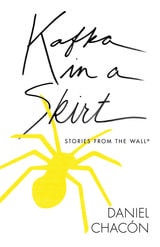
Kafka in a Skirt
Stories from the WallDaniel Chacón
University of Arizona Press, 2019
Set in El Paso and other Latinx-dominant urban spaces, Kafka in a Skirt is an immersive look into the myriad lives of the characters who inhabit these culturally diverse areas. Chacón masterfully weaves elements of the surreal and fantastic through a shining tapestry of fiction, creating moments of touching realism in contrast with scenes that are fascinatingly unfamiliar. Occasionally teasing the ghosts of Jorge Luis Borges and the Argentine poet Alejandra Pizarnik, this collection disregards boundaries and transports readers into a world merely parallel to our own. Kafka in a Skirt unravels the intricacies of culture, sexuality, love, and loneliness in a collection that shows the personal implications of barriers while remaining hopeful and bright.
Kafka
Toward a Minor LiteratureGilles Deleuze
University of Minnesota Press, 1986
Narrative Consciousness
Structure and Perception in the Fiction of Kafka, Beckett, and Robbe-GrilletBy George H. Szanto
University of Texas Press, 1972
Comparatively little critical attention has been devoted to narrative technique in modern fiction, and formal analysis of the work of Kafka, Beckett, and Robbe-Grillet in particular has for the most part been limited to short studies in journals, many of these in languages other than English. The criticism written in English has dealt primarily with theme with metaphysics and myth and ignored structure and style.
Yet it is structure and style that offer the reader a way into the often bewildering and disturbing fictional worlds these three writers present. The problem confronting writers since the middle of the nineteenth century has been how to cope artistically with an increasingly alienating and mechanized world. As George Szanto sees it, Kafka, Beckett and Robbe-Grillet conclude, by the example of their fictions, that the writer's province is no longer this impossible environment. Instead, the writer must work within the only knowledge available to any one person: the knowledge attained through perceptions. The proper study for a storyteller is thus the search for the unique details, the describable perceptions a person chooses from the outside world and brings into their mind, which in the end define their nature. The shape of the story is determined by the narrating consciousness, that single character through whose awareness the details are filtered. Thus, in a very special sense, the tale and the telling are one.
Szanto's meticulous and thoughtful study of the major fiction of Kafka, Beckett, and Robbe-Grillet searches out these details and examines the manner in which each author, through the minds of his characters, has selected and ordered them. His structural approach not only leads the reader directly into the works under scrutiny, but also provides an understanding of the workings of the art itself.
In the appendices, the author surveys the different ways in which criticism has treated these three writers. His extensive bibliography provides a valuable research tool.
The Bond of the Furthest Apart
Essays on Tolstoy, Dostoevsky, Bresson, and KafkaSharon Cameron
University of Chicago Press, 2017
Whether exploring Bresson’s efforts to reassess the limits of human reason and will, Dostoevsky’s subversions of Christian conventions, Tolstoy’s incompatible beliefs about death, or Kafka’s focus on creatures neither human nor animal, Cameron illuminates how the repeated juxtaposition of disparate, even antithetical, phenomena carves out new approaches to defining the essence of being, one where the very nature of fixed categories is brought into question. An innovative look at a classic French auteur and three giants of European literature, The Bond of the Furthest Apart will interest scholars of literature, film, ethics, aesthetics, and anyone drawn to an experimental venture in critical thought.