Results by title
52 books match the query 'Kant, Immanuel' and 5 start with a

A Moral Military
Sidney Axinn
Temple University Press, 1990
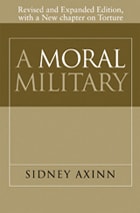
A Moral Military
Sidney Axinn
Temple University Press, 2008
In this new edition of the classic book on the moral conduct of war, Sidney Axinn provides a full-length treatment of the military conventions from a philosophical point of view. Axinn considers these basic ethical questions within the context of the laws of warfare: Should a good soldier ever disobey a direct military order? Are there restrictions on how we fight a war? What is meant by “military honor,” and does it really affect the contemporary soldier? Is human dignity possible under battlefield conditions?
Axinn answers “yes” to these questions. His objective in A Moral Military is to establish a basic framework for moral military action and to assist in analyzing military professional ethics. He argues for the seriousness of the concept of military honor but limits honorable military activity by a strict interpretation of the notion of war crime.
With revisions and expansions throughout, including a new chapter on torture, A Moral Military is an essential guide on the nature of war during a time when the limits of acceptable behavior are being stretched in new directions.
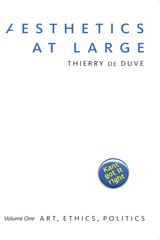
Aesthetics at Large
Volume 1: Art, Ethics, PoliticsThierry de Duve
University of Chicago Press, 2019
Central to de Duve’s re-reading of the Critique of Judgment is Kant’s idea of sensus communis, ultimately interpreted as the mere yet necessary idea that human beings are capable of living in peace with one another. De Duve pushes Kant’s skepticism to its limits by submitting the idea of sensus communis to various tests leading to questions such as: Do artists speak on behalf of all of us? Is art the transcendental ground of democracy? Or, Was Adorno right when he claimed that no poetry could be written after Auschwitz?
Loaded with de Duve’s trademark blend of wit and erudition and written without jargon, these essays radically renew current approaches to some of the most burning issues raised by modern and contemporary art. They are indispensable reading for anyone with a deep interest in art, art history, or philosophical aesthetics.
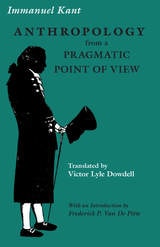
Anthropology from a Pragmatic Point of View
Immanuel Kant. Translated by Victor Lyle Dowdell. Revised and Edited by Hans H. Rudnick
Southern Illinois University Press, 1996
In the fall semester of 1772/73 at the Albertus University of Königsberg, Immanuel Kant, metaphysician and professor of logic and metaphysics, began lectures on anthropology, which he continued until 1776, shortly before his retirement from public life. His lecture notes and papers were first published in 1798, eight years after the publication of the Critique of Judgment, the third of his famous Critiques. The present edition of the Anthropology is a translation of the text found in volume 7 of Kants gesammelte Schriften, edited by Oswald Külpe.
Kant describes the Anthropology as a systematic doctrine of the knowledge of humankind. (He does not yet distinguish between the academic discipline of anthropology as we understand it today and the philosophical.) Kant’s lectures stressed the "pragmatic" approach to the subject because he intended to establish pragmatic anthropology as a regular academic discipline. He differentiates the physiological knowledge of the human race—the investigation of "what Nature makes of man"—from the pragmatic—"what man as a free being makes of himself, what he can make of himself, and what he ought to make of himself." Kant believed that anthropology teaches the knowledge of humankind and makes us familiar with what is pragmatic, not speculative, in relation to humanity. He shows us as world citizens within the context of the cosmos.
Summarizing the cloth edition of the Anthropology, Library Journal concludes: "Kant’s allusions to such issues as sensation, imagination, judgment, (aesthetic) taste, emotion, passion, moral character, and the character of the human species in regard to the ideal of a cosmopolitan society make this work an important resource for English readers who seek to grasp the connections among Kant’s metaphysics of nature, metaphysics of morals, and political theory. The notes of the editor and translator, which incorporate material from Ernst Cassirer’s edition and from Kant’s marginalia in the original manuscript, shed considerable light on the text."
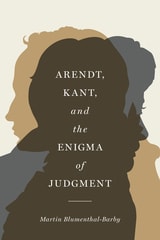
Arendt, Kant, and the Enigma of Judgment
Martin Blumenthal-Barby
Northwestern University Press, 2023
A nuanced extrapolation of Hannah Arendt’s theory of judgment through her highly provocative reading of Immanuel Kant
More than a half century after it was first published, Hannah Arendt’s Origins of Totalitarianism rose to the top of best-seller lists as readers grappled with the triumph of Trumpism. Arendt, Kant, and the Enigma of Judgment directs our attention to her later thought, the posthumously published and highly provocative Lectures on Kant’s Political Philosophy. Martin Blumenthal-Barby puts this work in dialogue with Arendt’s other writings, including her notes on Kant’s Critique of Judgment, to outline her own theory of judgment for the twentieth century. In an era of post-truths and artificial intelligence, the idea that authentic judgment—for example, the ability to distinguish right from wrong—is incommensurable with abstract, automated processes lies at the center of Arendt’s late work and at the fore of our collective reckoning.
Rather than presenting us with a fixed account, Blumenthal-Barby suggests, Arendt’s drawing and redrawing of conceptual distinctions is itself an enactment of judgment, a process that challenges and complicates what she says at every turn. In so doing, Arendt, in thoroughly Kantian fashion, establishes judgment as a performative category that can never be taught but only demonstrated. As sharp as it is timely, this incisive book reminds us why a shared reality matters in a time of intense political polarization and why the democratic project, vulnerable as it may appear today, crucially depends on it.