Results by title
8 books match the query 'Katrina'
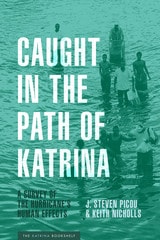
Caught in the Path of Katrina
A Survey of the Hurricane's Human EffectsBy J. Steven Picou and Keith Nicholls
University of Texas Press, 2019
In 2008, three years after Hurricane Katrina cut a deadly path along the northern coast of the Gulf of Mexico, researchers J. Steven Picou and Keith Nicholls conducted a survey of the survivors in Louisiana and Mississippi, receiving more than twenty-five hundred responses, and followed up two years later with their than five hundred of the initial respondents. Showcasing these landmark findings, Caught in the Path of Katrina: A Survey of the Hurricane's Human Effects yields a more complete understanding of the traumas endured as a result of the Storm of the Century.
The authors report on evacuation behaviors, separations from family, damage to homes, and physical and psychological conditions among residents of seven of the parishes and counties that bore the brunt of Katrina. The findings underscore the frequently disproportionate suffering of African Americans and the agonizingly slow pace of recovery. Highlighting the lessons learned, the book offers suggestions for improved governmental emergency management techniques to increase preparedness, better mitigate storm damage, and reduce the level of trauma in future disasters. Multiple major hurricanes have unleashed their destruction in the years since Katrina, making this a crucial study whose importance only continues to grow.
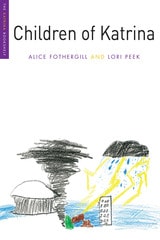
Children of Katrina
By Alice Fothergill and Lori Peek
University of Texas Press, 2015
Winner, Betty and Alfred McClung Lee Book Award, Association for Humanist Sociology, 2016
Outstanding Scholarly Contribution Award of the Section on Children and Youth, American Sociological Association, 2016
Honorable Mention, Leo Goodman Award, Methodology Section, American Sociological Association, 2016
When children experience upheaval and trauma, adults often view them as either vulnerable and helpless or as resilient and able to easily “bounce back.” But the reality is far more complex for the children and youth whose lives are suddenly upended by disaster. How are children actually affected by catastrophic events and how do they cope with the damage and disruption?
Children of Katrina offers one of the only long-term, multiyear studies of young people following disaster. Sociologists Alice Fothergill and Lori Peek spent seven years after Hurricane Katrina interviewing and observing several hundred children and their family members, friends, neighbors, teachers, and other caregivers. In this book, they focus intimately on seven children between the ages of three and eighteen, selected because they exemplify the varied experiences of the larger group. They find that children followed three different post-disaster trajectories—declining, finding equilibrium, and fluctuating—as they tried to regain stability. The children’s moving stories illuminate how a devastating disaster affects individual health and well-being, family situations, housing and neighborhood contexts, schooling, peer relationships, and extracurricular activities. This work also demonstrates how outcomes were often worse for children who were vulnerable and living in crisis before the storm. Fothergill and Peek clarify what kinds of assistance children need during emergency response and recovery periods, as well as the individual, familial, social, and structural factors that aid or hinder children in getting that support.
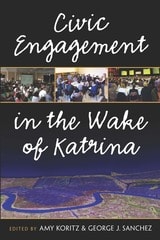
Civic Engagement in the Wake of Katrina
Amy Koritz and George J. Sanchez, editors
University of Michigan Press, 2009
"Civic engagement has been underrated and overlooked. Koritz and Sanchez illuminate the power of what community engagement through art and culture revitalization can do to give voice to the voiceless and a sense of being to those displaced."
---Sonia BasSheva Mañjon, Wesleyan University
"This profound and eloquent collection describes and assesses the new coalitions bringing a city back to life. It's a powerful call to expand our notions of culture, social justice, and engaged scholarship. I'd put this on my 'must read' list."
---Nancy Cantor, Syracuse University
"Civic Engagement in the Wake of Katrina is a rich and compelling text for thinking about universities and the arts amid social crisis. Americans need to hear the voices of colleagues who were caught in Katrina's wake and who responded with commitment, creativity, and skill."
---Peter Levine, CIRCLE (The Center for Information & Research on Civic Learning & Engagement)
This collection of essays documents the ways in which educational institutions and the arts community responded to the devastation wrought by Hurricane Katrina. While firmly rooted in concrete projects, Civic Engagement in the Wake of Katrina also addresses the larger issues raised by committed public scholarship. How can higher education institutions engage with their surrounding communities? What are the pros and cons of "asset-based" and "outreach" models of civic engagement? Is it appropriate for the private sector to play a direct role in promoting civic engagement? How does public scholarship impact traditional standards of academic evaluation? Throughout the volume, this diverse collection of essays paints a remarkably consistent and persuasive account of arts-based initiatives' ability to foster social and civic renewal.
Amy Koritz is Director of the Center for Civic Engagement and Professor of English at Drew University.
George J. Sanchez is Professor of American Studies and Ethnicity and History at the University of Southern California.
Front and rear cover designs, photographs, and satellite imagery processing by Richard Campanella.
digitalculturebooks is an imprint of the University of Michigan Press and the Scholarly Publishing Office of the University of Michigan Library dedicated to publishing innovative and accessible work exploring new media and their impact on society, culture, and scholarly communication. Visit the website at www.digitalculture.org.
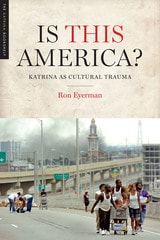
Is This America?
Katrina as Cultural TraumaBy Ron Eyerman
University of Texas Press, 2015
From police on the street, to the mayor of New Orleans and FEMA administrators, government officials monumentally failed to protect the most vulnerable residents of New Orleans and the Gulf Coast during the Katrina disaster. This violation of the social contract undermined the foundational narratives and myths of the American nation and spawned a profound, often contentious public debate over the meaning of Katrina’s devastation. A wide range of voices and images attempted to clarify what happened, name those responsible, identify the victims, and decide what should be done. This debate took place in forums ranging from mass media and the political arena to the arts and popular culture, as various narratives emerged and competed to tell the story of Katrina.
Is This America? explores how Katrina has been constructed as a cultural trauma in print media, the arts and popular culture, and television coverage. Using stories told by the New York Times, New Orleans Times-Picayune, Time, Newsweek, NBC, and CNN, as well as the works of artists, writers, musicians, filmmakers, and graphic designers, Ron Eyerman analyzes how these narratives publicly articulated collective pain and loss. He demonstrates that, by exposing a foundational racial cleavage in American society, these expressions of cultural trauma turned individual experiences of suffering during Katrina into a national debate about the failure of the white majority in the United States to care about the black minority.

Katrina on Stage
Five PlaysSuzanne M. Trauth
Northwestern University Press, 2011
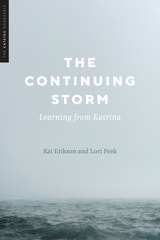
The Continuing Storm
Learning from KatrinaKai Erikson and Lori Peek
University of Texas Press, 2022
2023 Finalist, Colorado Book Awards, History/Biography Category
This final volume in the award-winning Katrina Bookshelf series reflects upon the lessons of Hurricane Katrina and what they reveal about our society and current cultural climate.
More than fifteen years later, Hurricane Katrina maintains a strong grip on the American imagination. The reason is not simply that Katrina was an event of enormous scale, although it certainly was by any measure one of the most damaging storms in American history. But, quite apart from its lethality and destructiveness, Katrina retains a place in living memory because it is one of the most telling disasters in our recent national experience, revealing important truths about our society and ourselves.
The final volume in the award-winning Katrina Bookshelf series The Continuing Storm reflects upon what we have learned about Katrina and about America. Kai Erikson and Lori Peek expand our view of the disaster by assessing its ongoing impact on individual lives and across the wide-ranging geographies where displaced New Orleanians landed after the storm. Such an expanded view, the authors argue, is critical for understanding the human costs of catastrophe across time and space. Concluding with a broader examination of disasters in the years since Katrina—including COVID-19—The Continuing Storm is a sobering meditation on the duration of a catastrophe that continues to exact steep costs in human suffering.
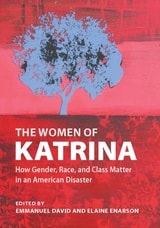
The Women of Katrina
How Gender, Race, and Class Matter in an American DisasterEmmanuel David
Vanderbilt University Press, 2012
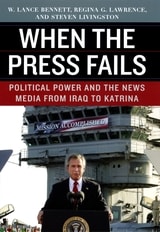
When the Press Fails
Political Power and the News Media from Iraq to KatrinaW. Lance Bennett, Regina G. Lawrence, and Steven Livingston
University of Chicago Press, 2007
“The hand-in-glove relationship of the U.S. media with the White House is mercilessly exposed in this determined and disheartening study that repeatedly reveals how the press has toed the official line at those moments when its independence was most needed.”—George Pendle, Financial Times
“Bennett, Lawrence, and Livingston are indisputably right about the news media’s dereliction in covering the administration’s campaign to take the nation to war against Iraq.”—Don Wycliff, Chicago Tribune