Results by title
3 books match the query 'Katz, Michael R.'

Antonina
Evgeniya Tur
Northwestern University Press, 1995
Patterned on the novels of the Brontë sisters, Antonina is a poignant account of a young Russian whose life is shaped by the cruel neglect of her stepparents, the financial ruin of her father and husband, and--the centerpiece of the novel--her failed love affair with a sensitive but weak young man.
[more]
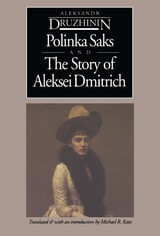
Polinka Saks and The Story of Aleksei
Aleksandr Druzhinin
Northwestern University Press, 1992
This volume offers two of Druzhinin's essential works in their first English translations. Polinka Saks, his most essential short novel, is an epistolary tale of a romantic triangle involving an older man, his young wife, and a dashing young prince. The husband attempts to introduce his wife to literature, art, and music, but his efforts run counter to the dominant trend of society, which "forces women to become little children." The wife falls victim to the prince and realizes too late the value of the education provided by her husband.
A far different tale, The Story of Aleksei Dmitrich is a complex social and psychological study of poverty, family disharmony, precocious children, and destructive self-sacrifice.
A far different tale, The Story of Aleksei Dmitrich is a complex social and psychological study of poverty, family disharmony, precocious children, and destructive self-sacrifice.
[more]

Prologue
A Novel for the Beginning of the 1860sMichael R. Katz
Northwestern University Press, 1994
Nikolai Chernyshevsky (1828-89) is most famous as the author of What is To Be Done? (1863), one of the most inspirational texts in the Russian revolutionary movement. But during his long and lonely Siberian exile Chernyshevsky wrote Prologue, an novel of extraordinary interest for anyone eager to understand the course of Russian history and the political debate over democratization taking place in Russia today.
Set in Petersburg in 1857, on the eve of the great reforms that would include the emancipation of the serfs, Prologue expresses the author's hostility toward Russian liberals, their halfhearted attempts to alleviate the sufferings of peasants, and their insufficient support of revolution, while also exploring the obstacles in the path of women's social and personal development in the Victorian era. Michael R. Katz's new translation makes this singular work available to the non-Russian reading public for the first time.
Set in Petersburg in 1857, on the eve of the great reforms that would include the emancipation of the serfs, Prologue expresses the author's hostility toward Russian liberals, their halfhearted attempts to alleviate the sufferings of peasants, and their insufficient support of revolution, while also exploring the obstacles in the path of women's social and personal development in the Victorian era. Michael R. Katz's new translation makes this singular work available to the non-Russian reading public for the first time.
[more]