Results by title
6 books match the query 'Kazakhstan'
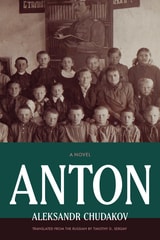
Anton
A NovelAleksandr Chudakov, Timothy D. Sergay
Northwestern University Press, 2027
A landmark work of contemporary Russian literature, now in English for the first time
Set in a fictitious town in North Kazakhstan settled by political and ethnic exiles, this panoramic narrative follows the relationship between the titular character Anton, a Moscow historian of the vital “1960s generation,” and his grandfather, Leonid, a titan of physical and intellectual rigor who is now on the verge of death. As Anton contemplates the fading away of that once-powerful vitality, he lets his thoughts plunge deep into the past, presented in a series of fine-grained sketches, scattered reminiscences, and subtly interconnected episodes, back and forth from childhood to present day. The resulting novel is a “Soviet family Robinson”: the history of rugged and free-thinking intellectuals eking out a tolerable, even enviable homestead existence despite the difficulties of the Stalin years. One of the most vibrant works of literary fiction created since the fall of the Soviet Union, Aleksandr Chudakov’s Anton is a testament to humanity's tenacity and tenderness.
In the Shadow of Russia
Reform in Kazakahstan and UzbekistanPamela Blackmon
Michigan State University Press, 2011
In the twenty years since the dissolution of the Soviet Union, the fifteen new independent republics have embarked on unprecedented transitions from command economies into market-oriented economies.
Important motivating factors for their reform efforts included issues of geographic and economic proximity to Europe and the influence of the pre-Soviet era histories in those countries. In the Shadow of Russia builds upon the conceptual frameworks that include geography and policy choices about economic integration in an analysis of the reform efforts of Kazakhstan and Uzbekistan.
Blackmon's book addresses such central questions as: How and in what areas has a republic's previous level of integration with Soviet-era Russia influenced its present economic orientation? What are the contributing factors that explain the differences in how leaders ( of a similar regime type) developed economic reform policies? To answer these questions, the author utilizes information from both the economic and the political literature on post-communist transitions, as well from political speeches.
Kazakhstan's New Economy
Post-Soviet, Central Asian Industries in a Global EraJay Nathan
University of Scranton Press, 2013
“An excellent resource on major industries in Kazakhstan.”—Byrganym Aitimova, Minister of Education and Science, the Republic of Kazakhstan

Post-Soviet Chaos
Violence and Dispossession in KazakhstanJoma Nazpary
Pluto Press, 2001
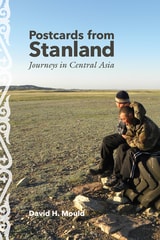
Postcards from Stanland
Journeys in Central AsiaDavid H. Mould
Ohio University Press, 2015
Central Asia has long stood at the crossroads of history. It was the staging ground for the armies of the Mongol Empire, for the nineteenth-century struggle between the Russian and British empires, and for the NATO campaign in Afghanistan. Today, multinationals and nations compete for the oil and gas reserves of the Caspian Sea and for control of the pipelines. Yet “Stanland” is still, to many, a terra incognita, a geographical blank.
Beginning in the mid-1990s, academic and journalist David Mould’s career took him to the region on Fulbright Fellowships and contracts as a media trainer and consultant for UNESCO and USAID, among others. In Postcards from Stanland, he takes readers along with him on his encounters with the people, landscapes, and customs of the diverse countries—Kazakhstan, Kyrgyzstan, Tajikistan, and Uzbekistan—he came to love. He talks with teachers, students, politicians, environmental activists, bloggers, cab drivers, merchants, Peace Corps volunteers, and more.
Until now, few books for a nonspecialist readership have been written on the region, and while Mould brings his own considerable expertise to bear on his account—for example, he is one of the few scholars to have conducted research on post-Soviet media in the region—the book is above all a tapestry of place and a valuable contribution to our understanding of the post-Soviet world.
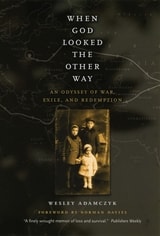
When God Looked the Other Way
An Odyssey of War, Exile, and RedemptionWesley Adamczyk
University of Chicago Press, 2004
Adamczyk was a young Polish boy when he was deported with his mother and siblings from their comfortable home in Luck to Soviet Siberia in May of 1940. His father, a Polish Army officer, was taken prisoner by the Red Army and eventually became one of the victims of the Katyn massacre, in which tens of thousands of Polish officers were slain at the hands of the Soviet secret police. The family's separation and deportation in 1940 marked the beginning of a ten-year odyssey in which the family endured fierce living conditions, meager food rations, chronic displacement, and rampant disease, first in the Soviet Union and then in Iran, where Adamczyk's mother succumbed to exhaustion after mounting a harrowing escape from the Soviets. Wandering from country to country and living in refugee camps and the homes of strangers, Adamczyk struggled to survive and maintain his dignity amid the horrors of war.
When God Looked the Other Way is a memoir of a boyhood lived in unspeakable circumstances, a book that not only illuminates one of the darkest periods of European history but also traces the loss of innocence and the fight against despair that took root in one young boy. It is also a book that offers a stark picture of the unforgiving nature of Communism and its champions. Unflinching and poignant, When God Looked the Other Way will stand as a testament to the trials of a family during wartime and an intimate chronicle of episodes yet to receive their historical due.
“A finely wrought memoir of loss and survival.”—Publishers Weekly
“Adamczyk’s unpretentious prose is well-suited to capture that truly awful reality.” —Andrew Wachtel, Chicago Tribune Books
“Mr. Adamczyk writes heartfelt, straightforward prose. . . . This book sheds light on more than one forgotten episode of history.”—Gordon Haber, New York Sun
“One of the most remarkable World War II sagas I have ever read. It is history with a human face.”—Andrew Beichman, Washington Times