Results by title

6 books match the query 'Keeping'
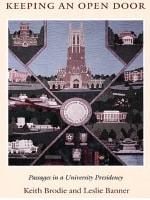
cover of Keeping An Open Door: Passages in a University Presidency

Keeping An Open Door

Passages in a University Presidency

Keith Brodie and Leslie Banner

Duke University Press, 1996

During the 1980s, many of America’s most respected colleges and universities suffered financial crises, athletic scandals, a troubling upsurge of racial conflict, and the divisiveness of political correctness “wars.” Yet Duke University not only avoided these dangers but changed dramatically from a very good regional university to one of the nation’s top research institutions. Its undergraduate campus was hailed as a “hot college”; its Blue Devils basketball team was pronounced a model for student athletes; its graduate and professional schools gained new national prominence; and its scholars were quoted frequently in the popular press on both sides of the political correctness debates.
In Keeping an Open Door, Duke chancellor (1982-1985) and president (1985-1993) Keith Brodie and coauthor Leslie Banner recount what it was like to lead Duke during an era of change for research universities across the country: how Brodie reached some of his most controversial decisions, including the “Black Faculty Initiative”; his strategy for precluding abuse in Division I athletics at Duke; how his training as a psychiatrist shaped his leadership style and influenced how he dealt with trustees, deans, faculty, and students; and the avenues of power still open to today’s university presidents. The history and feeling of life on the Duke campus during the Brodie era are vividly evoked in photographs and key speeches introduced by the former president’s personal recollections.
Keeping an Open Door provides an insider’s view of issues critical to modern research universities and will interest anyone concerned with the history and future of higher education.

[more]
cover of Keeping the Faith: Ordinary People, Extraordinary Lives

Keeping the Faith

Ordinary People, Extraordinary Lives

Wayne Flynt

University of Alabama Press, 2011
Normal0falsefalsefalseEN-USX-NONEX-NONEMicrosoftInternetExplorer4
This historical memoir by the widely recognized scholar, Wayne Flynt, chronicles the inner workings of his academic career at Samford and Auburn Universities, as well as his many contributions to the general history of Alabama. Flynt has traveled the state and the South lecturing and teaching both lay and academic groups, calling on his detailed knowledge of both the history and power structures in Alabama to reveal uncomfortable truths wherever he finds them, whether in academic institutions that fall short of their stated missions, in government and industry leaders who seek and hold power by playing to the fears and prejudices of the public, or in religious groups who abandon their original missions and instead seek financial and emotional comfort in lip service only.
 
In doing so he has not only energized those who think the State of Alabama can and must do better, but  also has earned the enmity of those who prosper, profit, and prevaricate for their own selfish ends. Nevertheless, Flynt utilizes a lifetime of learning and reflection to voice the conscience of his community. Keeping the Faith: Ordinary People, Extraordinary Lives tells the story of his life and his courageous battles against an indifferent or hostile hierarchy with modesty and honesty. In doing so he tells us how Alabama institutions really are manipulated and, more importantly, why we should care.

 
[more]
cover of Keeping the Feast: Metaphors of Sacrifice in 1 Corinthians and Philippians

Keeping the Feast

Metaphors of Sacrifice in 1 Corinthians and Philippians

Jane Lancaster Patterson

SBL Press, 2015

Develop a keener ear for Paul’s rhetorical strategy

Patterson uses cognitive metaphor theory to trace the apostle Paul’s use of metaphors from the Jewish sacrificial system in his moral counsels to the Philippians and the Corinthians. In these letters, Paul moves from the known (the practice of sacrifice) to the unknown (how to live in accord with the life, death, and resurrection of Jesus Christ). Patterson illustrates that the significant sacrificial metaphors in 1 Corinthians and Philippians are not derived from Jewish sacrifices of atonement, but rather from the Passover and sacrifices of thanksgiving. Attention to these metaphors demonstrates that imagery drawn from these sacrifices shapes the overall moral counsel of the letters, reveals more varied and nuanced interpretations of sacrificial references in Paul’s letters, and sheds light on Paul’s continuity with Jewish cultic practice.

Features

  • Clarification of the strategic function of metaphors as a means of establishing an imaginative framework for ethical deliberation
  • Evidence of Paul’s active processes of theological reflection
  • Exploration of the intertwining of Jewish cultic practice with the rhetoric of moral commitment within early Christian churches
[more]
cover of Keeping the Immigrant Bargain: The Costs and Rewards of Success in America

Keeping the Immigrant Bargain

The Costs and Rewards of Success in America

Vivian Louie

Russell Sage Foundation, 2012
Most nineteenth and early-twentieth-century European immigrants arrived in the United States with barely more than the clothes on their backs. They performed menial jobs, spoke little English, and often faced a hostile reception. But two or more generations later, the overwhelming majority of their descendants had successfully integrated into American society. Today's immigrants face many of the same challenges, but some experts worry that their integration, especially among Latinos, will not be as successful as their European counterparts. Keeping the Immigrant Bargain examines the journey of Dominican and Colombian newcomers whose children have achieved academic success one generation after the arrival of their parents. Sociologist Vivian Louie provides a much-needed comparison of how both parents and children understand the immigrant journey toward education, mobility, and assimilation. Based on Louie's own survey and interview study, Keeping the Immigrant Bargain examines the lives of thirty-seven foreign-born Dominican and Colombian parents and their seventy-six young adult offspring—the majority of whom were enrolled in or had graduated from college. The book shows how they are adapting to American schools, jobs, neighborhoods, and culture. Louie discovers that before coming to the United States, some of these parents had already achieved higher levels of education than the average foreign-born Dominican or Colombian, and after arrival many owned their own homes. Significantly, most parents in each group expressed optimism about their potential to succeed in the United States, while also expressing pessimism about whether they would ever be accepted as Americans. In contrast to the social exclusion experienced by their parents, most of the young adults had assimilated linguistically and believed themselves to be full participants in American society. Keeping the Immigrant Bargain shows that the offspring of these largely working-class immigrants had several factors in common that aided their mobility. Their parents were highly engaged in their lives and educational progress, although not always in ways expected by schools or their children, and the children possessed a strong degree of self-motivation. Equally important was the availability of key institutional networks of support, including teachers, peers, afterschool and other enrichment programs, and informal mentors outside of the classroom. These institutional networks gave the children the guidance they needed to succeed in school, offering information the parents often did not know themselves. While not all immigrants achieve such rapid success, this engrossing study shows how powerful the combination of self-motivation, engaged families, and strong institutional support can be. Keeping the Immigrant Bargain makes the case that institutional relationships—such as teachers and principals who are trained to accommodate cultural difference and community organizations that help parents and children learn how to navigate the system—can bear significantly on immigrant educational success.
[more]
cover of Keeping the World’s Environment under Review: An Intellectual History of the Global Environment Outlook

Keeping the World’s Environment under Review

An Intellectual History of the Global Environment Outlook

Jan Bakkes

Central European University Press, 2022

How do we take stock of the state and direction of the world’s environment, and what can we learn from the experience? Among the myriad detailed narratives about the condition of the planet, the Global Environment Outlook (GEO) reports—issued by the United Nations Environment Programme—stand out as the most ambitious. For nearly three decades the GEO project has not only delivered iconic global assessment reports, but through its multitude of contributors has inspired hundreds of similar processes worldwide from the regional to the local level.

This book provides an inside account of the evolution of the GEO project from its earliest days. Building on meticulous research, including interviews with former heads of the United Nations Environment Programme, diplomats, leading contributing scientists, and senior leaders of collaborating organizations, the story is told from the perspective of five GEO veterans who all played a pivotal role in shaping the periodic assessments. The GEO’s history provides striking insights and will save valuable time to those who commission, design and conduct, as well as critique and improve, assessments of environmental development in the next decade.
[more]
cover of Making, Keeping, and Losing Friends: How Campuses Shape College Students' Networks

Making, Keeping, and Losing Friends

How Campuses Shape College Students' Networks

Janice M. McCabe

University of Chicago Press, 2025

Draws attention to the importance of support networks for students as they make, keep, and lose friends throughout college and beyond.
 
We’re all familiar with the sentiment that “college is the best time of your life.” Along with a newfound sense of freedom, students have a unique opportunity to forge lifelong friendships at a point in life when friendship is particularly important. Why is it, then, that so many college students are falling victim to what the US Surgeon General termed an “epidemic of loneliness and isolation”? How do different aspects of college life help or hinder students’ ability to form deep connections?

In Making, Keeping, and Losing Friends: How Campuses Shape College Students’ Networks, sociologist Janice M. McCabe shows that the way a college is structured—whether students live in dorms or commute, study abroad or stay close to campus, have plentiful common areas for clubs to meet or not—can either encourage or hinder the making of meaningful friendships. Based on interviews with 95 students on three distinct campuses—a small private college (Dartmouth College), a large public university (University of New Hampshire), and a non-residential community college (Manchester Community College)—McCabe captures a wide range of experiences and discovers how features of the campuses make it easier or harder for students to make and keep friends. She shows how and why, across all three institutions, some students thrive in deep and lasting friendships with their peers.

As McCabe’s research reveals, we need to look at the structures of students’ networks, the institutions they attend, and the importance of their identities in these places if we are to truly uncover and address the loneliness epidemic facing today’s young adults.
 
[more]