Results by title
2 books match the query 'Keller, Evelyn Fox'
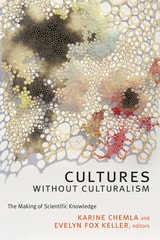
Cultures without Culturalism
The Making of Scientific KnowledgeKarine Chemla and Evelyn Fox Keller, editors
Duke University Press, 2017
Cultural accounts of scientific ideas and practices have increasingly come to be welcomed as a corrective to previous—and still widely held—theories of scientific knowledge and practices as universal. The editors caution, however, against the temptation to overgeneralize the work of culture, and to lapse into a kind of essentialism that flattens the range and variety of scientific work. The book refers to this tendency as culturalism. The contributors to the volume model a new path where historicized and cultural accounts of scientific practice retain their specificity and complexity without falling into the traps of culturalism. They examine, among other issues, the potential of using notions of culture to study behavior in financial markets; the ideology, organization, and practice of earthquake monitoring and prediction during China's Cultural Revolution; the history of quadratic equations in China; and how studying the "glass ceiling" and employment discrimination became accepted in the social sciences. Demonstrating the need to understand the work of culture as a fluid and dynamic process that directly both shapes and is shaped by scientific practice, Cultures without Culturalism makes an important intervention in science studies.
Contributors. Bruno Belhoste, Karine Chemla, Caroline Ehrhardt, Fa-ti Fan,Kenji Ito, Evelyn Fox Keller, Guillaume Lachenal, Donald MacKenzie, Mary S. Morgan, Nancy J. Nersessian, David Rabouin, Hans-Jörg Rheinberger, Claude Rosental, Koen Vermeir
Contributors. Bruno Belhoste, Karine Chemla, Caroline Ehrhardt, Fa-ti Fan,Kenji Ito, Evelyn Fox Keller, Guillaume Lachenal, Donald MacKenzie, Mary S. Morgan, Nancy J. Nersessian, David Rabouin, Hans-Jörg Rheinberger, Claude Rosental, Koen Vermeir
[more]

The Mirage of a Space between Nature and Nurture
Evelyn Fox Keller
Duke University Press, 2010
In this powerful critique, the esteemed historian and philosopher of science Evelyn Fox Keller addresses the nature-nurture debates, including the persistent disputes regarding the roles played by genes and the environment in determining individual traits and behavior. Keller is interested in both how an oppositional “versus” came to be inserted between nature and nurture, and how the distinction on which that opposition depends, the idea that nature and nurture are separable, came to be taken for granted. How, she asks, did the illusion of a space between nature and nurture become entrenched in our thinking, and why is it so tenacious? Keller reveals that the assumption that the influences of nature and nurture can be separated is neither timeless nor universal, but rather a notion that emerged in Anglo-American culture in the late nineteenth century. She shows that the seemingly clear-cut nature-nurture debate is riddled with incoherence. It encompasses many disparate questions knitted together into an indissoluble tangle, and it is marked by a chronic ambiguity in language. There is little consensus about the meanings of terms such as nature, nurture, gene, and environment. Keller suggests that contemporary genetics can provide a more appropriate, precise, and useful vocabulary, one that might help put an end to the confusion surrounding the nature-nurture controversy.
[more]