Results by title
4 books match the query 'Keynesian economics'

Anticipations of the General Theory?
And Other Essays on KeynesDon Patinkin
University of Chicago Press, 1982
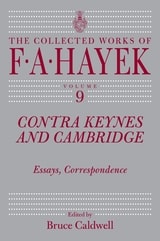
Contra Keynes and Cambridge
Essays, CorrespondenceF. A. Hayek
University of Chicago Press, 1995
When the journal Economica published a review of Keynes's Treatise on Money by Hayek in 1931, Keynes's response consisted principlally of an attack on Hayek's own work on monetary theory, Prices and Production. Conducted almost entirely in economics journals, the battle that followed revealed two very different responses to a world in economic crisis. Keynes sought a revision of the liberal political order—arguing for greater government intervention in the hope of protecting against the painful fluctuations of the business cycle. Hayek instead warned that state involvement would cause irreparable damage to the economy.
This volume begins with Hayek's 1963 reminiscence "The Economics of the 1930s as Seen from London," which has never been published before. The articles, letters, and reviews from journals published in the 1930s are followed by Hayek's later reflections on Keynes's work and influence. The Introduction by Bruce Caldwell puts the debate in context, providing detailed information about the economists in Keynes's circle at Cambridge, their role in the acceptance of his ideas, and the ways in which theory affected policy during the interwar period.
Caldwell calls the debate between Hayek and Keynes "a battle for the minds of the rising generation of British-trained economists." There is no doubt that Keynes won the battle during his lifetime. Now, when many of Hayek's ideas have been vindicated by the collapse of collectivist economies and the revival of the free market around the world, this book clarifies Hayek's work on monetary theory—formed in heated opposition to Keynes—and illuminates his efforts to fight protectionism in an age of economic crisis.
F. A. Hayek (1899-1992), recipient of the Medal of Freedom in 1991 and co-winner of the Nobel Memorial Prize in Economics in 1974, was a pioneer in monetary theory and the principal proponent of classical liberal thought in the twentieth century. He taught at the University of London, the University of Chicago, and the University of Freiburg.
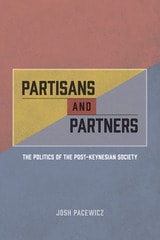
Partisans and Partners
The Politics of the Post-Keynesian SocietyJosh Pacewicz
University of Chicago Press, 2016
Wheels-down in Iowa—that most important of primary states—Pacewicz looks to two cities, one traditionally Democratic, the other traditionally Republican, and finds that younger voters are rejecting older-timers’ strict political affiliations. A paradox is emerging—as the dividing lines between America’s political parties have sharpened, Americans are at the same time growing distrustful of traditional party politics in favor of becoming apolitical or embracing outside-the-beltway candidates. Pacewicz sees this change coming not from politicians and voters, but from the fundamental reorganization of the community institutions in which political parties have traditionally been rooted. Weaving together major themes in American political history—including globalization, the decline of organized labor, loss of locally owned industries, uneven economic development, and the emergence of grassroots populist movements—Partisans and Partners is a timely and comprehensive analysis of American politics as it happens on the ground.
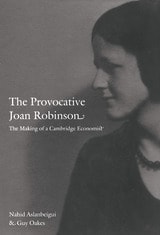
The Provocative Joan Robinson
The Making of a Cambridge EconomistNahid Aslanbeigui and Guy Oakes
Duke University Press, 2009
Aslanbeigui and Oakes demonstrate that Robinson’s professional identity was thoroughly embedded in a local scientific culture in which the Cambridge economists A. C. Pigou, John Maynard Keynes, Dennis Robertson, Piero Sraffa, Richard Kahn (Robinson’s closest friend on the Cambridge faculty), and her husband Austin Robinson were important figures. Although the economists Joan Robinson most admired—Pigou, Keynes, and their mentor Alfred Marshall—had discovered ideas of singular greatness, she was convinced that each had failed to grasp the essential theoretical significance of his own work. She made it her mission to recast their work both to illuminate their major contributions and to redefine a Cambridge tradition of economic thought. Based on the extensive correspondence of Robinson and her colleagues, The Provocative Joan Robinson is the story of a remarkable woman, the intellectual and social world of a legendary group of economists, and the interplay between ideas, ambitions, and disciplinary communities.