Results by title
8 books match the query 'Keywords'
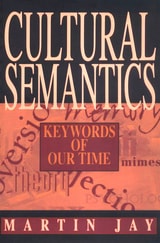
Cultural Semantics
Keywords of Our TimeMartin Jay
University of Massachusetts Press, 1998
A selection of Martin Jay's recent writings on contemporary thought and culture, this is a book about ideas that matter—and about why ideas matter. Borrowing from Flaubert's notion of a dictionary of “received ideas” and Raymond Williams's explorations of the “keywords” of the modern age, Jay investigates some of the central concepts by which we currently organize our thoughts and lives. His topics range from “theory” and “experience” to the meaning of “multiculturalism” and the dynamics of cultural “subversion.” Among the thinkers he engages are Bataille and Foucault, Adorno and Lacoue-Labarthe, Walter Benjamin, Christa Wolf, and Jean-François Lyotard.
By looking closely at what “words do and perform,” Jay makes us aware of the extent to which the language we use mediates and shapes our experience. By helping to distance us from much that we now take for granted, he makes it difficult for us to remain comfortably certain about what we think we know.
Elegantly written and richly insightful, this is a work of cultural criticism and intellectual analysis of the first order.

From A to A
Keywords of MarkupBradley Dilger
University of Minnesota Press, 2010
From A to investigates the relationship between media and culture by articulating questions regarding the role of markup. How do the codes of HTML, CSS, PHP, and other markup languages affect the Web's everyday uses? How do these languages shape the Web's communicative functions? This novel inquiry positions markup as the basis of our cultural, rhetorical, and communicative understanding of the Web.
Contributors: Sarah J. Arroyo, CSU Long Beach; Jennifer L. Bay, Purdue U; Helen J. Burgess, U of Maryland, Baltimore County; Michelle Glaros, Centenary College of Louisiana; Matthew K. Gold, NYCC of Technology; Cynthia Haynes, Clemson U; Rudy McDaniel, U of Central Florida; Colleen A. Reilly, UNC, Wilmington; Thomas Rickert, Purdue U; Brendan Riley, Columbia College Chicago; Sae Lynne Schatz, U of Central Florida; Bob Whipple, Creighton U; Brian Willems, U of Split, Croatia.
Keywords in Creative Writing
Wendy Bishop and David Starkey
Utah State University Press, 2006
Keywords in Design Thinking
A Lexical Primer for Technical Communicators and DesignersJason C. K. Tham
University Press of Colorado, 2023
Keywords in Sound
David Novak and Matt Sakakeeny, eds.
Duke University Press, 2015
Contributors. Andrew Eisenberg, Veit Erlmann, Patrick Feaster, Steven Feld, Daniel Fisher, Stefan Helmreich, Charles Hirschkind, Deborah Kapchan, Mara Mills, John Mowitt, David Novak, Ana Maria Ochoa Gautier, Thomas Porcello, Tom Rice, Tara Rodgers, Matt Sakakeeny, David Samuels, Mark M. Smith, Benjamin Steege, Jonathan Sterne, Amanda Weidman
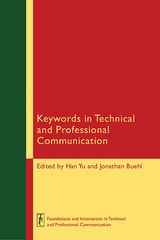
Keywords in Technical and Professional Communication
Han Yu
University Press of Colorado, 2024
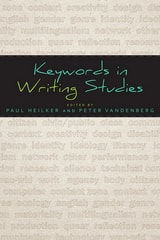
Keywords in Writing Studies
Paul Heilker
Utah State University Press, 2015
Keywords in Writing Studies is an exploration of the principal ideas and ideals of an emerging academic field as they are constituted by its specialized vocabulary. A sequel to the 1996 work Keywords in Composition Studies, this new volume traces the evolution of the field’s lexicon, taking into account the wide variety of theoretical, educational, professional, and institutional developments that have redefined it over the past two decades.
Contributors address the development, transformation, and interconnections among thirty-six of the most critical terms that make up writing studies. Looking beyond basic definitions or explanations, they explore the multiple layers of meaning within the terms that writing scholars currently use, exchange, and question. Each term featured is a part of the general disciplinary parlance, and each is a highly contested focal point of significant debates about matters of power, identity, and values. Each essay begins with the assumption that its central term is important precisely because its meaning is open and multiplex.
Keywords in Writing Studies reveals how the key concepts in the field are used and even challenged, rather than advocating particular usages and the particular vision of the field that they imply. The volume will be of great interest to both graduate students and established scholars.
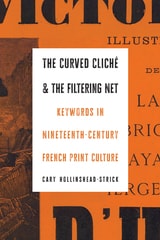
The Curved Cliché and the Filtering Net
Keywords in Nineteenth-Century French Print CultureCary Hollinshead-Strick
Northwestern University Press, 2027
Tracing multivalent words of nineteenth-century French print culture
The production of printed text changed radically over the course of the nineteenth century: Everything from the material used to make paper to the gender of the people assembling books shifted. Examining ten key terms as they took on new meanings in the world of print, Cary Hollinshead-Strick shows how the words, borrowed to name technical transformations, reveal the social expectations surrounding the birth of industrial print culture. Through these homonyms she connects papermaking to both Renaissance ceramics and fin-de-siècle japonisme, reveals the politics behind typos and the reasons women went to work in Parisian suburbs, shows how newspaper formats mapped onto rural and urban forms of entertainment and food, and explores the fantasy that information itself could be gathered and distributed in reliable, comprehensive ways.
By lingering over the resonances set in motion when ordinary words like canard and filet became terms for modern media formats, this book situates communication practices in the social, economic, and political environments that gave rise to them. This innovative approach not only elucidates nineteenth-century French print culture’s influence on the literature of the period but also invites us to consider the relationships between contemporary forms of information, media, labor, and language.