Results by title
8 books match the query 'Kindergarten'
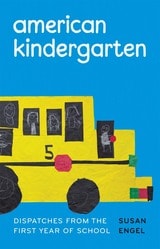
American Kindergarten
Dispatches from the First Year of SchoolSusan Engel
University of Chicago Press, 2026
When we think of kindergarten, many might imagine joyous free play, and a tangle of trucks, dress-up clothes, and blocks, as five-year-olds explore their vivid imaginations and budding social skills. Others might envision a quiet group sitting cross-legged in a circle during story time. Neither of these scenes would be an inaccurate representation of the pivotal year of entry into traditional education in this country. However, neither offers a complete picture of what children do every day in those seemingly transparent, yet actually mysterious, classrooms. What can or should we expect during the first year of school? How are children learning and growing during those hours spent away from their homes?
Susan Engel embarked on finding these answers in American Kindergarten: Dispatches from the First Year of School. Engel toured twenty-nine classrooms across fourteen states, observing each closely, with a special eye toward the ways each classroom’s goals reflect its community. As she made her way across the country, Engel found that on the surface, kindergarten students are similar: good-natured, eager to learn, and deeply affectionate. Their classrooms, too, feature many of the same expectations, routines, and activities. But the differences between the classrooms were striking and often surprising. Over the two years of her classroom visits, Engel identified five promises that teachers and their classrooms make to their students: reading, order, thinking, identity, and love. Engel found that schools differ in how they prioritize and keep the promises they make; some make all five promises, while others emphasize only one or two. The five promises capture a set of values, aspirations, and goals that drive everything that happens in a classroom.
Engaging and incisive, American Kindergarten is the story of the promises our country’s schools make to five-year-old children, and how those promises are kept and sometimes broken.

Boys and Girls
Superheroes in the Doll CornerVivian Gussin Paley
University of Chicago Press, 1984
"I will admit my biases up front: having a three-year old daughter of my own made it impossible for this book to be anything but fun to read. I dare anyone who enjoys children not to enjoy this story about stories, this narrative about narratives."—Jerry Powell, Winterthur Portfolio
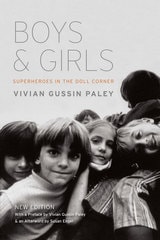
Boys and Girls
Superheroes in the Doll CornerVivian Gussin Paley
University of Chicago Press, 2014
For more than forty years, Boys and Girls has a classic account of the little-known world that young children create together when they play. Vivian Gussin Paley takes readers inside a kindergarten classroom to show them in detail how boys and girls play—and how, by playing and fantasizing in different ways, they work through complicated notions of gender roles and identity. The children’s own conversations, stories, playacting, and scuffles are interwoven with Paley’s observations and accounts of her vain attempts to alter their stereotyped play. In the decades since the book's original publication, play in kindergarten and early years of school has lost ground to structured teaching and even testing, which makes Paley's book, updated for a new era, more important than ever. To teach kids successfully, we must make space for play.
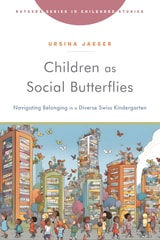
Children as Social Butterflies
Navigating Belonging in a Diverse Swiss KindergartenUrsina Jaeger
Rutgers University Press, 2025
This book is also freely available online as an open-access digital edition, published with the support of the Swiss National Science Foundation.

Counting Down to Kindergarten
A Complete Guide to Creating a School Readiness Program for Your CommunityR. Lynn Baker
American Library Association, 2015
The public library is in the perfect position as a community resource to help bridge the gap between preschool and kindergarten; however, starting from scratch can feel daunting. In this guide, Baker combines her background in early childhood education with her experience as a youth services programming specialist to present a school readiness program that can be tailored for any public library. Based on the successful framework of her tried and tested original program, this book offers everything that a public library needs in order to get started, including
- A six-week schedule of detailed lesson plans which combine the best practices of the Every Child Ready to Read® (ECRR) Second Edition (talking, singing, reading, writing, playing) with nationally identified school readiness skills
- A six-month family calendar with activities to help parents engage their children in activities that foster early literacy and school readiness skills at home
- Tips for maintaining a collaborative relationship with early childhood stakeholders and policymakers to help maintain a program that fits the school readiness needs of the local community
- Specific examples of successful school readiness programs and partnerships from public library systems across the country
Baker's guide will help public libraries ensure that young children are ready for school from day one.
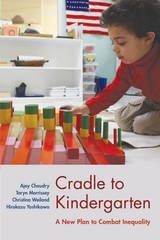
Cradle to Kindergarten
A New Plan to Combat InequalityAjay Chaudry
Russell Sage Foundation, 2017
The U.S. government invests less in children under the age of five than do most other developed nations. Most working families must seek private childcare, which means that children from low-income households, who would benefit most from high-quality early education, are the least likely to attend them. Existing policies, such as pre-kindergarten in some states are only partial solutions. To address these deficiencies, the authors propose to overhaul the early care system, beginning with a federal paid parental leave policy that provides both mothers and fathers with time and financial support after the birth of a child. They also advocate increased public benefits, including an expansion of the child care tax credit, and a new child care assurance program that subsidizes the cost of early care for low- and moderate-income families. They also propose that universal, high-quality early education in the states should start by age three, and a reform of the Head Start program that would include more intensive services for families living in areas of concentrated poverty and experiencing multiple adversities from the earliest point in these most disadvantaged children’s lives. They conclude with an implementation plan and contend that these reforms are attainable within a ten-year timeline.
Reducing educational and economic inequalities requires that all children have robust opportunities to learn, fully develop their capacities, and have a fair shot at success. Cradle to Kindergarten presents a blueprint for fulfilling this promise by expanding access to educational and financial resources at a critical stage of child development.
Cradle to Kindergarten
A New Plan to Combat InequalityAjay Chaudry
Russell Sage Foundation, 2021
The U.S. government invests less in children under the age of five than do most other developed nations. Most working families must seek private child care, but high-quality child care options are expensive relative to the means of most families. This means that children from lower-income households, who would benefit most from high-quality early education, are the least likely to attend them. Existing policies, such as pre-kindergarten in some states, are only partial solutions, and what exists varies tremendously in terms of access and quality.
To address these deficiencies, the authors propose to overhaul the early care and education system, beginning with a federal paid parental leave policy that provides both mothers and fathers with time and financial support after the birth of a child. They also advance an expansion of the child care tax credit, and a new child care assurance program that provides grant assistance towards the cost of high-quality early care for low- and moderate-income families. Their plan establishes universal, high-quality early education in the states starting by age three, and a reform of the Head Start program that would include more intensive services for families living in areas of concentrated poverty and experiencing multiple adversities from the earliest point in these most disadvantaged children’s lives. They conclude with an implementation plan and contend that these reforms are attainable well within a ten-year timeline.
Reducing educational and economic inequalities requires that all children have robust opportunities to learn and fully develop their capacities and have a fair shot at success. Cradle to Kindergarten presents a blueprint for fulfilling this promise by expanding access to educational and financial resources at a critical stage of child development.
Kindergarten Magic
Theme-Based Lessons for Building Literacy and Library SkillsKathy MacMillan
American Library Association, 2012