Results by title
3 books match the query 'King, Desmond'
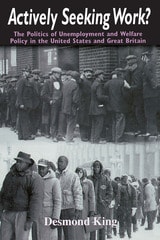
Actively Seeking Work?
The Politics of Unemployment and Welfare Policy in the United States and Great BritainDesmond King
University of Chicago Press, 1995
The goal of work-welfare policy in both countries has been to provide financial aid, training, and placement services for the unemployed. In order to muster support for these programs, however, work-welfare programs had to incorporate liberal requirements that they not interfere with private market forces, and that they prevent the "undeserving" from obtaining benefits. For King, the attempt to integrate these incompatible functions is the defining feature of British and American policies as well as the cause of their failure.
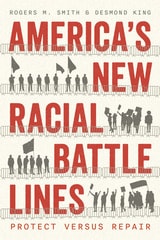
America’s New Racial Battle Lines
Protect versus RepairRogers M. Smith and Desmond King
University of Chicago Press, 2024
A sobering portrait of the United States’ divided racial politics.
For nearly two decades, Rogers M. Smith and Desmond King have charted the shifting racial policy alliances that have shaped American politics across different eras. In America’s New Racial Battle Lines, they show that US racial policy debates are undergoing fundamental change. Disputes over colorblind versus race-conscious policies have given way to new lines of conflict. Today’s conservatives promise to protect traditionalist, predominantly white, Christian Americans against what they call the “radical” Left. Meanwhile, today’s progressives seek not just to integrate American institutions but to more fully transform and “repair” pervasive systemic racism.
Drawing on interviews with activists, surveys, social network analyses, and comprehensive reviews of federal, state, and local policies and advocacy groups, Smith and King map the memberships and goals of two rival racial policy alliances and delineate the contrasting stories each side tells. They also show that these increasingly polarized racial policy alliances are substantially funded on both the Left and Right.
Placing today’s conflicts in theoretical and historical perspectives, Smith and King analyze where these intensifying clashes may take the nation in the years ahead. They highlight the great potential for mounting violence, as well as the remaining possibilities for finding common ground.

The State and the City
Ted Robert Gurr and Desmond King
University of Chicago Press, 1987
Gurr and King's analysis assumes modern states have their own interests, institutional momentum, and the capacity to act with relative autonomy. Their historically based analysis begins with an account of the evolution of the Western state's interest in the viability of cities since the industrial revolution. Their agument extends to the local level, examining the nature of the local state and its autonomy from national political and economic forces.
Using cross-national evidence, Gurr and King examine specific problems of urban policy in the United States and Britain. In the United States, for example, they show how the dramatic increases in federal assistance to cities in the 1930s and the 1960s were made in response to urban crises, which simultaneously threatened national interests and offered opportunities for federal expansion of power. As a result, national and local states now play significant material and regulatory roles that can have as much impact on cities as all private economic activities.
A comparative analysis of thirteen American cities reflects the range and impact of the state's activities at the urban level. Boston, they argue, has become the archetypical postindustrial public city: half of its population and personal income are directly dependent on government spending. While Gurr and King are careful to delineate the limits to the extent and effectiveness of state intervention, they conclude that these limits are much broader than formerly thought. Ultimately, their evidence suggests that the continued decline of most of the old industrial cities is the result of public decisions to allow their economic fate to be determined in the private sector.