Results by title
7 books match the query 'King Lear'
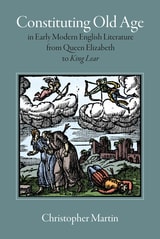
Constituting Old Age in Early Modern English Literature, from Queen Elizabeth to King Lear
Christopher Martin
University of Massachusetts Press, 2012
How did Shakespeare and his contemporaries, whose works mark the last quarter century of Elizabeth I's reign as one of the richest moments in all of English literature, regard and represent old age? Was late life seen primarily as a time of withdrawal and preparation for death, as scholars and historians have traditionally maintained? In this book, Christopher Martin examines how, contrary to received impressions, writers and thinkers of the era—working in the shadow of the kinetic, long-lived queen herself—contested such prejudicial and dismissive social attitudes.
In late Tudor England, Martin argues, competing definitions of and regard for old age established a deeply conflicted frontier between external, socially “constituted” beliefs and a developing sense of an individual's “constitution” or physical makeup, a usage that entered the language in the mid-1500s. This space was further complicated by internal divisions within the opposing camps. On one side, reverence for the elder's authority, rooted in religious and social convention, was persistently challenged by the discontents of an ambitious younger underclass. Simultaneously, the aging subject grounded an enduring social presence and dignity on a bodily integrity that time inevitably threatened. In a historical setting that saw both the extended reign of an aging monarch and a resulting climate of acute generational strife, this network of competition and accommodation uniquely shaped late Elizabethan literary imagination. Through fresh readings of signature works, genres, and figures, Martin redirects critical attention to this neglected aspect of early modern studies.
King Lear
William Shakespeare
Arizona Center for Medieval and Renaissance Studies, 2022
Marcus Gardley’s translation of King Lear renews the language of one of Shakespeare’s most frequently staged tragedies for a modern audience. Gardley’s update allows audiences to hear the play anew while still finding themselves in the tragic midst of Shakespeare’s play.
This translation of King Lear was written as part of the Oregon Shakespeare Festival’s Play On! project, which commissioned new translations of thirty-nine Shakespeare plays. These translations present the work of “The Bard” in language accessible to modern audiences while never losing the beauty of Shakespeare’s verse. Enlisting the talents of a diverse group of contemporary playwrights, screenwriters, and dramaturges from diverse backgrounds, this project reenvisions Shakespeare for the twenty-first century. These volumes make these works available for the first time in print—a new First Folio for a new era.
King Lear and the Naked Truth
Rethinking the Language of Religion and ResistanceJudy Kronenfeld
Duke University Press, 1998
Kronenfeld’s focus expands from the text of Shakespeare’s play to a discussion of a shared Christian culture—a shared language and set of values—a common discursive field that frames the social ethics of the play. That expanded focus is used to address the multiple ways that clothing and nakedness function in the play, as well as the ways that these particular images and terms are understood in that shared context. As Kronenfeld moves beyond Lear to uncover the complex resonances of clothing and nakedness in sermons, polemical tracts, legislation, rhetoric, morality plays, and actual or alleged practices such as naked revolts by Anabaptists and the Adamians’ ritual disrobing during religious services, she demonstrates that many key terms and concepts of the period cannot be tied to a single ideology. Instead, they represent part of an intricate network of thought shared by people of seemingly opposite views, and it is within such shared cultural networks that dissent, resistance, and creativity can emerge. Warning her readers not to take the language of literary texts out of the linguistic context within which it first appeared, Kronenfeld has written a book that reinterprets the linguistic model that has been the basis for much poststructuralist criticism.
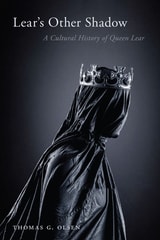
Lear’s Other Shadow
A Cultural History of Queen LearThomas G. Olsen
University of Delaware Press, 2025
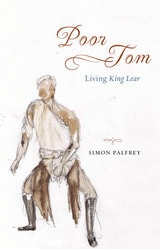
Poor Tom
Living "King Lear"Simon Palfrey
University of Chicago Press, 2014
In Poor Tom, Simon Palfrey asks us to go beyond any such received understandings—and thus to experience King Lear as never before. He argues that the part of Edgar is Shakespeare’s most radical experiment in characterization, and his most exhaustive model of both human and theatrical possibility. The key to the Edgar character is that he spends most of the play disguised, much of it as “Poor Tom of Bedlam,” and his disguises come to uncanny life. The Edgar role is always more than one person; it animates multitudes, past and present and future, and gives life to states of being beyond the normal reach of the senses—undead, or not-yet, or ghostly, or possible rather than actual. And because the Edgar role both connects and retunes all of the figures and scenes in King Lear, close attention to this particular part can shine stunning new light on how the whole play works.
The ultimate message of Palfrey’s bravura analysis is the same for readers or actors or audiences as it is for the characters in the play: see and listen feelingly; pay attention, especially when it seems as though there is nothing there.
The King and the Adulteress
A Psychoanalytic and Literary Reinterpretation of Madame Bovary and King LearRoberto Speziale-Bagliacca
Duke University Press, 1998
Approaching the characters in Bovary and Lear from both an analytic and a critical viewpoint, Speziale-Bagliacca reinterprets many issues and events that involve archetypal figures of modern literary mythology. In fact, he reverses much of the received opinion about them. Charles Bovary, for example, far from being a victim of his wife’s neurotic restlessness or the epitome of a passive imbecile, is a masochist of the highest order who makes a decisive contribution to Emma’s miserable end. Lear, rather than a tragedy involving the sweet Cordelia, noble Kent, and the Fool as good and loyal supporters of an old king driven to madness by his overbearing evil daughters, is precisely the opposite. The sympathetic understanding of the reader should go, Speziale-Bagliacca suggests, also to Regan, Goneril, and Edmund, while the king, whose crisis is interpreted in the light of psychoanalytic findings on depression, finally becomes the true unbeloved "bastard" of the play.
Roberto Speziale-Bagliacca is a psychoanalyst and Professor of Psychotherapy at the Medical School of the University of Genoa. He is the author of On the Shoulders of Freud and many other works.
The Vanishing
Shakespeare, the Subject, and Early Modern CultureChristopher Pye
Duke University Press, 2000
Pye explores the emergence of the early modern subject in terms of a range of subjectivizing mechanisms tied to the birth of a modern conception of history, one that is structured around a spatial and temporal horizon—a vanishing point. He also discusses the distinctly economic character of early modern subjectivity and how this, too, is implicated in our own modern modes of historical understanding. After explaining how the aims of New Historicist and Foucauldian approaches to the Renaissance are inseparably linked to such a historical conception, Pye demonstrates how the early modern subject can be understood in terms of a Lacanian and Zizekian account of the emerging social sphere. By focusing on the Renaissance as a period of remarkable artistic and cultural production, he is able to illustrate his points with discussions of a number of uniquely fascinating topics—for instance, how demonism was intimately related to a significant shift in law and symbolic order and how there existed at the time a “demonic” preoccupation with certain erotic dimensions of the emergent social subject.
Highly sophisticated and elegantly crafted, The Vanishing will be of interest to students of Shakespeare and early modern culture, Renaissance visual art, and cultural and psychoanalytic theory.